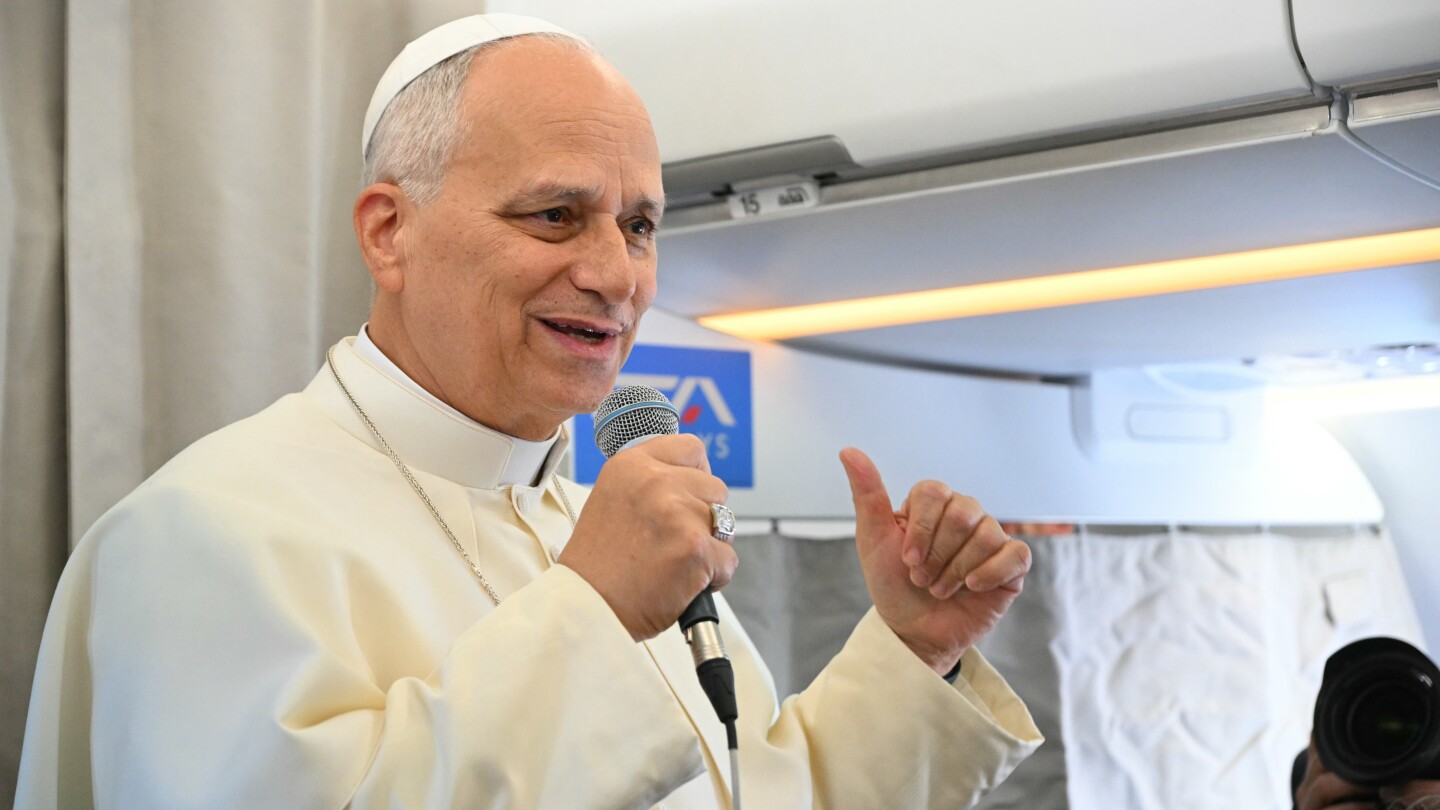
Aboard the Papal Plane — During his inaugural airborne press conference en route to Beirut, Pope Leo XIV emphatically reinforced the Vatican’s diplomatic stance regarding the Israeli-Palestinian conflict, declaring a two-state solution as the singular viable path toward achieving lasting justice for both nations. The pontiff’s remarks came during the concluding segment of his first international journey as head of the Catholic Church.
While responding to limited questions from Turkish journalists during the brief flight from Istanbul, Pope Leo revealed details of his private discussions with Turkish President Recep Tayyip Erdogan in Ankara. Their dialogue encompassed both the Gaza and Ukraine conflicts, with the Pope acknowledging Turkey’s “significant role” in facilitating preliminary negotiations between Russia and Ukraine. “Although resolution remains elusive,” he noted, “recent developments include fresh, substantive peace proposals.”
Regarding the Middle East, the American-born Pope reiterated the Holy See’s consistent position supporting Palestinian statehood in East Jerusalem, the West Bank, and Gaza—a framework internationally regarded as the fundamental compromise for regional stability. The Vatican originally extended recognition to Palestine in 2015, but the current Israel-Hamas war has revitalized global momentum for this approach, evidenced by additional countries formalizing recognition during the latest UN General Assembly.
“We acknowledge Israel’s present opposition to this solution,” Pope Leo stated, “yet we perceive it as the exclusive mechanism capable of resolving the enduring conflict. As friends to both parties, the Holy See strives to serve as a mediating voice that fosters mutual understanding and equitable justice.”
The Pope’s commentary contrasted sharply with Israeli Prime Minister Benjamin Netanyahu’s persistent rejection of Palestinian statehood, which his administration believes would effectively reward Hamas and potentially establish an expanded threat along Israel’s borders. Netanyahu recently emphasized that no external pressure would alter Israel’s position.
Notably absent from the Pope’s travel summary was any reference to his visit to Istanbul’s Blue Mosque, his most visible interaction with Turkey’s Muslim community. Instead, he focused on the primary purpose of his Turkish visit: commemorating the 1,700th anniversary of the Council of Nicaea. This historic gathering of bishops in AD 325 produced the Nicaean Creed, which remains a unifying theological foundation for Catholic, Orthodox, and Protestant denominations worldwide.
Looking toward future ecumenical collaboration, Pope Leo proposed an unprecedented joint commemoration in Jerusalem for 2033—marking the 2,000th anniversary of Christ’s crucifixion and resurrection. This initiative, welcomed by Orthodox patriarchs, aims to demonstrate renewed Christian unity after centuries of division.