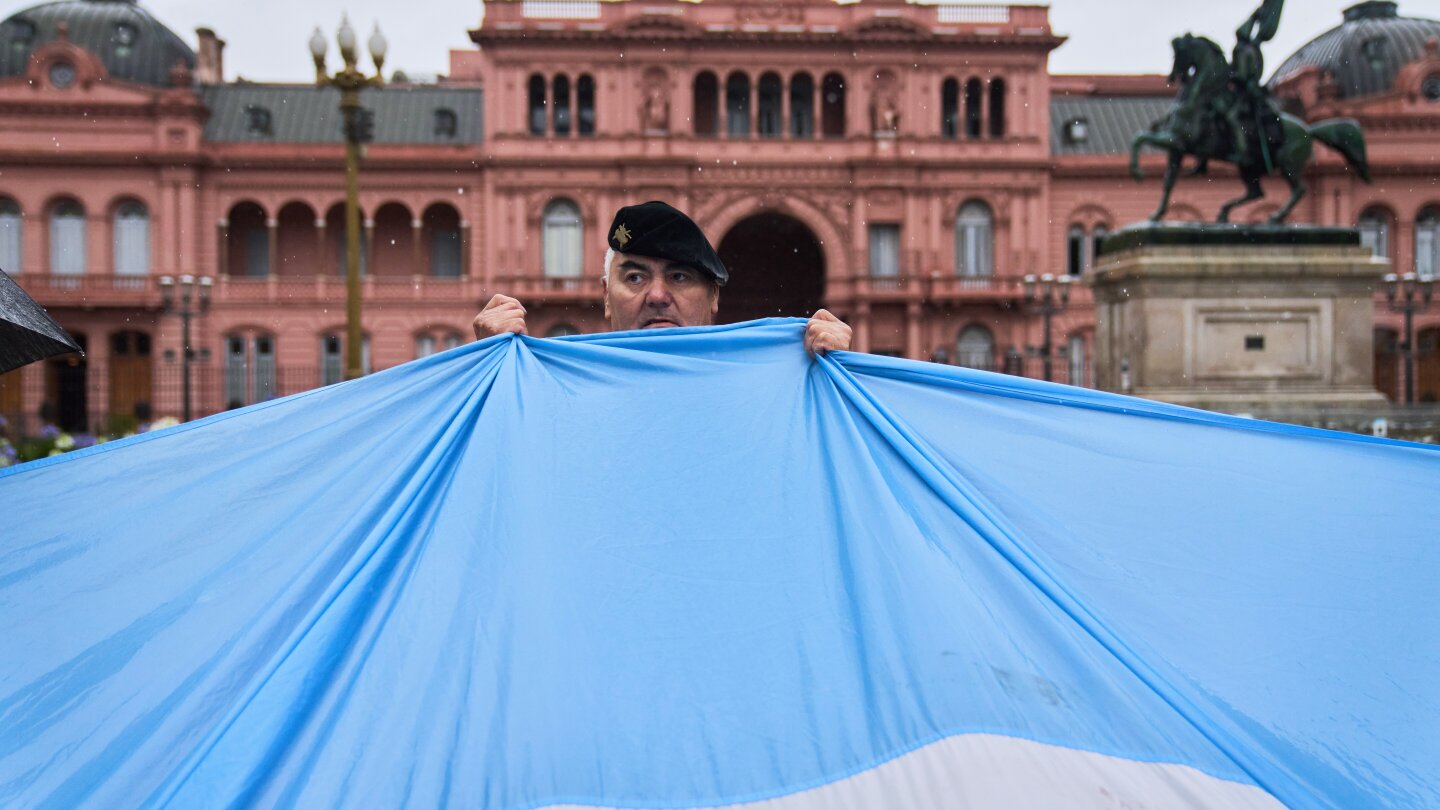
BUENOS AIRES — In a provocative demonstration that has exposed deep societal fractures, former Argentine military officers and their families staged an unprecedented rally at Plaza de Mayo on Saturday, demanding the release of personnel imprisoned for human rights violations during the nation’s 1976-1983 dictatorship.
The gathering represented a direct challenge to Argentina’s foundational “Nunca Más” (Never Again) principle that has guided the nation’s reckoning with authoritarian rule. The location itself carried profound symbolism—the same square where the Grandmothers of Plaza de Mayo have conducted silent weekly protests for decades seeking answers about children abducted by the junta.
This demonstration occurred amidst a dramatic ideological shift under right-wing President Javier Milei, who has repeatedly characterized the dictatorship’s state terrorism as a necessary campaign against leftist guerrillas. His administration has taken unprecedented steps to rehabilitate the military’s image, including appointing Army chief Lt. Gen. Carlos Alberto Presti as defense minister—the first active military official to hold a cabinet position since democracy’s restoration in 1983.
Vice President Victoria Villarruel, daughter of an Argentine lieutenant colonel, has spent years advocating for what she calls the “other victims” of left-wing guerrilla violence, further signaling the government’s revisionist approach to historical memory.
Human rights organizations have expressed outrage at these developments, viewing them as attempts to legitimize systematic extrajudicial killings that resulted in an estimated 30,000 disappearances. The United Nations Committee Against Torture recently criticized Milei’s dismantling of programs investigating military actions during the dictatorship and budget cuts to institutions working on truth and justice initiatives.
Counter-protesters flooded the plaza alongside military supporters, shouting insults and bearing “Never Again” signs. Police established physical barriers separating the factions, highlighting the tense divide over how Argentina should confront its violent past.
The demonstration’s organizers brandished black bandanas—a deliberate contrast to the white kerchiefs embroidered with missing children’s names worn by the Grandmothers. Rally organizer Maria Asuncion Benedit decried what she called a “militant, activist judiciary” and demanded “moral vindication” for military veterans.
Unlike other Latin American nations that granted amnesty after democratic transitions, Argentina has prosecuted over a thousand military officials for participation in state terror, with hundreds still awaiting trial. This ongoing pursuit of justice now faces its most significant political challenge in decades.