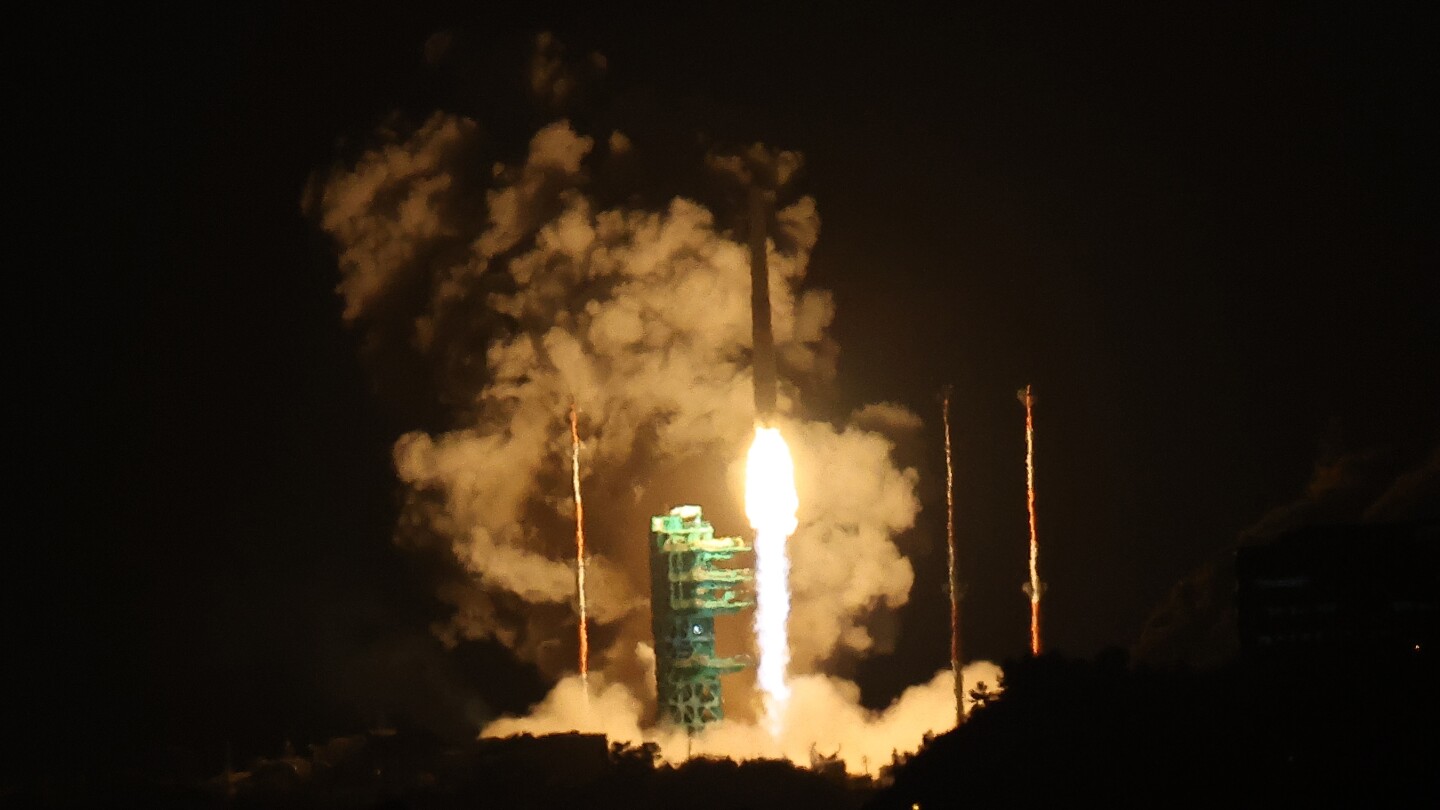
South Korea has taken a significant leap in its space exploration endeavors with the successful launch of its largest satellite to date using the domestically developed Nuri rocket. The event, which took place early Thursday from the Naro Space Center on Goheung Island, marks the fourth in a series of six planned launches extending through 2027. The three-stage Nuri rocket successfully deployed a 516-kilogram science satellite and 12 microsatellites into a target orbit approximately 600 kilometers above Earth. The Korea Aerospace Administration is currently verifying the successful transmission of signals from the satellites. The primary satellite is equipped with advanced instruments, including a wide-range airglow camera for observing auroral activity, systems for measuring plasma and magnetic fields, and equipment for conducting life-science experiments in space. The smaller cube satellites, developed by university teams and research institutions, are designed for various purposes, such as studying Earth’s atmosphere, tracking oceanic plastic, and testing solar cells and communication equipment. This launch follows a successful mission in May 2023, which placed a 180-kilogram observation satellite into orbit, and represents a recovery from the initial failed attempt in October 2021. Further launches are scheduled for 2026 and 2027 as part of South Korea’s broader strategy to enhance its space technologies and narrow the gap with leading Asian space powers like China, Japan, and India. The Nuri rocket, powered by five 75-ton-class engines in its first and second stages and a 7-ton-class engine in its third stage, is a testament to South Korea’s growing capabilities in space technology, having previously relied on other nations for satellite launches since the 1990s.
South Korea’s largest satellite launched on Nuri rocket in ambitious space mission