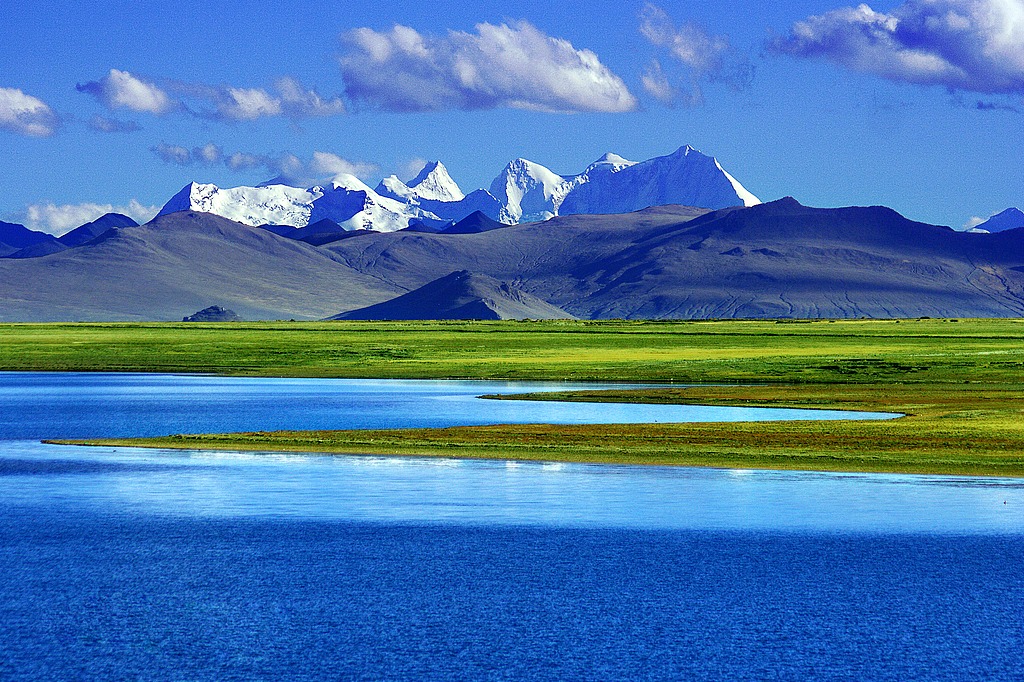
The Qinghai-Tibet Plateau, often referred to as Asia’s ‘water tower,’ is estimated to hold approximately 10 trillion cubic meters of surface water, a critical resource for over two billion people across the continent. This revelation, unveiled on November 19 in Lhasa, the capital of the Xizang Autonomous Region, underscores the plateau’s growing hydrological significance and the environmental risks it confronts. Researchers from China’s second Qinghai-Tibet scientific expedition revealed that the plateau’s vast water reserves sustain major river systems, including the Yangtze, Yellow, and Lancang-Mekong, which support communities across China and neighboring nations. The total water volume is comparable to the Yellow River’s runoff over 200 years. The latest assessments indicate that the plateau has experienced three significant environmental shifts, enhancing its water supply capacity. ‘The Qinghai-Tibet Plateau is becoming warmer, wetter, and greener, all of which boost its water supply,’ stated Yao Tandong, an academician with the Chinese Academy of Sciences and a lead scientist on the expedition. However, he also noted that the plateau is ‘becoming darker,’ leading to significant changes in Earth system processes, including alterations to the Asian monsoon and an increase in extreme climate events. These changes, driven by complex ice-water-air interactions, are heightening disaster risks. Despite the plateau’s contribution of over 1 trillion cubic meters of water vapor annually, scientists warn that rising downstream demand, fueled by population growth and resource consumption, is placing unprecedented strain on the system. ‘The increased water availability upstream does not entirely meet the rapidly growing needs downstream,’ Yao emphasized, advocating for stronger regional cooperation to ensure sustainable water management. Long-term data from the expedition shows a steady increase in runoff from major rivers like the Yangtze and Lancang over the past four decades, with projections suggesting a potential 49 percent increase by the end of the century. However, the team has identified 85 glacial lakes at extreme risk of outburst flooding, highlighting the urgent need for targeted disaster-prevention measures. The findings provide a crucial foundation for policy planning, encompassing water resource management, climate adaptation, and infrastructure protection, including projects such as the Sichuan-Xizang transport corridor. The expedition aims to enhance monitoring systems, improve early-warning mechanisms, and refine strategies to safeguard the plateau, a region now central to Asia’s long-term water security.