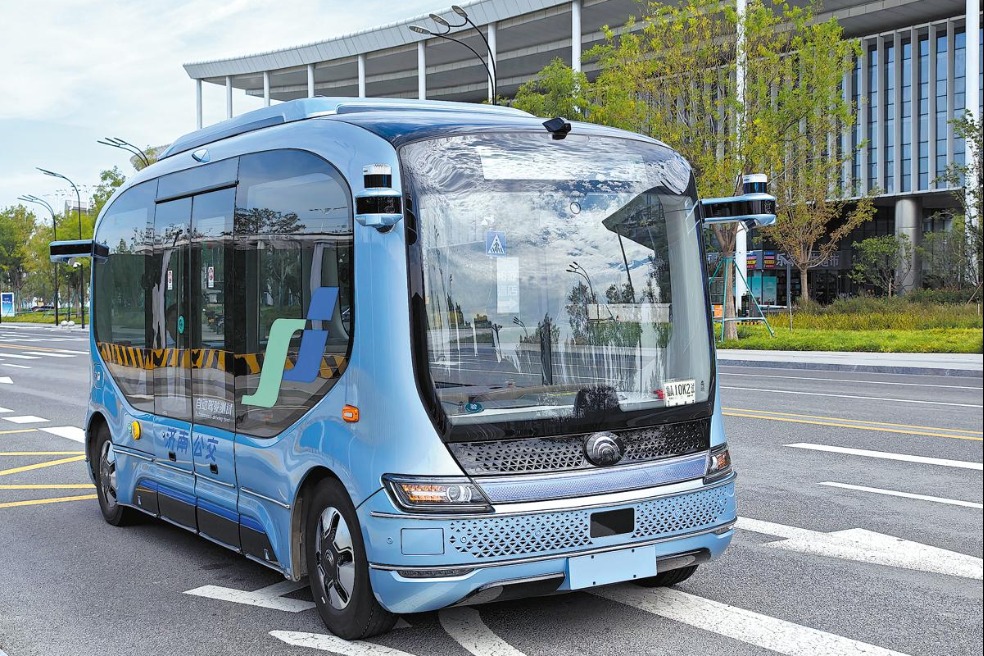
A transformative shift is underway in Jinan, the capital of Shandong province, as autonomous vehicles take to the streets, marking a significant leap in China’s smart transportation ambitions. Ding Pingshun, a seasoned bus driver with 22 years of experience, now finds himself in a new role as a safety officer for self-driving buses. ‘It’s quite a change from driving manned buses to monitoring autonomous ones,’ Ding remarked as he observed a self-driving bus navigating Huanghe Avenue in Jinan’s autonomous driving demonstration area. This bus, part of a pilot initiative by Jinan Public Transport Group, has been rigorously tested on a 6.4-kilometer route since June 2025. The route, which includes traffic lights, pedestrian crossings, and complex maneuvers like U-turns and lane changes, is monitored by an onboard system that provides real-time alerts based on proximity to nearby objects. Measuring 5.5 meters in length, the bus is equipped with nine seats and relies entirely on Chinese-made components, from its body to its control software. Advanced sensors, including HD cameras, lidar, and radar, enable the vehicle to navigate independently. ‘The bus has performed exceptionally well, making decisions to detour or stop when encountering obstacles,’ Ding noted, emphasizing his role as a monitor rather than an active driver. The test route is open to the public, with eight slots available for weekend reservations, allowing families to experience this futuristic mode of transportation. Beyond road tests, the project integrates smart infrastructure, such as a low-carbon green charging station where the bus autonomously parks at a V2G charger. A robotic arm, developed by State Grid’s Jinan power supply company, inserts the plug in about 40 seconds, showcasing the seamless automation of the system. Wang Shuai, deputy station head, explained, ‘Our self-developed arm uses pure vision recognition to identify vehicles and enable smart charging, significantly boosting efficiency.’ Similar initiatives are spreading across China. In Guangzhou, 19 autonomous minibuses began operating on five routes on November 3, 2025, in preparation for the 15th National Games. In Chengdu, six-meter-long self-driving buses were tested in May, alongside the release of a white paper on integrated vehicle-road-cloud systems. In Wuhan, robotaxis crossed the Yangtze River via bridges last year, launching commercial inter-river services. Experts predict 2025 to be a pivotal year for smart city-vehicle synergy under the ‘vehicle-road-cloud integration’ framework, with a rise in functional autonomous vehicles such as logistics and sanitation trucks, reshaping urban landscapes.