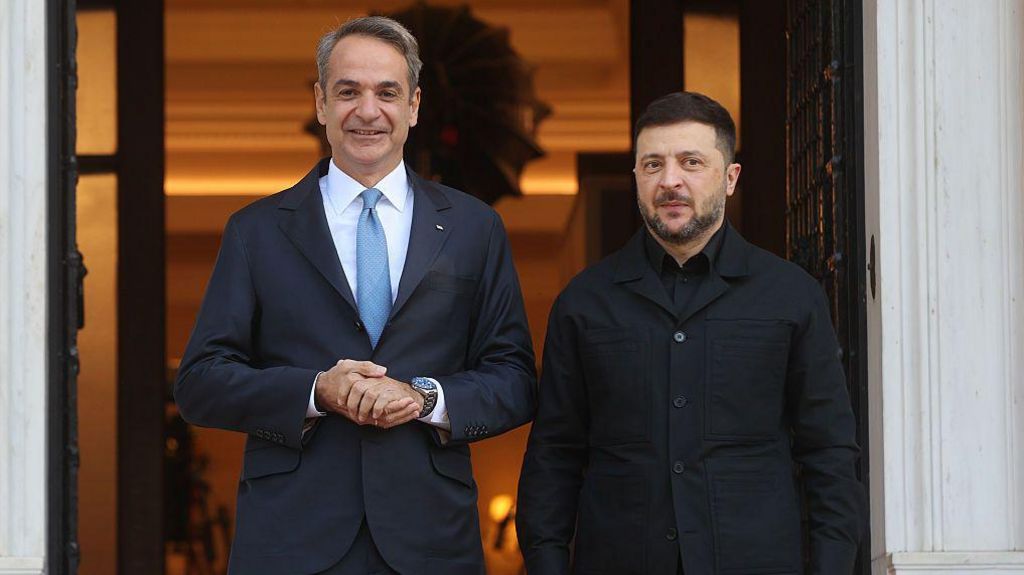
In a significant move to enhance Ukraine’s energy resilience during the ongoing conflict, vital supplies of US liquefied natural gas (LNG) are set to flow into the war-torn nation this winter via a pipeline traversing the Balkans. This development follows a high-profile meeting between Ukrainian President Volodymyr Zelensky and Greek Prime Minister Kyriakos Mitsotakis in Athens on Sunday. Mitsotakis emphasized Greece’s role in increasing the influx of American LNG to its terminals, aiming to ‘replace Russian gas in the region.’
The European Commission has outlined plans to completely halt Russian gas imports to EU member states by the end of 2027, citing concerns that such revenues fund Russia’s military operations in Ukraine. Meanwhile, Zelensky has shifted his focus to France, engaging in discussions with President Emmanuel Macron regarding a major air defense hardware deal.
Amid these diplomatic efforts, the conflict on the ground remains intense. Overnight, Russian attacks in the Kharkiv, Kherson, and Donetsk regions reportedly claimed six lives, while Russia’s military announced the capture of three additional Ukrainian villages. These reports, however, remain unverified.
Speaking in Athens, Zelensky revealed that American LNG deliveries are scheduled to commence in January. ‘We rebuild each time the Russians destroy, but this requires significant time, effort, and resources,’ he stated. Mitsotakis affirmed Greece’s commitment, declaring, ‘Greece is becoming an energy security provider for your homeland.’
According to Reuters, Ukraine has allocated nearly €2 billion to cover gas imports through March, leveraging funds from European partners, banks under European Commission guarantees, and Ukrainian financial institutions. Since 2015, Ukraine has relied on EU states for gas supplies, bypassing direct purchases from Russia. The Soviet-era Trans-Balkan pipeline, linking Ukraine to Greek LNG terminals via Moldova, Romania, and Bulgaria, plays a pivotal role in this arrangement.
On Monday, Zelensky’s visit to France included an inspection of Rafale fighter jets, the SAMP-T air defense system, and several drone systems at Villacoublay airbase near Paris. He also reviewed the nascent headquarters of a planned multinational force, which may eventually oversee a Ukraine-Russia ceasefire.
The conflict, which began with Russia’s full-scale invasion in February 2022, has resulted in tens of thousands of casualties, predominantly soldiers, and displaced millions of civilians. As Ukraine continues to navigate the dual challenges of war and energy security, international support remains crucial.