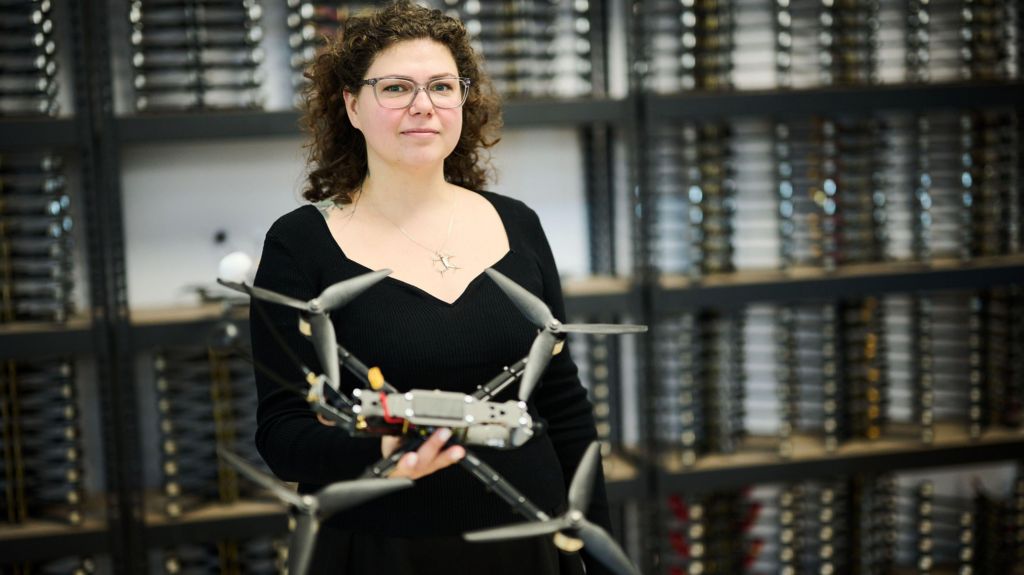
The ongoing conflict in Ukraine has been dubbed the world’s ‘first drone war,’ catalyzing a surge in military drone production both within and beyond the country’s borders. Among the many individuals contributing to this transformation is Kseniia Kalmus, a former floral artist who now dedicates her skills to manufacturing drones for the Ukrainian army. Before Russia’s invasion in February 2022, Kalmus co-owned a flower shop in Kyiv and showcased her floral arrangements across Europe. However, the war prompted a dramatic shift in her life. ‘It was just an obvious decision for me,’ Kalmus told the BBC from Kyiv. ‘I just wanted to help my country, help my people, and the military.’ Initially, she raised funds to purchase essential supplies for soldiers, but as the conflict evolved, the demand shifted to first-person view (FPV) drones. Recognizing this need, Kalmus began producing drones herself, and today, she and her team manufacture hundreds of these devices monthly. These small, plastic-framed quadcopters, originally designed for aerial photography, have been repurposed into lethal weapons by attaching small bombs. The widespread use of drones in Ukraine has not only revolutionized warfare but also spurred a global counter-drone industry. Companies like DroneShield and Munin Dynamics are developing technologies to detect and neutralize drones, while nations worldwide are investing heavily in drone defense systems. Experts predict that artificial intelligence will drive the next major advancements in drone technology, potentially leading to fully autonomous systems. Despite the challenges, Kalmus remains committed to her new role. ‘I miss flowers very much and that previous life, of course,’ she said. ‘But this is a question of existence. We just fight for our country, for our existence, for our culture.’