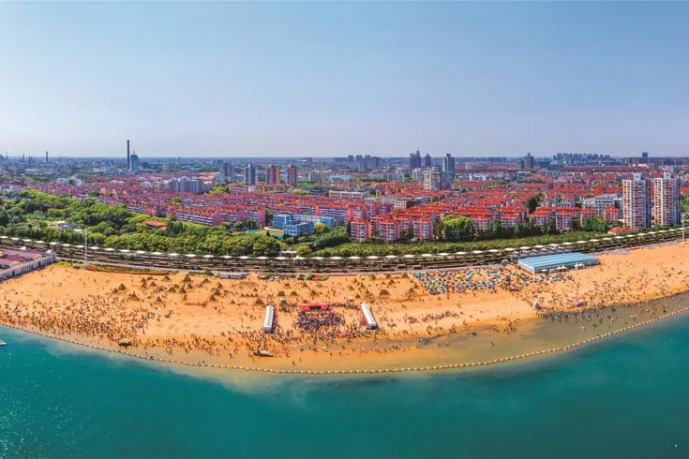
Shanghai’s Jinshan district has demonstrated significant economic progress and rural revitalization during the 14th Five-Year Plan period (2021-25). According to local officials, the district’s GDP surpassed 120 billion yuan ($16.9 billion) in 2024, with per capita GDP reaching $21,500. Liu Jian, Party secretary of Jinshan district, highlighted the district’s focus on industrial transformation, spatial reorganization, and governance reforms during a recent press conference. The total industrial output of enterprises above a designated size exceeded 300 billion yuan, with emerging sectors like fiber materials, drones, and optoelectronic transmission materials gaining national recognition as characteristic industrial clusters for SMEs. The service sector also showed robust growth, with businesses above a designated size achieving an average annual growth rate of 62%. Jinshan attracted 20 major investment projects, each exceeding 1 billion yuan, including four megaprojects valued at over 10 billion yuan each. Innovation metrics surged, with invention patents per 10,000 residents doubling and international PCT patent applications increasing nearly 11-fold. High-tech enterprises grew by 39.5%, while specialized and sophisticated technology enterprises expanded by 375.3%. In agriculture, Jinshan implemented key initiatives, boosting agricultural labor productivity by 21%, surpassing the city’s average. Rural residents’ per capita disposable income rose by an average of 7.4% annually. The tourism sector flourished with the opening of the Legoland Shanghai Resort, which attracted over 800,000 visitors since July 2025, driving accommodation and catering business revenue up by 15.2% year-on-year. Looking ahead to the 15th Five-Year Plan (2026-30), Jinshan aims to become an innovative, green, and livable bay area, focusing on emerging industries, technological innovation, and urban-rural integration.