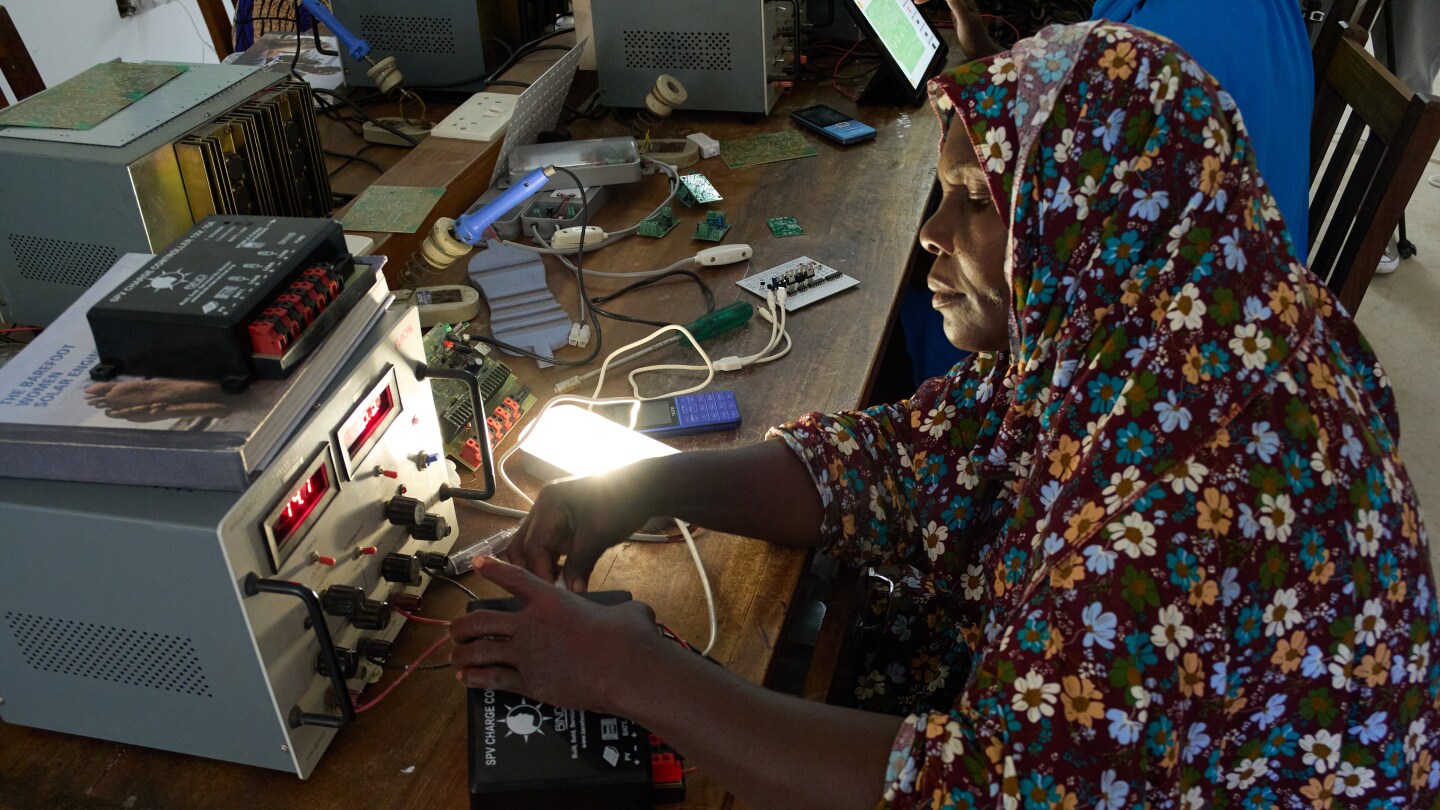
In the semi-autonomous archipelago of Zanzibar, Tanzania, the absence of electricity has long cast a shadow over daily life. For Hamna Silima Nyange and her eight children, the dim glow of smoky oil lamps was the only source of light after sunset. ‘The light was too weak,’ Nyange recalled. ‘And the smoke from the lamp hurt my eyes.’ However, a transformative change arrived when her neighbor, Tatu Omary Hamad, installed solar panels and bulbs, harnessing the abundant sunlight along the Indian Ocean coast. ‘Today we have enough light,’ Nyange said with relief.
Hamad is one of the many ‘solar mamas’ trained by Barefoot College International, a global nonprofit dedicated to bringing light to rural communities while empowering local women. Since its inception in Zanzibar, the program has illuminated 1,845 homes. The initiative focuses on middle-aged women, often with little or no formal education, who are trained over six months to become solar power technicians. These women return to their communities equipped with at least 50 sets of household solar panel kits and the skills to install and maintain them.
Brenda Geofrey, the director of Barefoot College International Zanzibar, emphasized the program’s mission: ‘We want to train women who become change makers.’ The Zanzibar campus, now in its 10th year, has become a beacon of hope. Previously, women were sent to India for training, where the organization was founded. Khazija Gharib Issa, once an unemployed widow, is now a master trainer. ‘I got a job. I got a place to stay. Before, I didn’t have one,’ she shared.
The program’s impact extends beyond lighting homes. It also addresses health concerns by replacing harmful light sources like kerosene, which can irritate eyes, damage lungs, and pose fire hazards. Jacob Dianga, a local healthcare worker, highlighted the importance of clean energy: ‘It helps protect our health.’ Additionally, Barefoot College International offers courses in tailoring, beekeeping, and sustainable agriculture, ensuring women are equipped with diverse skills and health knowledge to share with their communities.
Despite its successes, the program faces challenges. Funding is a persistent issue as major donors reduce foreign aid, and projects compete for limited resources. Resistance within local communities also poses a hurdle, with some husbands preventing their wives from participating. ‘In most African communities, women are pictured as somebody who is just at home,’ Geofrey noted. Yet, the solar mamas are breaking stereotypes and proving their worth. ‘People used to say this work is for men. They were surprised and laughed at me,’ Issa said. ‘But now they see how important my work is. I have become an example.’
Barefoot College International continues to expand across Africa, with campuses in Madagascar and Senegal, and plans to recruit women from the Central African Republic. The organization’s efforts underscore the transformative power of education, clean energy, and gender equality in driving sustainable development.