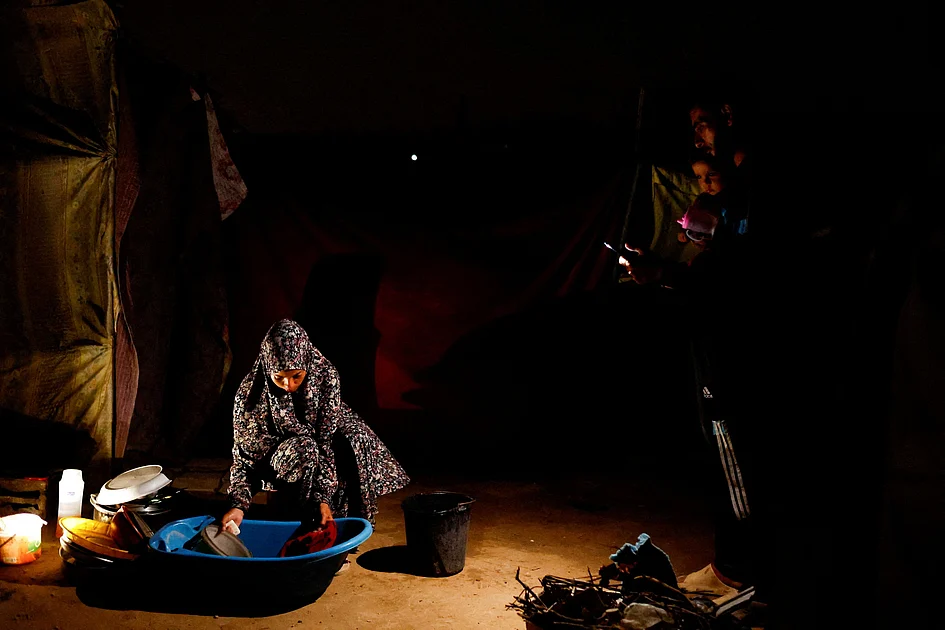
Despite the ceasefire between Israel and Hamas last month, thousands of families in Gaza continue to live without electricity, facing dire living conditions. Hanan Al Joujou, a 31-year-old Palestinian mother, describes the daily struggle of feeding her three children in the dark, relying on a flashlight when possible. When the flashlight cannot be charged, the family goes without food or light, often sleeping without dinner. The Al Joujou family has been without electricity since the war began over two years ago, initially relying on candles after being displaced to Rafah in southern Gaza. However, even this became untenable due to fire hazards in their tent. Before the conflict, Gaza received 120 megawatts of electricity from Israel, supplemented by 60 megawatts from its lone power plant. However, after Hamas attacked southern Israel on October 7, 2023, Israel imposed a ‘total siege,’ cutting off all electricity when Gaza’s power station ran out of fuel. The Israeli military stated that civilian infrastructure, including electricity facilities, were not military targets but acknowledged that Hamas operated within civilian areas. Today, Gaza’s electrical grid is in ruins, with over 80% of its distribution networks destroyed. Initial estimates place infrastructure losses at $728 million. Some residents have turned to solar-powered charging points or private generators, but these are scarce and often targeted. Mohammed Al Hor, 32, lost his brother and charging business in an Israeli strike. Israeli Minister Eli Cohen stated in March that electricity sales to Gaza were halted as a punitive measure against Hamas. Even after the ceasefire, restoring power to Gaza would require a massive infrastructure rebuild. COGAT, the Israeli military body overseeing aid to Gaza, claims Israel is committed to facilitating humanitarian aid, including fuel for electricity, under the ceasefire agreement. In July 2024, Israel connected a power line to a U.N.-managed desalination plant in Khan Younis to provide drinking water. However, for families like the Al Joujous, the darkness persists, symbolizing the ongoing humanitarian crisis in Gaza.