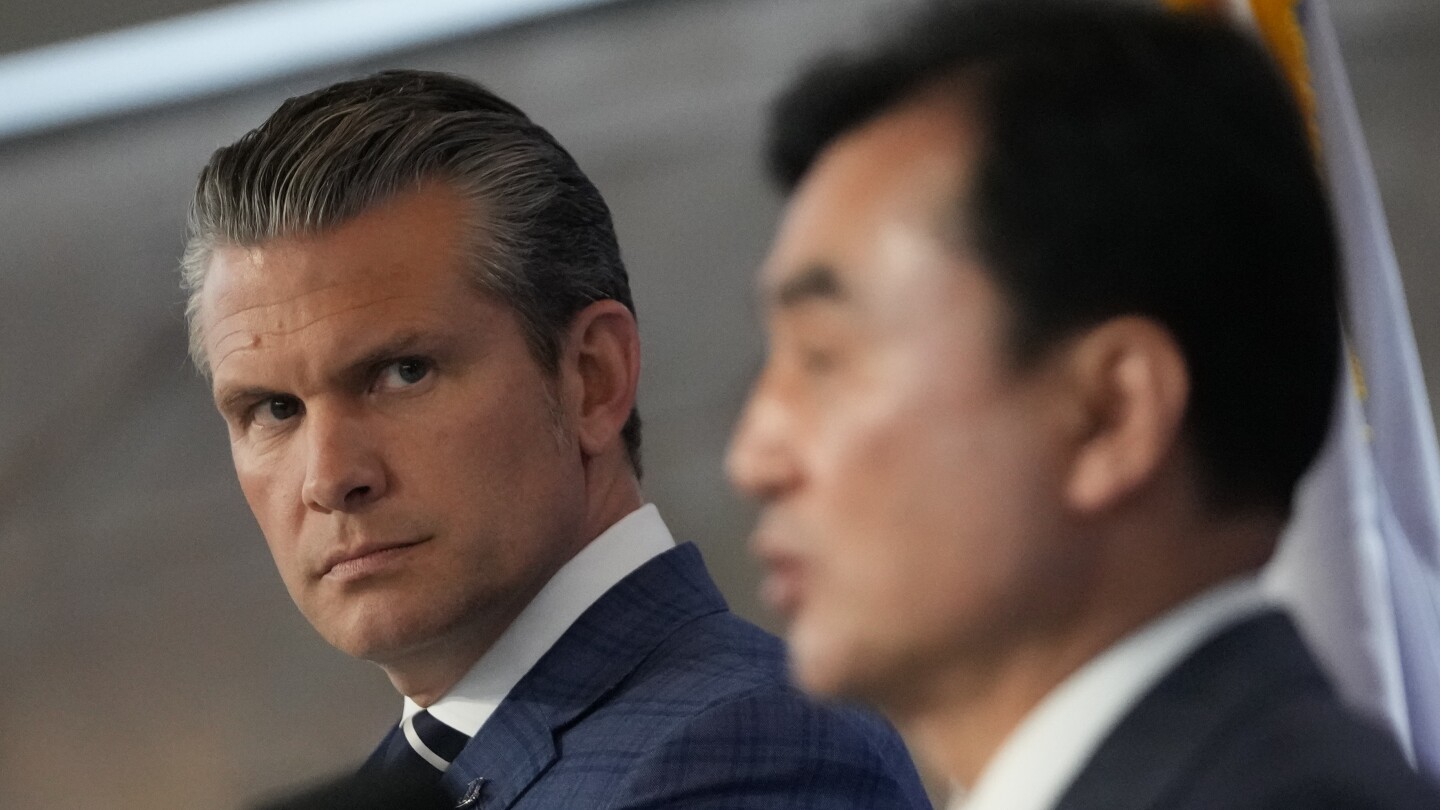
SEOUL, South Korea — U.S. Defense Secretary Pete Hegseth lauded South Korea’s decision to boost its military budget during a press briefing on Tuesday, emphasizing the nation’s growing role in countering North Korean aggression. This move comes as both allies prepare for potential regional crises, with the U.S. urging South Korea to enhance its conventional defense capabilities, allowing Washington to focus more on strategic challenges posed by China.
Following annual security discussions with South Korean Defense Minister Ahn Gyu-back in Seoul, Hegseth expressed strong encouragement regarding Seoul’s pledge to increase defense spending and invest in advanced military capabilities. The two leaders agreed that these investments would significantly bolster South Korea’s ability to lead its own conventional deterrence and defense efforts against North Korea.
Earlier in the day, South Korean President Lee Jae Myung addressed parliament, urging lawmakers to approve an 8.2% hike in defense spending for the upcoming year. This proposed increase aims to modernize the nation’s military weaponry and reduce its dependence on U.S. support.
Hegseth highlighted the enduring strength of the U.S.-South Korea alliance, describing it as more robust than ever despite the volatile security environment. He also noted agreements to utilize South Korea’s world-class shipbuilding industry for the maintenance and repair of U.S. warships, ensuring that critical military assets remain combat-ready.
The alliance’s primary focus remains addressing North Korean provocations, but Hegseth stressed the need to remain vigilant against other regional threats. He reiterated the U.S. commitment to extending nuclear deterrence to South Korea, which lacks its own nuclear arsenal and relies on the U.S. “nuclear umbrella” for security.
Ahn dismissed speculation about South Korea pursuing its own nuclear weapons program or seeking the redeployment of U.S. tactical nuclear weapons, reaffirming Seoul’s commitment to the nuclear non-proliferation treaty. He emphasized the importance of the Conventional-Nuclear Integration (CNI) framework, which combines U.S. nuclear capabilities with South Korea’s conventional forces.
Notably, the meeting concluded without a joint statement, an unusual outcome for such high-level talks. However, Hegseth assured that there were no disagreements between the two nations, attributing the delay to the complexity of the discussions.
Amid these developments, North Korea conducted artillery tests near its western seas, underscoring the ongoing tensions. South Korea’s Joint Chiefs of Staff reported approximately 10 rounds of artillery fire on Monday, coinciding with Hegseth’s visit to the inter-Korean border. This follows similar tests conducted before President Lee’s recent summit with Chinese President Xi Jinping, where Lee urged Beijing to play a more active role in persuading North Korea to resume dialogue with the U.S. and South Korea.
North Korea has dismissed such efforts, mocking Seoul’s hopes for denuclearization as a “pipe dream.”