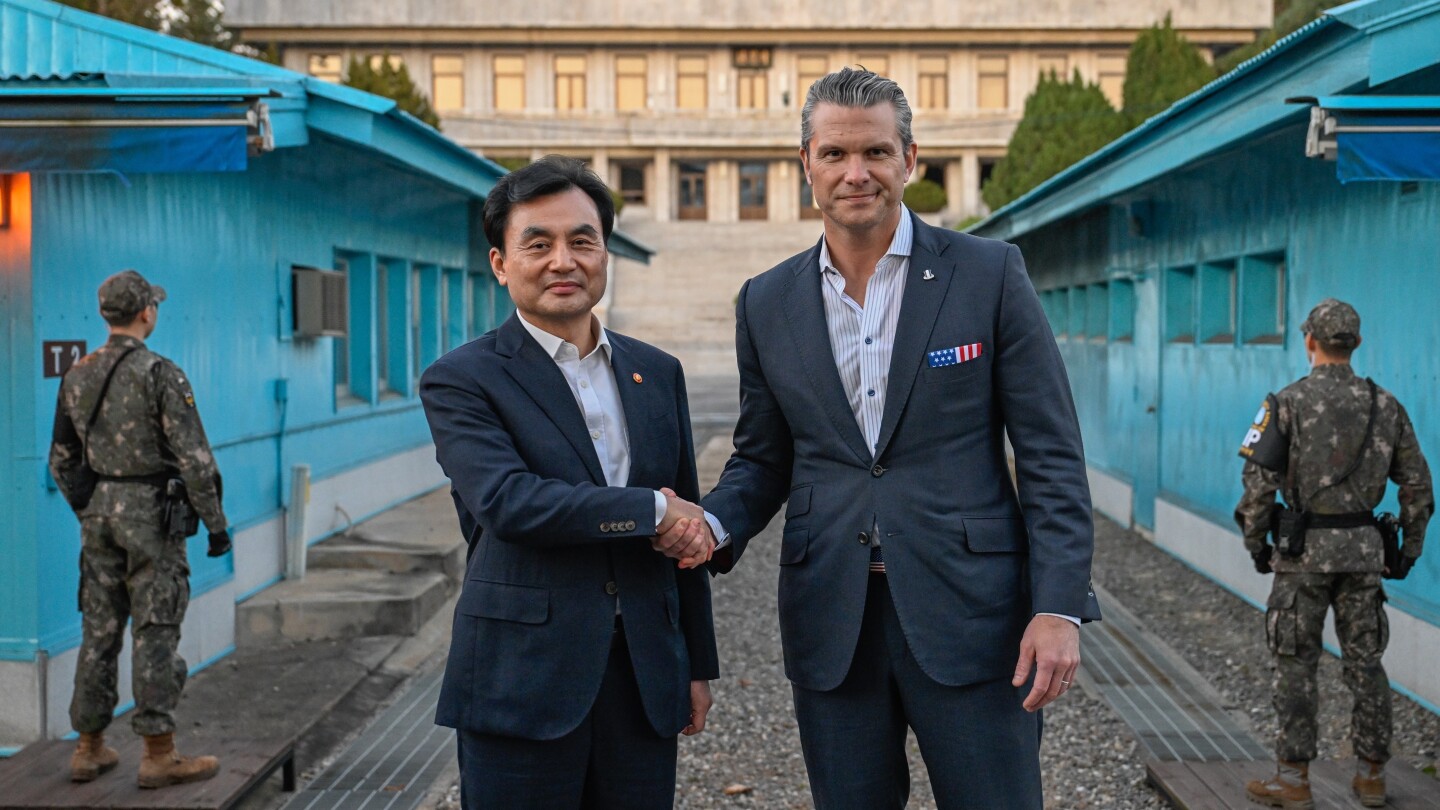
SEOUL, South Korea — U.S. Defense Secretary Pete Hegseth embarked on a two-day visit to South Korea, focusing on strengthening bilateral security ties and reaffirming the alliance between the two nations. His itinerary included a visit to the Demilitarized Zone (DMZ), a symbolic and strategic area separating the two Koreas, where he received a detailed briefing from military officials at Observation Post Ouellette. This site has previously hosted notable figures, including former U.S. President Donald Trump in 2019, who used the vantage point to observe North Korea and engage with American troops stationed there. Hegseth, accompanied by South Korean Defense Minister Ahn Gyu-back, also toured the historic Panmunjom border village, where the 1953 armistice agreement was signed, effectively halting the Korean War. The visit underscored the robust defense collaboration and seamless coordination between the two allies, as highlighted by Ahn’s ministry. Notably, Hegseth refrained from addressing North Korea’s ongoing nuclear and missile advancements, despite the regime’s persistent refusal to engage in dialogue with Washington and Seoul. In a display of military solidarity, South Korea’s Joint Chiefs of Staff Chairman Gen. Jin Yong-sung and U.S. Gen. Dan Caine jointly supervised a combined formation flight of South Korean and U.S. F-16 fighter jets above Pyeongtaek, a major U.S. military base. This inaugural exercise aimed to showcase the unwavering strength and ironclad defense posture of the alliance. Hegseth and Ahn, who had previously convened at a defense ministers’ meeting in Malaysia, are set to participate in the annual U.S.-South Korea defense talks in Seoul. Key agenda items include South Korea’s pledge to bolster defense spending and the implementation of a prior agreement to transition wartime operational control to a binational command led by a South Korean general with a U.S. deputy. However, concerns linger in Seoul regarding potential demands from the Trump administration for increased financial contributions to support the U.S. military presence or a possible reduction of American forces to prioritize strategic focus on China. Hegseth’s visit follows closely on the heels of Trump’s recent trip to South Korea, where he engaged in discussions with South Korean President Lee Jae Myung and Chinese President Xi Jinping during the Asia-Pacific Economic Cooperation summit in Gyeongju. During their meeting, Lee reiterated South Korea’s commitment to enhancing defense expenditures and sought U.S. assistance in acquiring nuclear-powered submarines. Trump subsequently announced on social media that the U.S. would share advanced technology to facilitate South Korea’s construction of a nuclear-powered submarine at the Philly Shipyard, recently acquired by South Korea’s Hanwha Group. Additionally, the leaders made progress in trade negotiations, addressing specifics of South Korea’s $350 billion investment pledge to mitigate the impact of U.S. tariffs.
Hegseth visits inter-Korean border ahead of security talks with South Korean officials