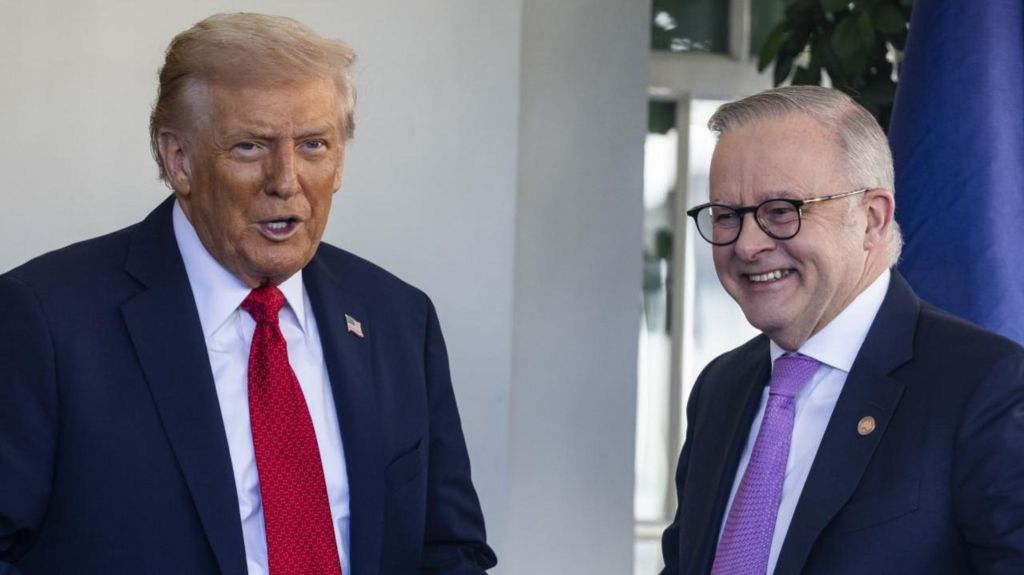
In a significant diplomatic encounter at the White House on Monday, US President Donald Trump and Australian Prime Minister Anthony Albanese reaffirmed their nations’ longstanding alliance. Trump emphasized the historical camaraderie, stating, ‘We’ve been long-term, longtime allies and I would say there’s never been anybody better.’ This meeting marked their first official dialogue, with both leaders expressing mutual respect and commitment to bolstering their strategic partnership. However, beneath the surface of this camaraderie lies a complex web of challenges. Australia, traditionally a staunch ally of the US, is beginning to scrutinize the reliability of this relationship under the Trump administration. The imposition of tariffs on Australian goods, including a 10% import tax on most products and a 50% levy on aluminium and steel, has been perceived as a breach of a decades-long free trade agreement. Albanese remarked, ‘This is not the act of a friend,’ highlighting the strain these measures have placed on bilateral ties. Additionally, the review of the Aukus defence pact, which aims to provide Australia with advanced nuclear submarine technology in exchange for support in countering China in the Asia-Pacific, has caused unease in Canberra. Despite these challenges, the meeting concluded on a positive note, with Trump praising Albanese and securing a deal for US investment in Australia’s critical minerals industry. This agreement is expected to help Australia reduce its dependence on China’s near monopoly in this sector. Furthermore, the Aukus pact received a renewed commitment, effectively ending the prolonged review process. While the tariffs remain a contentious issue, they are at the lowest rate compared to other countries, and certain Australian sectors, such as beef, have benefited from the global market upheaval. The meeting also addressed regional security concerns, particularly in light of recent tensions between Chinese and Australian military jets. Beijing’s massive military build-up has heightened anxieties in Canberra, reinforcing the perception that Australia cannot defend itself independently. Consequently, there is a growing inclination among Australian political and security experts to seek closer ties with the US, despite the unpredictability of the Trump administration. As Jared Mondschein of the United States Studies Centre noted, ‘A lot of allies and partners throughout the region are grabbing for the uncertainty of a term-limited Trump administration over the certainty of a Xi Jinping-led China.’ Thus, while the dynamics of the US-Australia relationship are evolving, the fundamental alliance remains intact, driven by shared strategic interests and regional security concerns.