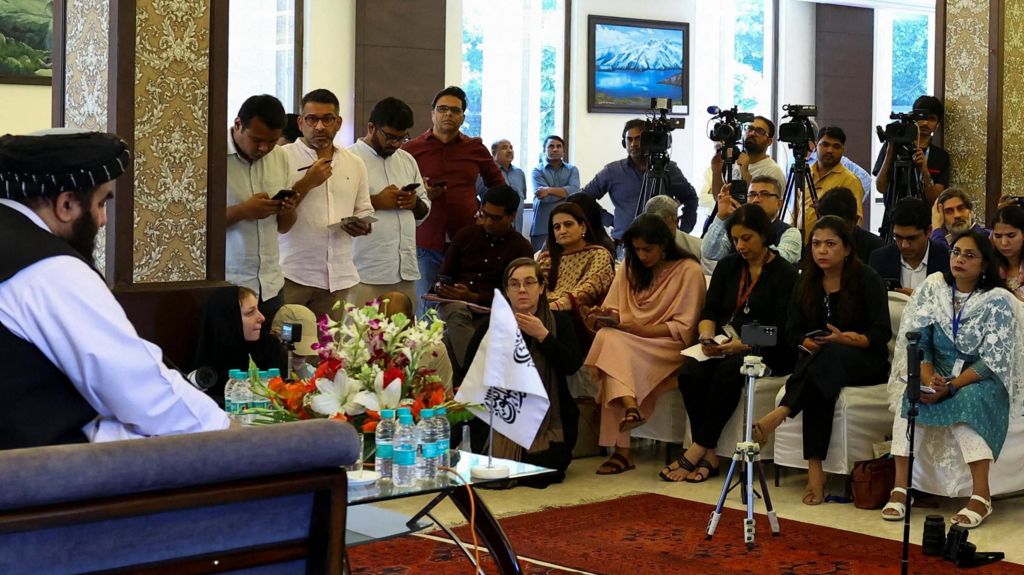
In a striking visual that has sparked widespread discussion, female journalists were prominently seated in the front row during a press conference held by Afghan Taliban Foreign Minister Amir Khan Muttaqi in Delhi on Sunday. This event followed significant backlash over the exclusion of women from his previous press meeting on Friday. Muttaqi addressed the controversy, stating that the initial exclusion was unintentional and due to a technical oversight in the invitation process. He emphasized that there was no deliberate intent to exclude female journalists. The press conference, held at the Afghan embassy, was part of Muttaqi’s week-long visit to India for high-level talks. India, while not formally recognizing the Taliban government, maintains diplomatic and humanitarian ties with Afghanistan. The visit is seen as a crucial step in strengthening bilateral relations. On Friday, Muttaqi met with Indian Foreign Minister S Jaishankar, who announced plans to reopen India’s embassy in Kabul, which had been closed since the Taliban regained power in 2021. However, the initial press event on Friday was marred by gender discrimination, as female journalists were barred from attending, leading to widespread criticism from Indian politicians, journalists, and advocacy groups. Organizations such as the Editors Guild of India and the Network of Women in Media, India, condemned the exclusion as blatant gender discrimination and called on the Indian government to uphold democratic rights and constitutional freedoms. Amid growing outrage, Muttaqi’s team issued fresh invitations for Sunday’s press conference, which was described as an inclusive event open to all media personnel. During the conference, Muttaqi faced tough questions regarding the exclusion of women from Friday’s meeting and the broader issue of women’s rights in Afghanistan. He claimed that education for women and girls continues in Afghanistan, with over 2.8 million female students enrolled in schools and institutes. However, many journalists challenged his assertions, highlighting the severe restrictions imposed by the Taliban since their return to power in 2021, including bans on education for girls over 12 and the removal of books authored by women from universities. While the minister’s responses may not have fully addressed concerns, the organization of the second press conference and the inclusion of female journalists were seen as a step forward in addressing gender issues.