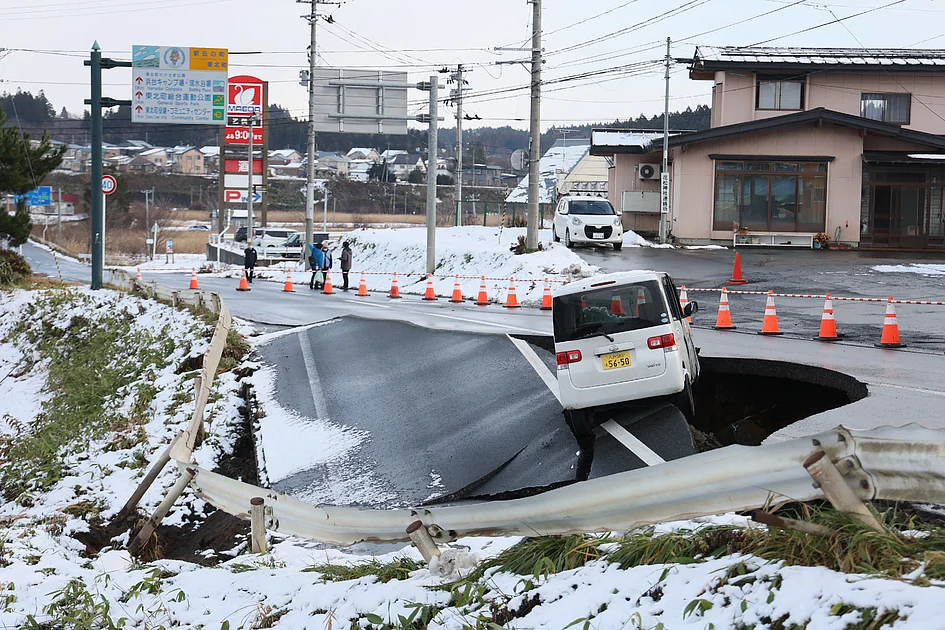
A substantial earthquake measuring 6.2 on the Richter scale struck Japan’s Chugoku region on Tuesday, according to the Japan Meteorological Agency. The seismic event, centered in eastern Shimane prefecture, triggered multiple aftershocks but posed no tsunami threat to the coastal nation.
The tremor registered an intensity of upper-5 on Japan’s specialized 7-point scale, indicating force strong enough to impede movement without support. Despite the significant magnitude, initial assessments revealed no structural damage or operational abnormalities at critical infrastructure facilities.
Of particular significance was the proximity to Shimane Nuclear Power Station, located approximately 32 kilometers from the epicenter. Chugoku Electric Power confirmed that operations continued normally at the facility’s No. 2 unit, which had only resumed operations in December 2024 following nationwide nuclear shutdowns after the 2011 Fukushima disaster. Japan’s Nuclear Regulation Authority separately verified no irregularities at nuclear facilities.
The seismic activity prompted West Japan Railway to temporarily suspend Shinkansen bullet train services between Shin-Osaka and Hakata stations as a precautionary measure, demonstrating the country’s rigorous safety protocols.
Japan’s vulnerability to earthquakes remains noteworthy as the archipelago experiences approximately 20% of the world’s magnitude 6+ quakes, reflecting its position within one of Earth’s most seismically active zones. The nation’s advanced early warning systems and construction standards have been developed through extensive experience with seismic events.