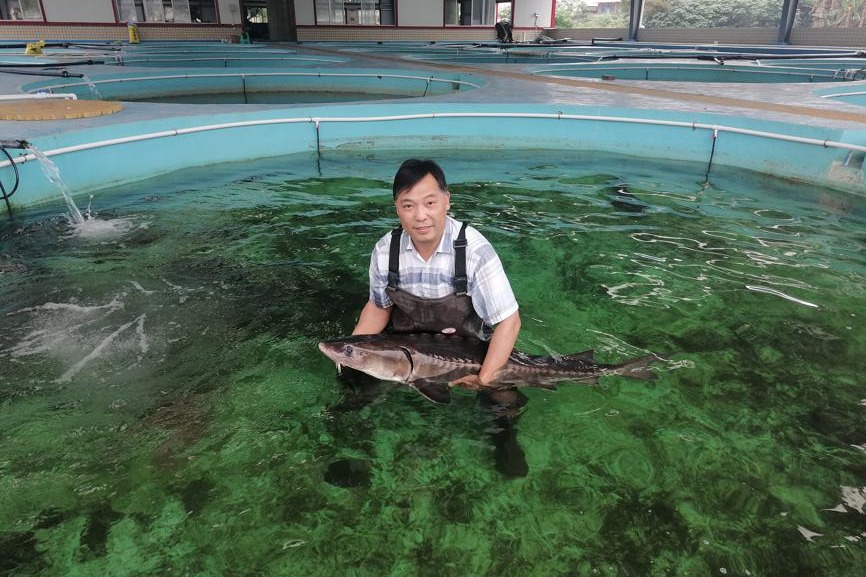
After 35 years of relentless dedication, Zhou Liang, director of the Yibin Institute of Rare Aquatic Animals, is witnessing transformative progress in restoring the wild population of the critically endangered Yangtze sturgeon. The 53-year-old conservationist has pursued this mission as both a professional commitment and a personal legacy, continuing the work initiated by his late father, Zhou Shiwu.
The Yibin Institute, recognized as China’s first private research organization focused on preserving rare aquatic species in the Yangtze River, represents a remarkable family endeavor. Rather than pursuing urban career opportunities after university, Zhou Liang returned to his hometown in Sichuan Province to establish this pioneering conservation facility during a period of severe ecological crisis.
By the turn of millennium, the Yangtze sturgeon faced existential threats from multiple fronts: intensive overfishing, extensive dredging operations, and widespread dam construction had decimated natural breeding populations. Scientific surveys confirmed the alarming absence of naturally spawned juvenile sturgeons throughout the entire river system by approximately 2000.
The conservation breakthrough emerged in 2004 when Zhou’s team mastered large-scale artificial breeding techniques. This scientific achievement resulted in the successful hatching of tens of thousands of Yangtze sturgeon fry at the institute’s breeding facilities, marking a critical milestone in species preservation.
Current observations indicate promising signs of population recovery, suggesting that decades of coordinated efforts between research institutions, government agencies, and local communities are finally yielding measurable ecological restoration. Zhou’s work demonstrates how sustained scientific commitment can reverse even the most severe biodiversity declines, offering valuable insights for global conservation initiatives.