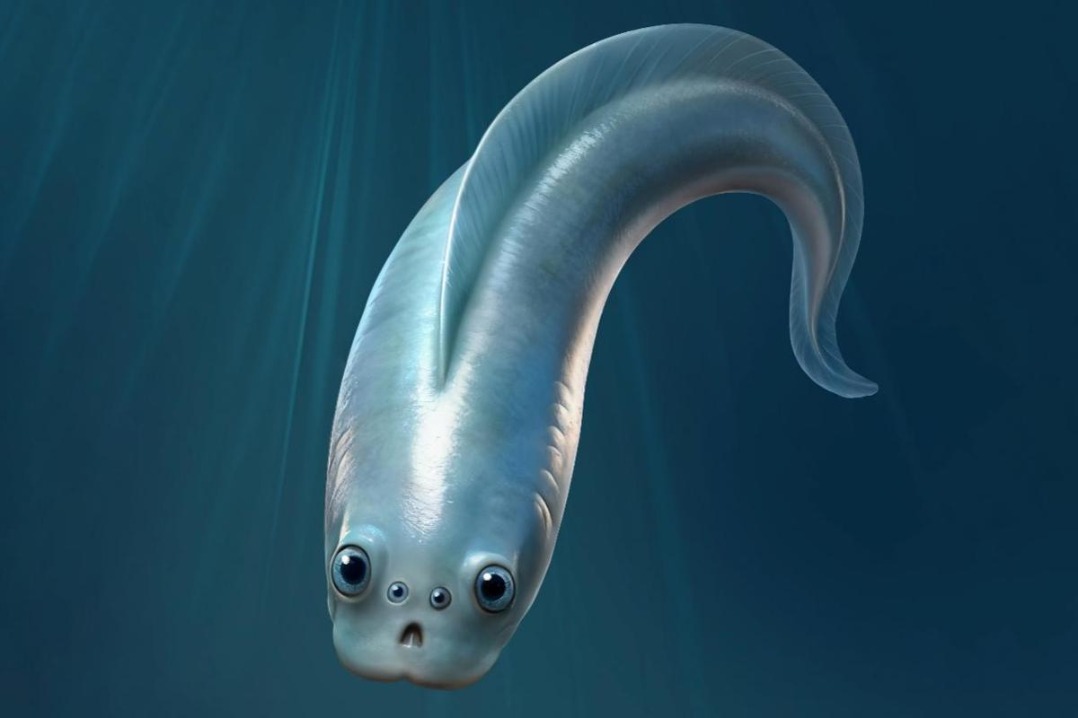
Paleontologists from Yunnan University have made a groundbreaking discovery that challenges conventional understanding of early vertebrate evolution. Their research indicates that the earliest known vertebrates from the Cambrian Period, approximately 518 million years ago, may have possessed not two but four camera-type eyes.
The study, published in the prestigious journal Nature, examines jawless vertebrates known as myllokunmingids that inhabited Earth’s oceans during a critical evolutionary period. Led by Academician Xu Xing from the School of Life Sciences and Researcher Cong Peiyun from the Institute of Paleontology, the team analyzed exceptionally preserved fossil specimens from the Chengjiang biota in Yunnan province.
These fossils reveal a remarkable anatomical feature: a smaller pair of round, dark structures positioned between the conventional lateral eyes. Through meticulous analysis, researchers determined these structures were preserved as organic carbon films containing melanin-bearing melanosomes—characteristics that closely match the retinal pigment epithelium found in modern vertebrates.
The most significant finding emerged when researchers identified traces of lenses within these additional ocular structures. The precise positioning and proportional size of these lenses relative to the retinal tissues mirror the anatomical relationship observed in functional camera-type eyes, strongly suggesting these organs possessed image-forming capabilities.
This extraordinary dorsal pineal complex, located atop the animals’ heads, represents a previously unknown visual system configuration in early vertebrates. The discovery provides unprecedented insights into how these ancient creatures perceived their environment and enhances our understanding of sensory evolution during the Cambrian explosion—a period of rapid biological diversification.
The research not only expands scientific knowledge of vertebrate visual system origins but also offers fresh perspectives on the survival strategies employed by animals during one of Earth’s most biologically creative eras.