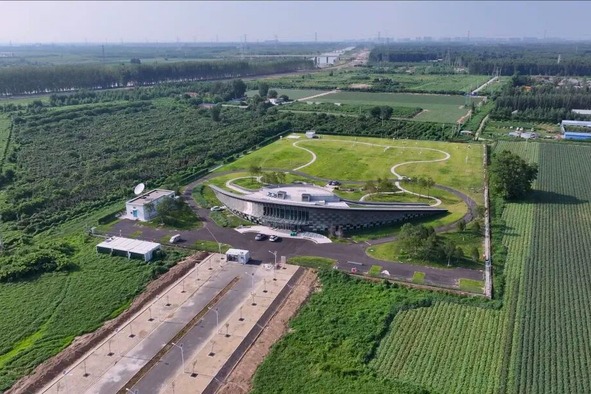
BEIJING – On Wednesday, China formally launched its 27th national climate observatory in the Xiong’an New Area, a strategically planned modern development zone located in Hebei Province, northern China. The inauguration marks a key milestone in strengthening the country’s national climate monitoring network and advancing meteorological research for one of China’s most ambitious urban development projects.
Officials from the China Meteorological Administration confirmed that the new observatory features a structured network of one central main monitoring station and eight regional auxiliary stations. This distribution allows the facility to capture comprehensive climate data across four distinct major ecosystem types that exist within the Xiong’an region, including dense urban development zones, natural forest landscapes, protected wetland reserves, and large-scale agricultural farmland areas.
Unlike traditional static observation facilities, all meteorological data collected across the Xiong’an network is transmitted instantly in real time to a cloud-hosted big data platform. This digital integration dramatically boosts local and national capabilities in continuous climate monitoring, rapid extreme weather early warning, and customized meteorological services tailored to the needs of different economic and public service sectors.
Located approximately one hour’s drive southwest of central Beijing, Xiong’an New Area was first established by Chinese authorities in 2017. Widely referred to as China’s “city of the future,” the development is a core component of the national strategy to relocate non-essential capital functions from Beijing to ease urban overcrowding pressure, while driving coordinated economic and social development across the Beijing-Tianjin-Hebei region. As the new city continues its phased construction and population growth, robust meteorological infrastructure has become an urgent priority to support sustainable urban planning and daily operation.
Following its official inauguration, the Xiong’an National Climate Observatory will take on dual roles beyond basic climate data collection. In addition to fulfilling routine long-term climate observation tasks, the facility will also conduct targeted cutting-edge research in multiple key climate-related fields. The data and research output from the observatory will provide more robust, reliable technical support for national efforts including climate resource assessment, long-term climate change tracking and impact analysis, and early identification of meteorological disaster risks across the region and beyond.
Over the past several years, local meteorological authorities in Xiong’an have already made significant progress in building out smart meteorological infrastructure, establishing a preliminary integrated regional monitoring network that covers the entire new area.
“Moving forward, our team will continue to strengthen core capabilities across three key areas: meteorological disaster risk monitoring and early warning, ecological meteorological support for environmental protection and restoration, and high-quality meteorological services that support stable urban operation,” said Guo Yitao, deputy director of the newly inaugurated Xiong’an observatory.