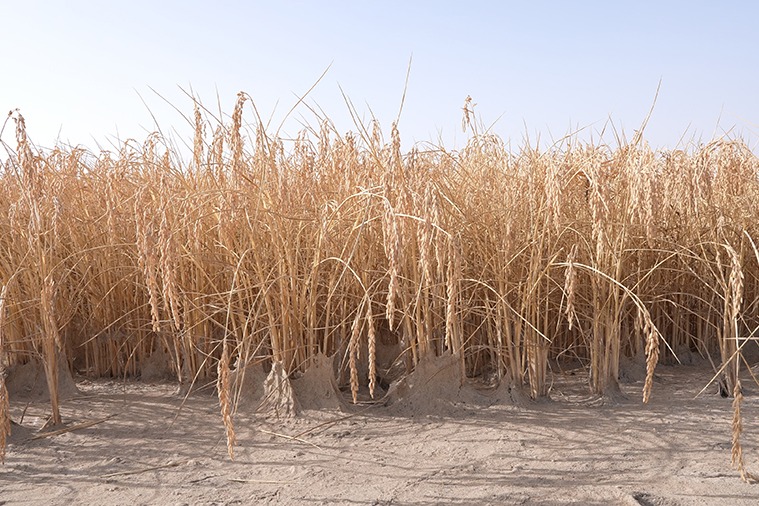
In a remarkable agricultural achievement, the arid desert landscapes of Tumxuk city in China’s Xinjiang Uygur autonomous region have yielded an unexpected bounty—a successful rice harvest from previously barren saline-alkali soil. Approximately 267 hectares of transformed desert terrain in Qianhai town have produced their first crop following an innovative ecological restoration project.
Situated along the harsh western periphery of the Taklimakan Desert, China’s largest desert expanse, this land rehabilitation initiative commenced earlier this year. By June, agricultural specialists had implemented comprehensive soil improvements and planted specially developed rice varieties engineered for exceptional drought resistance and salt tolerance.
The cultivation breakthrough employed sophisticated water management techniques, including an intermittent irrigation method applied once the late-planted rice plants reached 1-3 centimeters in height. This approach created optimal aeration conditions for root development while significantly reducing water evaporation from the desert soil.
According to technician Zhang Yuanqiang, this innovative water-conservation and salt-leaching strategy resulted in substantial resource savings, reducing water requirements by 20-30 percent compared to conventional methods. The agricultural team maintained strict organic protocols, completely avoiding pesticides to prevent chemical contamination of the newly rehabilitated soil.
Instead of chemical interventions, farmers leveraged the region’s abundant sunlight for natural pest control while implementing in-situ salt leaching techniques. The comprehensive approach created a sustainable ecological cycle: nurturing rice with carefully managed water resources, improving soil quality through rice cultivation, and enhancing water conservation through improved soil conditions.
The desert rice fields achieved yields exceeding 100 kilograms per mu (approximately 667 square meters), a result that agricultural specialists consider highly satisfactory given the challenging growing conditions. Following the successful harvest, local growers including farmer Zhang Fei have established partnerships with rice processing companies to manage subsequent sales and distribution.