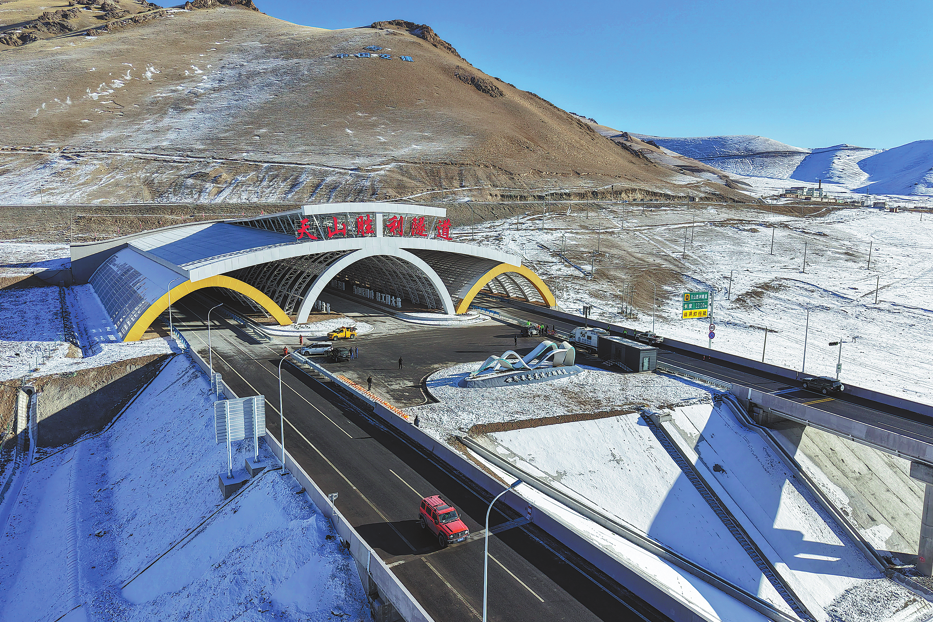
China has officially opened the world’s longest expressway tunnel, marking a monumental achievement in infrastructure engineering. The Tianshan Shengli Tunnel, stretching 22.13 kilometers through the formidable Tianshan Mountains in Xinjiang Uygur Autonomous Region, began operations on December 27, 2025, as the centerpiece of a newly completed 324.7-kilometer expressway connecting regional capital Urumqi with Yuli county.
This engineering marvel transforms what was previously a treacherous several-hour mountain crossing into a smooth 20-minute journey. The Urumqi-Yuli Expressway dramatically reduces travel time between Urumqi and Korla from seven hours to just three and a half, while effectively bridging northern and southern Xinjiang for the first time with high-speed connectivity.
Construction of the $6.66 billion project commenced in April 2020 under extreme conditions. Engineers from China Communications Construction Co faced formidable challenges including altitudes nearing 3,000 meters, temperatures plunging to -42°C, high seismic activity, and complex geological fault zones. The tunnel reaches its deepest point at 1,112 meters beneath the mountain ridge, while its longest shaft descends over 700 meters—setting a new world record.
The project incorporated cutting-edge technologies and innovative solutions in ultra-long tunnel surveying, design, construction techniques, and intelligent safety systems. These advancements establish new global standards for tunnel engineering in extreme environments.
Beyond its technical achievements, the expressway serves as a critical transportation artery linking major domestic routes including the G7 Beijing-Urumqi Expressway and G30 Lianyungang-Horgos Expressway. It further connects to international trade corridors such as the New Eurasian Land Bridge and China-Central Asia-West Asia Economic Corridor.
The infrastructure development specifically enhances connectivity within the China (Xinjiang) Pilot Free Trade Zone, reducing logistics costs and accelerating the flow of energy, manufactured goods, and agricultural products across the region. Environmental considerations were prioritized throughout construction, with dedicated wildlife passages, herder underpasses, and special protective measures implemented for water-source protection zones and national forest parks along the route.
Initial access is currently granted to public vehicles excluding medium and heavy-duty trucks, with formal trial operations scheduled to commence on January 1, 2026.