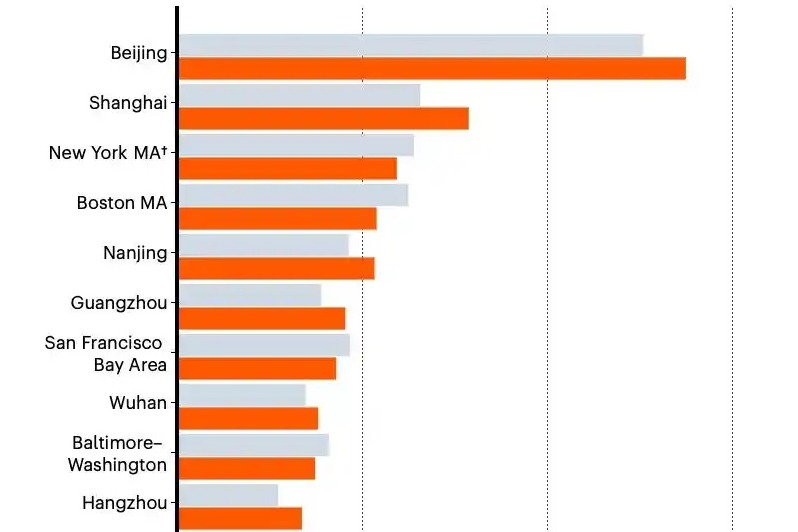
International scientific assessments and prestigious academic rankings reveal China’s remarkable ascendance as a world-leading scientific force. Recent data from multiple authoritative sources demonstrates China’s growing dominance across research output, innovation quality, and global scientific collaboration.
The Nature Index 2025 Science Cities report highlights China’s unprecedented achievement with six cities now ranking among the world’s top ten research hubs—marking the first time any single country has held the majority of positions. Beijing maintains its position as the world’s premier science city for the ninth consecutive year, showing a 9% growth in research output. Shanghai, Guangzhou, Wuhan, Nanjing, and Hangzhou join Beijing in the global top ten, with Shanghai experiencing a remarkable 20% surge in scientific production.
Chinese research institutions demonstrate particular strength in chemistry, physical sciences, and earth and environmental sciences, claiming all top ten positions in chemistry for the first time. The World Intellectual Property Organization’s Global Innovation Index 2025 further confirms this trend, ranking the Shenzhen-Hong Kong-Guangzhou cluster as the world’s top science and technology hub while placing China among the top ten most innovative economies globally.
Beyond quantitative metrics, China’s scientific influence shows qualitative improvement. Analysis published in the Proceedings of the National Academy of Sciences indicates Chinese scientists now lead over half of collaborative research projects with British counterparts, with similar leadership patterns emerging in partnerships with American and European institutions. The Chinese Academy of Sciences leads Clarivate’s Highly Cited Researchers 2025 list with 258 mentions, surpassing Harvard University.
According to the Swedish Foundation for International Cooperation in Research and Higher Education, China has surpassed the United States in research strength when measured by high-impact publications, particularly in mathematics, computing, and engineering. A comprehensive 70-year study by New York University found China produced 47% of global remote sensing journal papers in 2023.
China’s scientific contributions increasingly address global challenges. Springer Nature reports China as the largest contributor to research supporting Sustainable Development Goals, with Chinese scientific achievements significantly influencing global policy formulation. Twenty-five percent of citations in international SDG policy documents now reference Chinese research, particularly in health and environmental policies since 2022.
This scientific transformation, described by researchers as “meteoric,” reflects China’s strategic investment in research infrastructure and global scientific collaboration over the past two decades, positioning the country as an indispensable contributor to the global research ecosystem.