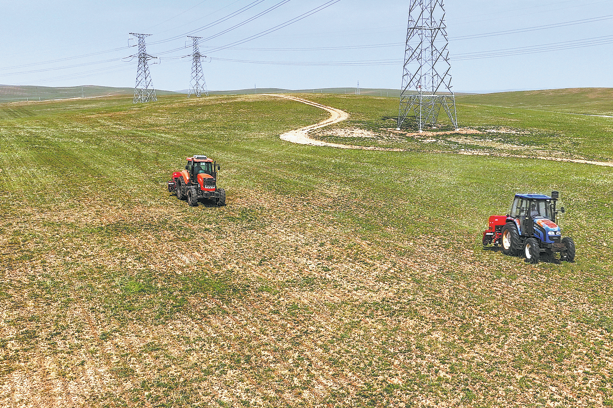
In China’s Inner Mongolia Autonomous Region, an innovative work-for-relief initiative is transforming ecological restoration into economic opportunity for rural communities. The program, implemented in Ulaanqab city, financially compensates farmers and herders for participating in desertification control and grassland rehabilitation projects.
Liu Cunxi, a 69-year-old farmer from Yujiahao village in Siziwang Banner, represents the human dimension of this environmental strategy. “We plant trees and shrubs to prevent wind erosion and stabilize the sand,” Liu explained. “Simultaneously, we earn 160 yuan ($22.7) daily.” Like approximately 20 other villagers, Liu supplements his income during the agricultural off-season from May to October through planting and harvesting drought-resistant vegetation.
The compensation structure demonstrates careful economic planning. Herders receive approximately 150 yuan per hectare for observing grazing restrictions, while daily wages exceed 150 yuan for planting, fertilizing, and managing grasslands. Additional transportation services for materials including grass seeds, fertilizer, and fencing generate further income streams, with households earning roughly 165 yuan per hectare plus management fees of about 180 yuan per hectare.
Pang Chengxiu, a 55-year-old community organizer from Siziwang Banner, has mobilized 105 households to restore over 14,000 hectares of degraded grassland. His responsibilities encompass fence installation, water transportation, and mediating pastoral disputes. Last year, Pang earned more than 15,000 yuan in labor remuneration while observing significant ecological recovery in previously degraded areas.
“This approach not only improves the ecological environment but also boosts our earnings,” Pang noted, highlighting the program’s dual benefits. Ulaanqab authorities have complemented these efforts with specialized training programs to enhance participants’ technical skills and environmental understanding, steadily expanding the initiative’s reach across the region.
The model represents a sustainable approach to environmental governance that aligns ecological objectives with economic incentives, creating a virtuous cycle where conservation becomes economically viable for local communities.