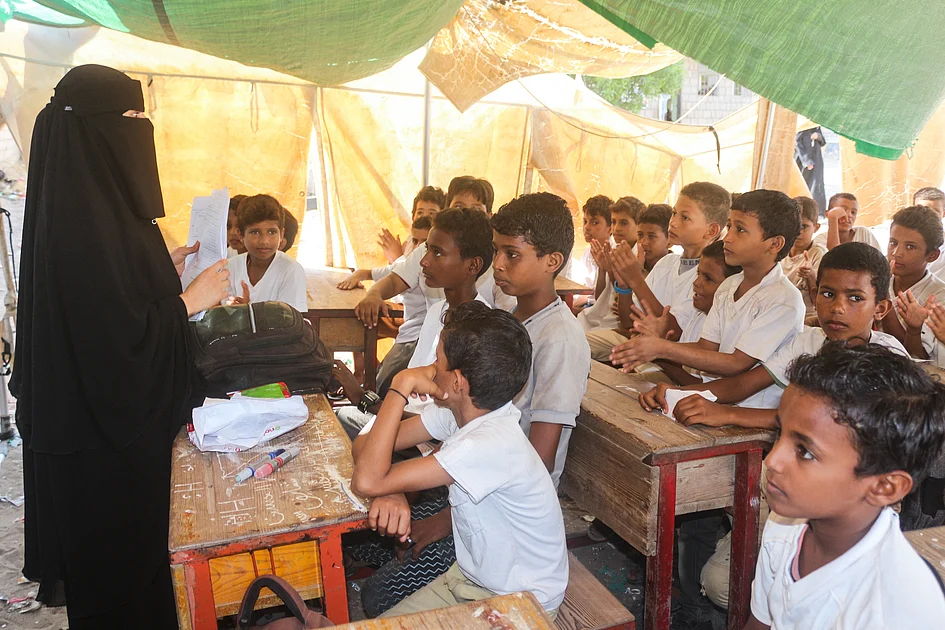
In the war-torn landscapes of Yemen, education has become a luxury for many children. Crammed under tattered tents or in makeshift classrooms, young learners grapple with the basics of Arabic grammar, often without textbooks or even shoes. Born into a nation fractured by years of conflict, these children are among the fortunate few who still have access to any form of schooling. Yemen’s education system lies in ruins, with nearly 3,000 schools destroyed and those still standing plagued by power outages, water shortages, and a dire lack of trained teachers. At Al Ribat Al Gharbi school near Aden, a typical example, students endure overcrowded conditions, with classes often exceeding 100 pupils. Teacher Suad Saleh, clad in the traditional black niqab, struggles to maintain order in her rudimentary classroom, where many children sit on the tiled floor with exercise books on their laps. ‘It takes me 10 minutes just to quiet them down,’ she laments. The crisis extends beyond infrastructure. Many teachers have abandoned their posts due to meager wages, with some earning as little as $31 a month. The consequences are dire: over 4.5 million children in Yemen are out of school, according to UNICEF, leaving an entire generation at risk of illiteracy. Amid this devastation, Saudi Arabia has stepped in with development programs, focusing on rebuilding schools and training teachers in government-controlled areas. However, the scars of war remain deep. ‘Stopping education has had a terrible impact,’ says Fathiya Al Afifi, a school principal. ‘An entire generation can neither read nor write. This is a disaster.’