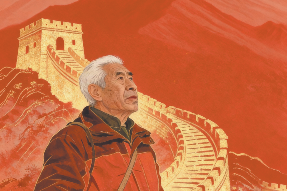
For over four decades, 81-year-old Mei Jingtian has been the unwavering guardian of an unrestored section of the Great Wall in Shixia village, Beijing’s Yanqing district. Despite his advanced age, Mei continues to navigate the steep slopes with remarkable agility, having dedicated his life to preserving this national treasure since returning to his village in the 1980s.
Upon his return, Mei was devastated to discover the historical structure had been systematically dismantled, with villagers repurposing ancient bricks for construction projects. “The Great Wall in my childhood stood intact in its original grandeur,” Mei recalled. “Witnessing its deterioration compelled me to act. This monumental achievement of our ancestors, built with extraordinary hardship and wisdom, demanded protection.”
Armed only with a sickle and boundless determination, Mei single-handedly carved out kilometers of mountain paths to access remote wall sections. His weekly patrols involved clearing invasive vegetation, removing litter, and educating adventurous tourists about the wall’s historical significance. In one particularly grueling endeavor, he spent over two days manually transporting a 34.5-kilogram inscribed stone tablet down the mountain to deliver it to preservation authorities.
Mei’s initially solitary mission gradually transformed into a community movement. He pioneered innovative conservation approaches, even trading cement with villagers to recover embedded Great Wall bricks from their properties. This grassroots effort culminated in 2007 with the establishment of the Shixia Village Great Wall Protection Association, formalizing what began as one man’s passionate crusade.
The conservation movement achieved another milestone in 2019 when the government officially incorporated Great Wall protectors into its budgetary framework. This institutional recognition coincided with Mei’s niece, Liu Hongyan, passing rigorous examinations to become one of Shixia’s first six officially recognized protectors—marking the formal transition of guardianship to the next generation.
Now 45, Liu patrols the same challenging terrain her uncle once protected, monitoring structural integrity while sharing the wall’s rich history with visitors. “This transcends mere employment,” Liu explained. “It represents the custodianship of our cultural heritage and homeland. My uncle demonstrated that genuine commitment stems from love rather than expectation of reward.”
Despite confronting physical dangers including treacherous topography, extreme weather, and encounters with wildlife such as snakes and wild boars, Liu finds profound purpose in her conservation work. However, she acknowledges concerning demographic challenges: most current protectors are aged 60-70, while many younger villagers have migrated to urban areas.
“Upon my retirement, I remain confident that successors will emerge to continue this vital work,” Liu stated. “We urgently need more youth to join our protection teams. Ultimately, we are all guardians of the Great Wall—collaborating to preserve our shared heritage and home.”