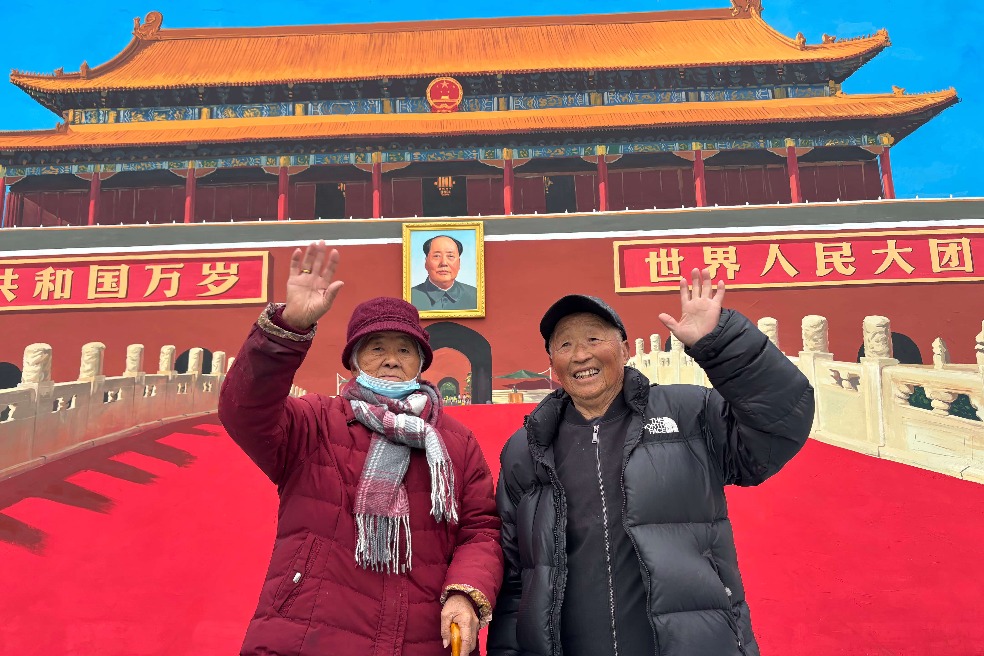
Nestled in Wuying Village, a quiet rural community in Shangqiu, Henan Province, a striking 18-meter-long, 8-meter-high mural of Beijing’s Tian’anmen Square has turned the once-overlooked village into an unexpected travel destination for elderly travelers from across China. Created by local 39-year-old artist Wu Chengyan, the hyper-realistic artwork has fulfilled a decades-long unmet dream for hundreds of seniors who never had the chance to visit the iconic capital landmark due to health, financial or mobility barriers.
During this year’s New Year holiday, crowds of elderly visitors lined up for photos in front of the mural, many dressed in their finest new clothing, some arriving in wheelchairs or assisted by family members on three-wheeled carts. The narrow roads leading in and out of the village were filled end-to-end with parked vehicles. For many visitors, the lifelike depiction felt as authentic as standing in Tian’anmen Square itself. “It is exactly the same as seeing Tian’anmen Square on TV,” shared a 70-year-old female visitor, echoing the sentiment of dozens of other guests.
Wu’s journey to creating this viral work of community art has been marked by personal persistence and a deep commitment to giving back to the village that raised him. A lifelong art lover who grew up in Wuying, Wu dreamed of attending China’s top art school, the Central Academy of Fine Arts, during his high school years. Between 2006 and 2010, he took the national college entrance exam (gaokao) five times, but fell short of admission each time due to low English scores. Undeterred, he continued to hone his craft while building a life with his wife Chang Lihua: the pair opened a local kindergarten in Shangqiu in 2015, and by 2018, Wu earned a place as a member of the Henan Provincial Art Association, a milestone he called a “high recognition of my life’s work.”
A series of financial setbacks followed, however, as operational challenges left the couple with substantial debt from the kindergarten. Wu’s creative path shifted in 2015, when he painted his first village mural as a personal gift for Chang’s grandparents, who were unable to travel for leisure due to advanced age and limited mobility. To bring them the joy of a hiking experience without leaving home, Wu painted a vivid natural landscape across an exterior wall of their house.
Word of Wu’s skill spread quickly through the village, and soon other elderly residents began asking for custom murals of their own. Wu accepted every request, completing more than 40 large-scale works for villagers entirely free of charge. Chang began sharing short videos of Wu’s process and finished murals on Chinese short-video platform Douyin, and the account quickly gained a national following. Over the past year, two of their posts went viral: the first for a dynamic Nezha-themed mural in March 2025, and the second for the Tian’anmen mural, which drew more than 100,000 visitors to Wuying Village over the 2026 New Year holiday alone.
Wu initially focused his murals on sweeping landscapes and beloved animation characters, but shifted to include more culturally meaningful themes after local elders expressed interest in “red stories” of China’s revolutionary history. Today, his village works include depictions of the People’s Republic of China’s founding ceremony, Japan’s surrender in World War II, the founding of the Communist Party at the Red Boat, and historical exposures of the atrocities committed by Unit 731. To prepare for the Tian’anmen mural, Wu asked a friend living in Beijing to take new, high-resolution reference photos of the landmark, and spent five days refining the work. He even adjusted his technique to accommodate seniors with age-related farsightedness, using bolder outlines and exaggerated three-dimensional effects to make the image clear and easy to see.
For Wu, the project is deeply personal. “I was raised by the elders in the village. After my mother passed away in 2019, they took even better care of me. I always feel I owe them something,” he explained. “Many of them regret not being able to visit places they dreamed of. My mother had such dreams, too. When I paint for other elders, I feel like I’m making up for that regret.”
His work has now attracted invitations from across China, with community groups in Anhui, Jiangxi, Guizhou, Shanxi and Shandong provinces asking Wu to bring his art to their rural areas. Today, Wu earns his primary income from these off-site mural commissions, and he and Chang are experimenting with livestream e-commerce to supplement their income. Even as his career grows, however, Wu remains committed to his original mission: he plans to continue painting free murals for rural elders, and even extend the offer to his online followers. “We wouldn’t be where we are without the villagers lifting us up,” Chang said. “We’ll never forget our roots. The village and its people are the foundation of everything we do.”