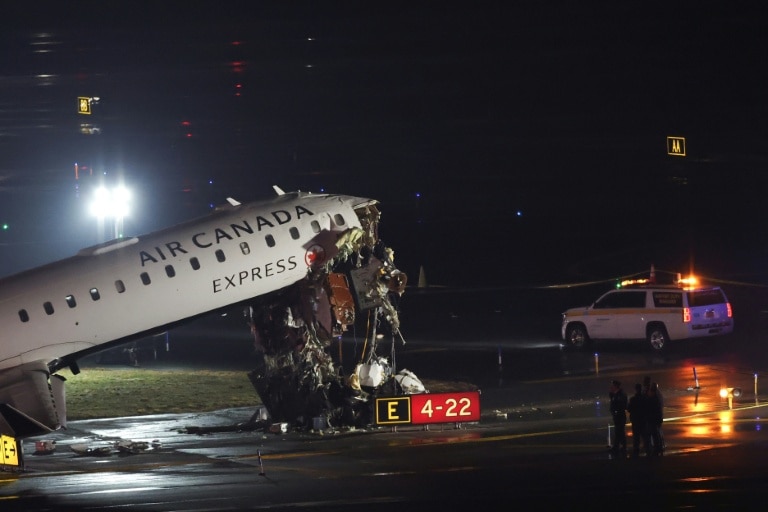
Federal investigators are urging caution against attributing blame to air traffic controllers as the probe into a fatal runway collision at New York’s LaGuardia Airport continues. The incident, which occurred late Sunday, resulted in the deaths of two pilots when an Air Canada Bombardier aircraft collided with a fire truck, crushing the aircraft’s cockpit and severely damaging the emergency vehicle.
National Transportation Safety Board (NTSB) Chair Jennifer Homendy addressed speculation that controller distraction might have been a factor, particularly following media reports that controllers were simultaneously managing an odor-related emergency on a United Airlines flight—the very incident to which the fire truck was responding. ‘I would caution pointing fingers at controllers and saying distraction was involved,’ Homendy stated during a press briefing. ‘We rarely, if ever, investigate a major accident where it was one failure.’
Homendy emphasized that the U.S. aviation safety system relies on multiple layers of defense, suggesting that a catastrophic failure implies numerous breakdowns in the safety chain. The investigation has revealed that two controllers were on duty in the tower at the time of the accident, handling both departure clearances and ground traffic control, though the specific distribution of these duties remains unclear.
While noting that the staffing level was consistent with national standards for a midnight shift, Homendy acknowledged that the NTSB has previously raised concerns about controller fatigue during such hours, though no evidence currently links fatigue to this incident.
A significant finding emerged regarding the airport’s runway safety system (ASDE-X), designed to track aircraft and ground vehicles. The system failed to generate a collision alert because the fire truck involved was not equipped with a necessary transponder.
NTSB lead investigator Doug Brazy confirmed the agency is analyzing substantial evidence, including over 25 hours of cockpit voice recordings and 80 hours of flight data. The final moments of the recording reveal the co-pilot transferring control to the captain just six seconds before the recording ended, for reasons that remain unknown.
The collision marks LaGuardia’s first fatal accident since 1992. The Queens-based airport, ranked as New York’s third-busiest with 33.5 million passengers in 2024, now faces scrutiny amid a series of recent U.S. aviation tragedies, including January’s deadly collision near Washington that claimed 67 lives.