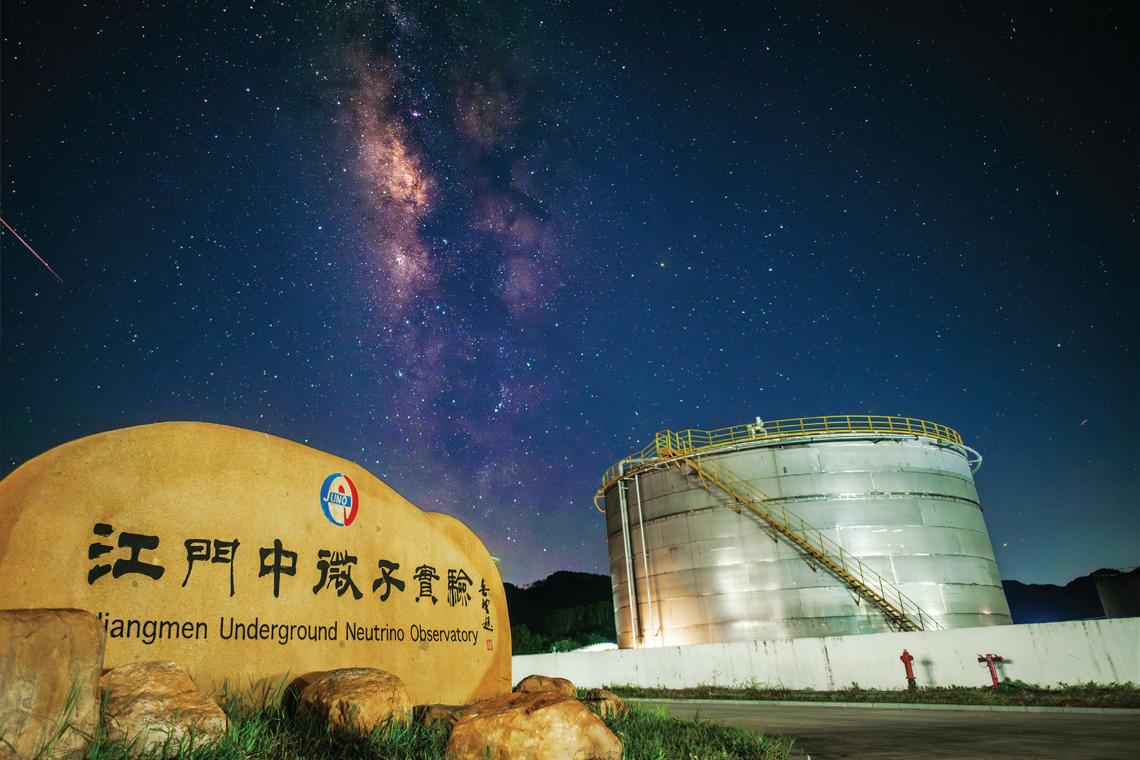
Deep beneath the earth’s surface in Jiangmen, Guangdong province, an international scientific collaboration has achieved a monumental breakthrough in particle physics. The Jiangmen Underground Neutrino Observatory (JUNO), situated 700 meters underground, has released its first research results just two months after commencing operations, marking a significant advancement in humanity’s quest to understand the universe’s fundamental building blocks.
This ambitious project represents one of China’s largest international fundamental science initiatives, uniting over 700 scientists from 75 institutions across 17 countries and regions. The observatory features a massive spherical detector spanning 41 meters in diameter, equipped with 45,000 photomultiplier tubes surrounding 20,000 metric tons of liquid scintillator. Its strategic location 53 kilometers from southern China’s nuclear power plants provides ideal conditions for capturing neutrinos—near-massless particles traveling at near-light speed that hold keys to understanding matter’s origins, stellar evolution, and physics beyond the standard model.
The international collaboration faced extraordinary challenges, including constructing entirely new underground facilities from scratch and navigating pandemic restrictions that forced overseas scientists to work remotely. Despite these obstacles, the project demonstrated remarkable global cooperation, with countries contributing specialized expertise: Italy developed the liquid scintillation system, France provided cosmic muon tracking technology, and China’s Institute of High Energy Physics led detector design.
Marcos Dracos, French physicist and chair of JUNO’s Institutional Board, emphasized the project’s unprecedented scale: ‘Previous experiments were nothing compared to JUNO in terms of collaboration size, detector scale, or research context.’ The initial results have validated the decade-long design and construction period, confirming the detector meets all design expectations and positioning JUNO for advanced neutrino physics research over its planned 30-year operational lifespan.
Beyond scientific achievement, JUNO represents China’s strategic evolution from follower to leader in foundational scientific discovery. The project has enhanced China’s reputation as a global research hub while serving as a training ground for new generations of scientists and engineers. As researchers now focus on measuring neutrino mass ordering within approximately six years, the collaboration stands as a testament to international scientific cooperation’s power in pushing knowledge boundaries, demonstrating that while scientists have national affiliations, fundamental science truly knows no borders.