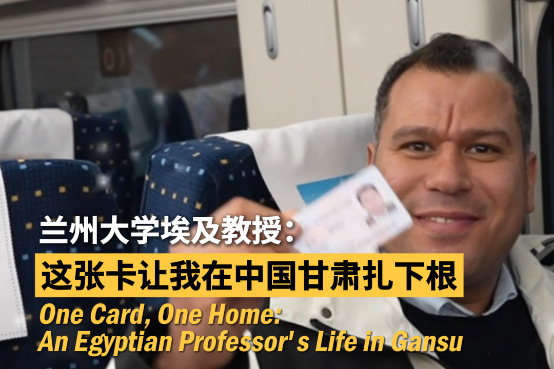
In China’s northwestern Gansu province, Egyptian public health professor El-Sayed Salama has discovered what he describes as “Chinese-style happiness” through a revolutionary document—the newly implemented Five-Star Card. As a long-term faculty member at Lanzhou University’s School of Public Health, Salama recently became among the first foreign nationals to receive China’s upgraded permanent residence identification system.
The professor characterizes the card as far more than administrative documentation—it represents what he calls “a master key that has unlocked a whole new life” in China. This sophisticated identification platform has fundamentally transformed his daily experience, granting him parity with Chinese citizens across numerous service sectors. From streamlined medical appointments and exploration of traditional Chinese medicine to financial transactions and transportation, the Five-Star Card has eliminated previous bureaucratic barriers.
According to the Gansu Provincial Public Security Department, the province has significantly intensified its international talent attraction initiatives throughout 2024. The Five-Star Card system represents a cornerstone of these efforts, with coordinated upgrades across more than 60 service domains including healthcare, education, finance, and transportation infrastructure.
Salama emphasizes how these integrated improvements have effectively bridged the “last mile” in services for foreign professionals residing in Gansu. Previously time-consuming processes like high-speed rail travel arrangements, hotel registrations, and cross-border financial transactions now require mere minutes—a efficiency standard the professor admiringly labels “Chinese speed.
Beyond practical conveniences, the Five-Star Card has facilitated deeper cultural integration for Salama and his family. From mobile payment systems and vibrant night market explorations to museum visits and cultural exchanges with his son, the Egyptian academic now considers Gansu his genuine home. The card has not only provided administrative efficiency but has fostered what Salama describes as a profound “sense of belonging” within Chinese society.