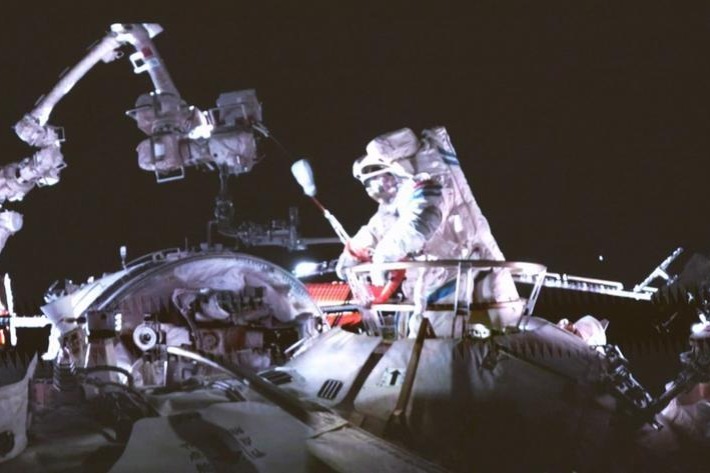
China’s Tiangong space station has solidified its position as a world-class orbital research facility, with the China Manned Space Agency reporting the successful completion of 86 cutting-edge scientific missions throughout 2025. The station, which became fully operational in late 2022, has demonstrated exceptional capabilities in supporting advanced space-based research across multiple disciplines.
According to official data released by the space agency, the station facilitated the transportation of 1,179 kilograms of specialized experimental equipment and research materials to orbit while successfully returning 105 kilograms of valuable scientific samples to Earth for detailed analysis. The research operations generated an unprecedented volume of data, with over 150 terabits of scientific information transmitted to ground-based research facilities.
The year 2025 witnessed several landmark achievements in space science, including China’s pioneering in-orbit experimentation involving rodent mammals—a significant breakthrough in space biology research. Additionally, the station hosted the world’s first demonstration of an autonomous pipe-inspection robotic system under microgravity conditions, showcasing innovative engineering solutions for space infrastructure maintenance.
The scientific output from these orbital experiments has been substantial, resulting in the publication of more than 230 peer-reviewed academic papers in prestigious journals and the filing of over 70 patents for novel technologies and methodologies developed through space station research.
Currently orbiting at approximately 400 kilometers altitude, Tiangong represents humanity’s largest independently operated space habitat with a mass of approximately 100 metric tons. The complex comprises three permanent modules—the Tianhe core module accompanied by the Wentian and Mengtian laboratory modules—and is presently docked with both the Shenzhou XXII crew spacecraft and Tianzhou 9 cargo transport vehicle.
Since becoming operational, Tiangong has hosted 25 astronauts across 10 separate crew rotations, with several veteran spacefarers having completed multiple missions aboard the orbital outpost. By the conclusion of 2025, the station had supported 265 distinct scientific and technological research initiatives spanning life sciences, microgravity physics, and next-generation space technologies.