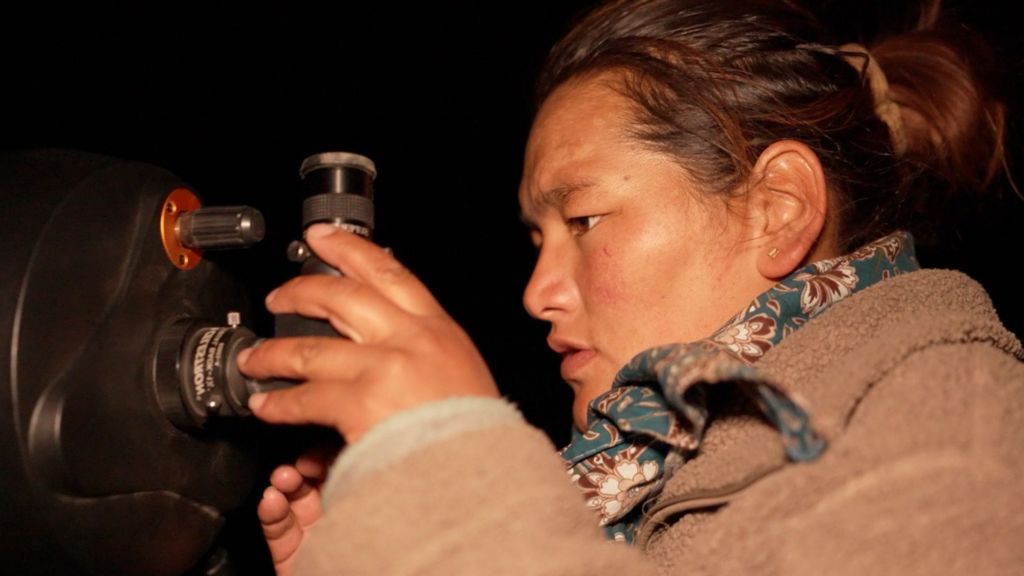
Perched 4,500 meters above sea level in the frigid high Himalayan desert of India’s Ladakh region, the remote village of Hanle settles into deep stillness long before most towns hit the 10 p.m. mark. On cold, windy nights when temperatures plummet well below freezing, locals and visitors alike shrug off thick jackets and woolen layers, and step outside instead of turning in for the night. Above them stretches one of the clearest, darkest night skies on Earth — a natural treasure that has transformed this once-isolated community and opened new doors for four young local women.
Hanle’s unique geography made it a standout for astronomical research long before it became a tourism hotspot. Its high altitude, dry atmosphere, extreme remoteness, and near-total lack of light pollution create ideal stargazing conditions for roughly 260 nights each year. It is already home to the Indian Astronomical Observatory (IAO), one of the highest operating astronomical research facilities in the world, run by the Indian Institute of Astrophysics. In 2022, the village earned a new distinction: it became India’s first official Dark Sky Reserve, a designation created to protect its pristine night skies from artificial light encroachment and cement its reputation as a world-class stargazing destination.
The designation triggered an explosive boom in astronomy tourism. Government data shows annual visitor numbers have jumped tenfold in just five years, rising from roughly 3,000 visitors five years ago to nearly 30,000 in the 2024-25 travel season. This surge brought not just more foot traffic, but new economic opportunities for local residents — including four women in their late 20s, who have become Hanle’s first official astro-ambassadors.
In 2022, the Ladakh regional administration partnered with the IAO to host a 15-day intensive training program for 24 young people from Hanle and surrounding villages, teaching participants how to identify celestial bodies, navigate the night sky, operate professional-grade telescopes, and capture stunning photos of the Milky Way on mobile devices. Palzes Angmo, Tsering Dolker, Tsering Yangdol, and Padma Chamchot were among the program’s first trainees, a role that none of them had ever imagined for themselves growing up.
“Growing up here, the sky was always twinkling like this — it was just an ordinary part of life,” Dolker explains. Like most local women, the four spent their days managing household chores and supporting their family-run homestays, the backbone of Hanle’s small tourism sector, where most visitors stay since the village has no large hotels or resorts. When they first handled professional astronomy equipment, they were nervous they would damage the expensive gear. Over the past four years, though, they have grown into skilled, confident guides.
Each night, their work begins around 9 p.m. After finishing dinner and household tasks, they set up telescopes, calibrate the instruments to target the Moon, planets, and prominent constellations visible that night, and meet groups of visitors eager to see the sky. Using laser pointers, they trace out constellations for the naked eye, point out the Moon’s craggy craters, Saturn’s iconic rings, and Vega, the brightest star in the Northern Hemisphere’s night sky. At 11 p.m. sharp, the entire village switches off all non-essential lights, plunging Hanle into total darkness to reveal the full, brilliant glow of the Milky Way for visitors, who often scramble to capture the perfect photo. The astro-ambassadors even help visitors adjust their phone camera settings to get the best shot, a service that almost always leads to a long queue of people waiting for their turn.
By day, their routine returns to the familiar: cooking meals for homestay guests, cleaning rooms, and managing household work. While their families’ homestays remain the primary household income, the women earn roughly 25,000 rupees ($260) per month from their stargazing sessions, charging 200 rupees per guest. The income dips during the harsh, frigid winter when almost no tourists visit, but it has already given them a level of financial independence they did not have before. “We can save our own money and spend it on what we want, even new phones,” Chamchot says. Beyond the financial gains, the role has transformed their confidence: before, they say, they never would have imagined themselves guiding groups of visitors from across the country and around the world.
For all the benefits the tourism boom has brought to Hanle, it also carries growing risks that threaten the very resource that draws visitors. As visitor numbers surge, driven in part by viral social media posts and Hanle’s location on the popular route to Umling La, one of the world’s highest motorable mountain passes, the village is seeing more construction, more vehicle traffic, and more artificial light — all of which erode the dark skies that make Hanle unique. Longtime residents like Dhuntup Chamchot, Padma’s 70-year-old father, say the sky is already dimmer than it was when he was young, when clear nights were so dark villagers would often sleep outdoors under the open sky.
Sonam Jorphail, senior engineer and head of outreach at the IAO, notes that tourism has brought much-needed jobs and development to Hanle, but careful growth management is critical to protect the dark sky reserve. He adds that the local astro-ambassadors fill a unique and important role, bridging the gap between professional astronomers and the general public, both visitors and locals.
For the four women themselves, the stars have become the foundation of the future they want to build right here in Hanle. They have even started introducing their own families to stargazing through the telescope, and now their relatives ask where the telescopes are if the women take a single day off. They have no interest in leaving the village they grew up in; instead, they hope to get advanced astronomy training and access to better equipment to improve the experience for future visitors. Four years ago, a telescope was an unfamiliar, intimidating tool. Today, it is the key to the independent, meaningful life they have built under the stars.