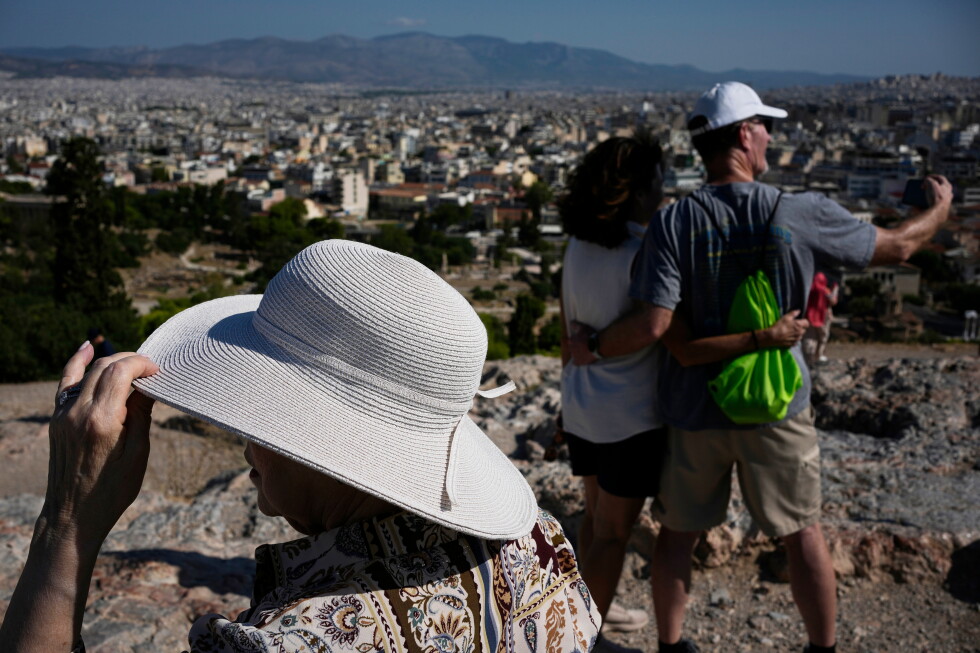
Amid relentless summer heat and a historic surge in international tourism, sun protection has become a top priority for visitors exploring Greece’s iconic cultural sites, turning everyday headwear into one of the country’s most in-demand tourist commodities this season.
On the sloped paths leading up to Athens’ ancient Acropolis, a moving sea of hats — ranging from casual straw boaters and classic Panama styles to sporty baseball caps and trendy bucket hats — bobs up and down the hill as tourists seek any possible shield from the unforgiving midday sun. This summer, towering displays of piled-high hats have become impossible to miss across central Athens. Kiosks, souvenir shops and local boutiques have stacked outdoor stands full of options, catering to the flood of travelers looking for relief from temperatures that consistently hover in the mid-30s Celsius (mid-90s Fahrenheit), with very little natural shade available across the open ancient site.
Greek tourism hit unprecedented milestones in recent years. The Acropolis alone drew a record 4.6 million visitors in 2024, while the country as a whole welcomed a total of 38 million visitors that same year — the highest annual number on record. Even scorching heat has done little to deter tourists from flocking to the country’s most famous landmarks, though the combination of extreme temperatures and overwhelming visitor demand means many guests have no choice but to explore during the hottest midday hours, when UV radiation is at its peak. This mismatch has added new urgency to efforts to promote public sun safety among travelers.
Even local animals have gotten in on the trend: a carriage horse giving rides at the foot of the Acropolis now sports a custom brown bucket hat, with holes cut specially to fit its ears. Australian tourist Jack Yosif, who purchased a black baseball cap shortly after arriving in Athens, summed up the shifting mindset among visitors. “You need a hat. I’m already red as it is,” Yosif explained. “It’s a bit more of a common thing nowadays, and people are a bit more aware.”
Public health and safety advocates across Greece have welcomed this growing public awareness of the risks of extended ultraviolet exposure and heat stroke, both life-threatening conditions that can arise quickly during summer heat waves. Red Cross volunteers stationed at the Acropolis now distribute free emergency kits to passing tourists, stocked with sunscreen, bottled water, sun safety information leaflets and complimentary red baseball caps for visitors who do not have headwear.
Local vendors have reported a steady, ongoing rise in hat sales over the past several years, a trend that has accelerated amid more frequent extreme heat events and shifting tourist behavior. Konstantinos Mallios, a kiosk owner on central Athens’ busy Syntagma Square, says the business has boomed. His inventory ranges from budget basic hats priced at 6 euros ($24) to higher-end stylish and souvenir-focused options that sell for up to 20 euros. For budget-conscious travelers, many low-cost retailers also sell affordable semi-disposable paper pulp hats that cost just a few euros.
For travelers seeking handcrafted, high-quality options, local artisanal hatmakers have also seen a sharp jump in demand. In her basement workshop in central Athens, third-generation hatmaker Lisa Sarigiannidou — who learned the craft from her hatmaker father — crafts custom straw boaters using century-old hand presses and traditional molds, turning out finished hats in minutes. Her entry-level designs start at around 50 euros, with elaborate custom pieces costing more than 100 euros.
Sarigiannidou has observed a dramatic shift in public attitudes toward hat-wearing among both tourists and Greeks over the past decade. “In the past, when a young woman tried on a hat and looked at herself in the mirror, she usually laughed,” she said. “Now they try them on seriously … and they wear them straight out the door.”