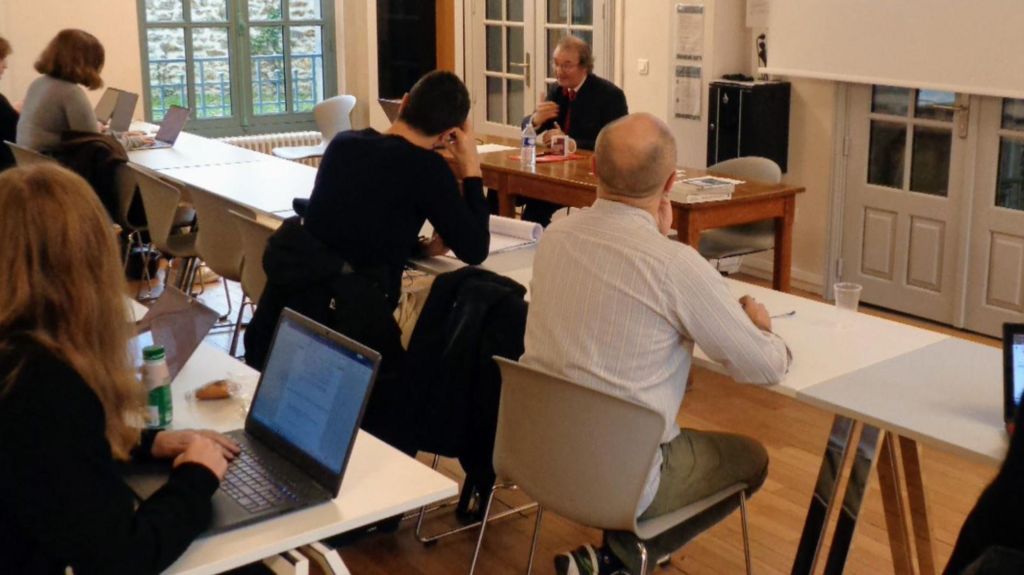
At the Sciences Po Saint-Germain campus on the outskirts of Paris, an unconventional academic program operates behind intimidating metal gates and dour 20th-century buildings. Here, Professor Xavier Crettiez conducts classes where many students use pseudonyms—because they are active French intelligence agents undergoing training alongside traditional university students.
The unique Diploma of Intelligence and Global Threats (Diplôme sur le Renseignement et les Menaces Globales) represents a collaborative effort between the prestigious university and France’s intelligence training arm, Académie du Renseignement. Established a decade ago following a government request that gained urgency after the 2015 Paris terrorist attacks, the program serves dual purposes: training potential new spies while providing continuous professional development for current agents.
The four-month intensive course comprises 120 hours of instruction covering critical topics including organized crime economics, Islamic jihadism, business intelligence gathering, and political violence. With tuition set at approximately €5,000 for external participants, the program attracts both government agents typically aged 35-50 and conventional students in their early 20s.
Professor Crettiez notes the significant expansion of French intelligence services, now numbering approximately 20,000 agents across major agencies including the DGSE (overseas intelligence, equivalent to MI6/CIA) and DGSI (domestic security, equivalent to MI5/FBI). Beyond counterterrorism, the curriculum addresses growing concerns about financial crimes, with Tracfin—France’s money laundering intelligence agency—playing an increasingly important role against surging mafia activity in southern France.
The program’s practical relevance has attracted substantial corporate interest. Major French companies including mobile operator Orange, defense giant Thales, and luxury conglomerate LVMH actively recruit graduates to combat escalating cybersecurity threats, corporate espionage, and sabotage attempts. Even energy titan EDF contributes instructional expertise.
Current enrollment stands at 28 students, including six intelligence professionals who maintain noticeable discretion during breaks. These agents describe the program as a potential fast-track to promotion from office work to field operations. Meanwhile, younger students like 21-year-old Alexandre Hubert seek understanding of economic tensions between Europe and China, while Valentine Guillot draws inspiration from French spy television dramas.
Notably, nearly half the students are women—a significant shift according to technology-in-espionage specialist Sebastien-Yves Laurent. “Women’s interest in intelligence gathering is new,” he observes, noting their motivation to “provide for a better world” and a renewed patriotism among young applicants.
Despite this openness, security remains paramount. French citizenship is essentially required (though some dual citizens are accepted), and applications from suspiciously qualified Russian or Israeli candidates are immediately rejected. The program’s discreet nature was evident in a recent class photo where several students—presumably active agents—chose to stand with their backs to the camera.
Professor Crettiez emphasizes that despite the athletic appearance of many participants, most intelligence careers remain desk-bound, contradicting popular James Bond fantasies. The reality of modern espionage involves meticulous risk analysis rather than cinematic adventure, preparing graduates for the complex security challenges of the contemporary world.