标签: Oceania

大洋洲

  • Russell wins first race of new F1 era in Australia

    Russell wins first race of new F1 era in Australia

    In a spectacular season-opening performance at Melbourne’s Albert Park, Mercedes driver George Russell claimed a commanding victory at the Australian Grand Prix, signaling a potential power shift in Formula 1’s new regulatory era. The British driver overcame an initial battery concern and engaged in a thrilling early battle with Ferrari’s Charles Leclerc before strategic mastery propelled him to a comfortable win.

    The race commenced with intense wheel-to-wheel action as Russell and Leclerc exchanged leads multiple times during the opening laps, utilizing Formula 1’s newly implemented energy boost systems. The critical turning point emerged when a virtual safety car period prompted divergent strategies—Mercedes opted for immediate pit stops while Ferrari maintained track position. This decision proved decisive as Leclerc eventually emerged from his pit stop fourteen seconds behind the Mercedes duo.

    Russell’s triumph marked Mercedes’ first Australian victory since 2019, with rookie teammate Kimi Antonelli securing an impressive second-place finish in his debut race for the team. Leclerc settled for third position ahead of Ferrari counterpart Lewis Hamilton, who mounted a late challenge on his teammate but ultimately couldn’t improve his standing.

    The race witnessed several notable performances beyond the podium finishers. McLaren’s Lando Norris defended vigorously against Red Bull’s Max Verstappen, who staged a remarkable recovery from twentieth on the grid to claim sixth position. The event also featured a sensational Formula 1 debut for 18-year-old British driver Arvid Lindblad, who scored championship points with an eighth-place finish for Racing Bulls.

    Technical and strategic discussions dominated post-race analysis, particularly regarding Ferrari’s controversial decision to avoid pitting during the virtual safety car period. The new regulatory framework—emphasizing hybrid power deployment and electronic overtaking systems—generated mixed reactions from drivers and teams, with some questioning whether the increased focus on energy management has diminished traditional racing elements.

    The complete results demonstrated Mercedes’ dominance, with five British drivers finishing within the top eight positions. The Formula 1 circus now prepares for the Chinese Grand Prix in Shanghai, where the season’s first sprint race format will provide additional competitive excitement.

  • Iran says can fight for months as Israel strikes Beirut hotel

    Iran says can fight for months as Israel strikes Beirut hotel

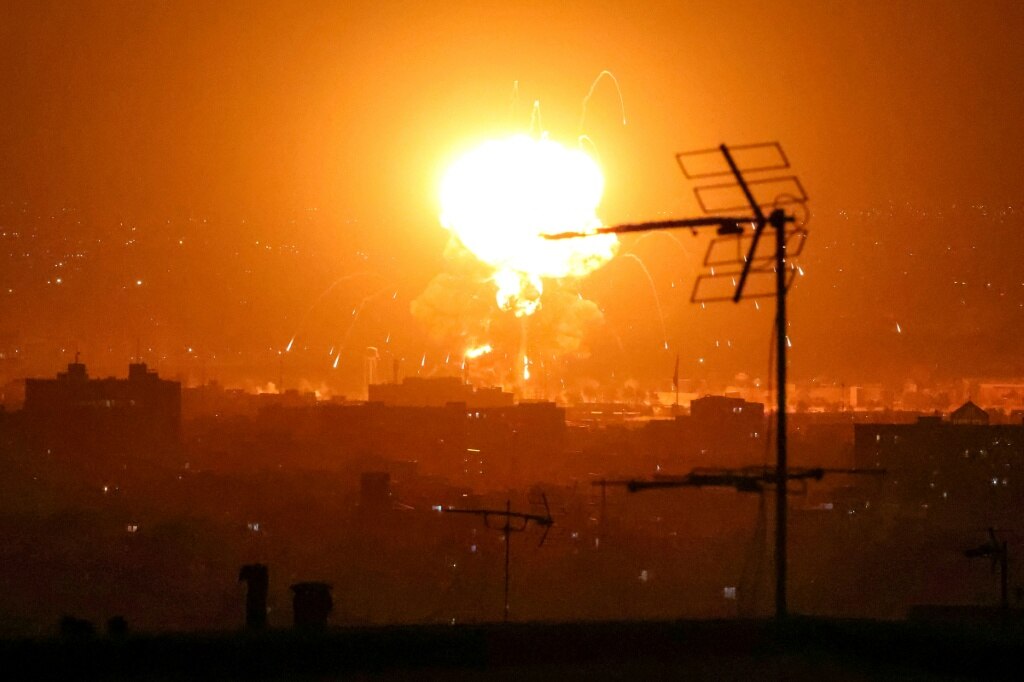
    The Middle East conflict entered a dangerous new phase as Israeli forces targeted a hotel in central Beirut, killing at least four people, while Iran’s Revolutionary Guards declared their capacity to wage intense warfare against the United States and Israel for six months. The strike on Beirut’s Ramada hotel in the tourist-frequented Rawche area left visible damage with shattered windows and charred walls, according to AFP correspondents on scene.

    The regional escalation continues to broaden with Saudi Arabia reporting interception of multiple drones targeting Riyadh’s diplomatic quarter, while Kuwait confirmed attacks on aviation fuel storage at its international airport. These developments have triggered significant energy security concerns, particularly regarding the Strait of Hormuz transit corridor where Kuwait’s national oil company announced production cuts due to security threats.

    Tehran has accused the US and Israel of striking oil infrastructure within the Iranian capital, marking the first reported attack on Iran’s oil facilities since the conflict began. Israel’s military acknowledged targeting “fuel storage facilities in Tehran” that allegedly supported military operations.

    Israeli Prime Minister Benjamin Netanyahu has pledged to continue military operations “with all our force” following joint US-Israeli raids that killed Supreme Leader Ayatollah Ali Khamenei last week. Despite this, Revolutionary Guards spokesman Ali Mohammad Naini asserted Iran’s preparedness for prolonged conflict, indicating the deployment of “advanced and less-used long-range missiles” in coming days.

    The human cost continues to mount with Iran’s health ministry reporting approximately 926 civilian deaths and 6,000 wounded, though these figures remain unverified independently. Lebanon reports at least 294 fatalities from Israeli airstrikes over the past week, with Prime Minister Nawaf Salam warning of an impending “humanitarian disaster.”

    International responses remain divided with China’s top diplomat Wang Yi stating the conflict “should never have happened” and criticizing what he characterized as “law of the jungle” mentality. Meanwhile, the United States under President Donald Trump has suggested potential troop deployment to secure Iran’s enriched uranium stockpiles, though neither US nor Israeli authorities have claimed responsibility for several attacks including a deadly strike on an elementary school in Minab.

    Analysts indicate no clear resolution path exists for a conflict that officials suggest could persist for months, with regional stability and global energy markets hanging in the balance.

  • Sony faces $2.7 bn class action from UK PlayStation users

    Sony faces $2.7 bn class action from UK PlayStation users

    Japanese entertainment conglomerate Sony Group Corporation confronts a monumental legal challenge as a £2 billion ($2.7 billion) collective action lawsuit commences proceedings at London’s Competition Appeal Tribunal. The case alleges systematic anticompetitive behavior through Sony’s digital marketplace operations spanning nearly a decade.

    The litigation, spearheaded by consumer rights advocate Alex Neill, represents an estimated 12.2 million United Kingdom PlayStation users who purchased digital content between February 2016 and February 2026. The core allegation centers on Sony’s purported exploitation of its market dominance to impose inflated pricing structures on digital games and supplementary content.

    Central to the claimants’ argument is Sony’s alleged maintenance of a near-monopolistic position regarding digital game distribution for PlayStation consoles. This market control supposedly enabled the corporation to mandate a standardized 30% commission fee from game developers and publishers—a rate substantially exceeding the 12-20% commissions prevalent on competitive PC gaming platforms.

    The lawsuit further contends that contemporary game design intentionally encourages excessive spending patterns, particularly concerning vulnerable demographics including minors. These monetization strategies allegedly pressure players to purchase additional content for progression, feature unlocking, or character customization.

    Sony’s defense maintains the legitimacy of its distribution model, though company representatives declined immediate commentary regarding the ongoing proceedings. The trial is projected to extend across ten weeks, with potential implications for digital marketplace regulations globally.

    This legal action follows similar antitrust proceedings against technology behemoths, including Apple’s recent litigation concerning App Store commission structures. Under UK collective action regulations, all potentially affected consumers are automatically included in the claimant group unless they formally opt out, potentially enabling widespread compensation distribution should the case succeed.

  • Philippines’ ‘Cockroach Lord’ goes to bat for misunderstood bugs

    Philippines’ ‘Cockroach Lord’ goes to bat for misunderstood bugs

    In the dense blackness of a Philippine rainforest, a narrow beam of light from Cristian Lucanas’s headlamp cuts through the darkness. The 31-year-old entomologist from the University of the Philippines Los Baños carefully excavates the underbrush before gently retrieving a cockroach with his bare hands. Known among colleagues as the ‘Ipis Lord’ (Cockroach Lord), Lucanas stands as the nation’s sole specialist in these frequently maligned insects, having personally identified 15 previously unknown species.

    Despite widespread public perception of cockroaches as disease-ridden pests, Lucanas advocates for greater scientific appreciation of their crucial ecological functions. ‘I also hated cockroaches when I was a child,’ he admitted during an interview in Los Baños, south of Manila. ‘Fear of cockroaches is innate,’ he conceded, often telling strangers he simply ‘works in a museum’ to avoid uncomfortable reactions.

    The biodiversity-rich Philippines hosts approximately 130 documented cockroach species, with three-quarters existing nowhere else on Earth. Lucanas estimates another 200 local varieties await scientific documentation. ‘For the longest time, no one was studying them,’ he noted, expressing disappointment given the archipelago’s significant cockroach population diversity.

    As detritivores, cockroaches perform essential ecosystem services by consuming and breaking down dead organic matter—including their own kind—and returning nutrients to the soil. While certain species do carry disease-spreading microbes, Lucanas emphasizes that their disappearance would disrupt decomposition processes critical for sustaining healthy ecosystems. Birds and spiders would lose a primary food source, and plants would absorb less carbon dioxide, potentially exacerbating global warming.

    Lucanas’s unusual passion ignited twelve years ago during a biology field trip to a bat cave on a remote island, where he observed cockroaches thriving on guano. When his professor couldn’t identify the species, the young scientist discovered his professional calling. An avid J.R.R. Tolkien enthusiast, Lucanas frequently names his discoveries after creatures from ‘The Lord of the Rings,’ including ‘Valar,’ ‘Hobbitoblatta,’ and ‘Nazgul.’

    His expertise occasionally attracts unconventional requests—the country’s largest insecticide manufacturer once invited him to lecture on cockroach identification, while a major restaurant chain sought advice against invasive German cockroaches raiding their commissary. ‘Control is not really my forte,’ Lucanas acknowledged.

    The entomologist debunks popular myths about cockroach resilience, noting their radiation resistance parallels other insects and contradicts post-apocalyptic survival narratives. He identifies human activity, particularly habitat encroachment, as the most immediate threat. Several cave-dwelling species first documented during the Spanish colonial period in the 1890s haven’t been observed since their habitats became tourist destinations.

    Lucanas laments that scientific funding in the Philippines predominantly supports research with direct human applications, potentially limiting his work to cataloging and explaining native cockroach species. Nevertheless, he remains committed to his unusual vocation: ‘I think I’ll stick with what I’m doing. It’s how I’ve built my reputation. And I really do enjoy working with cockroaches.’

  • Explosion at US embassy in Oslo, no injuries

    Explosion at US embassy in Oslo, no injuries

    Norwegian authorities are conducting an intensive investigation following an explosive incident at the United States Embassy in Oslo during the early hours of Sunday. According to Oslo police statements, the detonation occurred approximately at 1:00 AM local time (0000 GMT), resulting in minor structural damage to one of the embassy’s entrance points but no casualties.

    Police Commander Michael Dellemyr characterized the event as a deliberate act during his televised remarks, stating investigators have developed preliminary theories regarding the explosion’s origin. While refraining from specifying explosive types or damage particulars due to the ongoing investigation, Dellemyr confirmed authorities are pursuing one or multiple suspects through coordinated efforts involving canine units, aerial drones, and helicopter surveillance.

    Multiple witnesses reported auditory and physical manifestations of the blast. Edvard, a sixteen-year-old resident, described subsequent police mobilization with automatic weapons and specialized equipment. Another account from Kristian Wendelborg Einung detailed three distinct concussions that produced ground vibrations and substantial smoke coverage resembling dense fog around the diplomatic compound.

    Despite heightened security alerts at US diplomatic installations globally, particularly throughout Middle Eastern regions following military engagements with Iran, Norwegian officials explicitly stated no current evidence connects the Oslo incident to international conflicts. Police established perimeter security within hours, declaring the surrounding area safe for public transit while soliciting civilian reports of unusual observations between midnight and 2:00 AM local time.

  • Why have 1,000 ships at times lost their GPS in the Mideast?

    Why have 1,000 ships at times lost their GPS in the Mideast?

    A significant electronic navigation crisis has emerged across Middle Eastern waters as approximately 1,000 commercial vessels experience persistent GPS disruptions amid escalating regional conflicts. Maritime experts reveal that these disruptions, affecting nearly half of all ships in the Gulf and Gulf of Oman, stem from outdated navigation technology that cannot withstand sophisticated signal jamming techniques deployed in current military operations.

    According to Dimitris Ampatzidis, senior risk analyst at energy market intelligence firm Kpler, the affected vessels primarily cluster near the United Arab Emirates and Oman. The technological vulnerability exists because most commercial ships rely exclusively on the L1 C/A GPS signal—a civilian navigation standard dating back to the 1990s. This antiquated system lacks the redundancy and sophistication of modern multi-frequency receivers found in contemporary smartphones.

    University of Texas engineering professor Todd Humphreys explains the critical technological gap: ‘Modern smartphones utilize four satellite constellations—American GPS, European Galileo, Russian GLONASS, and Chinese BeiDou—across multiple frequency bands. Merchant vessels typically monitor only the original GPS band, leaving them completely disabled when jamming occurs.’

    The situation proves even more dire for aviation due to stringent regulatory constraints. Humphreys notes that aircraft navigation systems remain ’15 years out of date’ regarding signal reception capabilities.

    Electronic warfare tactics employed in the region include both jamming and spoofing techniques. Katherine Dunn, author of an upcoming GPS history titled ‘Little Blue Dot,’ describes jamming as relatively simple—requiring only a transmitter broadcasting ‘louder’ on the same frequency to create ‘a wall of mush.’ Spoofing presents greater sophistication and danger by manipulating ships’ Automatic Identification Systems (AIS) to broadcast false locations, sometimes showing vessels apparently positioned on land.

    The consequences extend beyond mere positioning. GPS signals now essential for onboard clocks, radar synchronization, and speed measurement systems. A veteran merchant marine captain, speaking anonymously, confirmed that crews must revert to 20th-century navigation methods using radar and visual landmarks when electronic systems fail.

    Gulf states currently engage in defensive jamming to protect against satellite-guided drones, accepting collateral damage to civilian navigation systems. This electronic countermeasure strategy mirrors Israel’s year-long GPS disruption in 2024 and Iran’s during its conflict with Israel.

    While startups develop alternative navigation technologies using Earth’s magnetic field or inertial systems, the maritime industry remains years away from implementing reliable GPS-independent solutions for large-scale commercial navigation.

  • ‘One Battle After Another’ location manager explains THAT car chase

    ‘One Battle After Another’ location manager explains THAT car chase

    While conventional Hollywood car chases typically feature urban environments with screeching tires and vehicular collisions, Paul Thomas Anderson’s Oscar-nominated masterpiece “One Battle After Another” pursued an entirely different vision. Location manager Michael Glaser revealed to AFP how the film’s climactic desert pursuit emerged from an unconventional setting: Southern California’s undulating Highway 78, poetically dubbed the “River of Hills.”

    This serpentine asphalt ribbon with its blind peaks and hidden troughs created a uniquely visceral chase sequence that stands apart in cinematic history. Anderson’s signature low-angle cinematography places audiences directly inside the roaring vehicles—a Ford Mustang, Dodge Charger, and modified purple Nissan Sentra—creating an immersive, palm-sweating experience.

    The location itself functions as a metaphorical landscape reflecting the psychological struggle of protagonist Bob Ferguson (Leonardo DiCaprio), a faded revolutionary forced back into action when his daughter (Chase Infiniti) disappears. As Ferguson battles through decades of drug-induced haze to recall passwords and safe houses, he must outmaneuver the deranged Colonel Lockjaw (Sean Penn), hired by wealthy right-wing extremists.

    Glaser, who guided AFP through the actual filming locations in Imperial County, described the road as embodying the characters’ dynamic: “It’s the characters pulling and pushing each other through something.” The production utilized multiple desert locations including Borrego Springs’ “The Texas Dip” among approximately 200 sites Glaser proposed.

    Editor Andy Jurgensen detailed the meticulous filming process: “We shot over multiple days, capturing all necessary angles from front and rear perspectives while maintaining spatial consistency before assembling the final sequence.”

    Glaser, whose role begins early in pre-production and continues through filming completion, emphasized how locations serve as “subconscious characters” that establish mood, visual palette, and emotional context. The film’s geographical journey mirrors its narrative arc—transitioning from Eureka’s lush greenery through central California’s winery country to the desert’s stark bleakness where the story culminates.

    The location scouting process evolved organically, with Glaser comparing it to tree growth: “Some branches would die off, and others would sprout up.” The desert’s isolation particularly shaped the film’s third act, creating an environment where characters exist beyond societal constraints or assistance.

    As “One Battle After Another” enters the Academy Awards with 13 nominations, Glaser reflects that while location managers don’t fit traditional award categories, their contribution remains fundamental: “Everyone’s DNA is in the film. We’re not directing it. We’re not in front of the camera. But there’s a little piece of us.”

  • US court voids mass layoffs at Voice of America parent

    US court voids mass layoffs at Voice of America parent

    A federal court has delivered a significant blow to the Trump administration’s efforts to restructure U.S. government-funded media outlets, declaring that mass layoffs at Voice of America and related organizations were implemented by an unlawfully appointed official.

    U.S. District Judge Royce Lamberth issued a ruling on Saturday that determined Kari Lake, a former television anchor selected by former President Donald Trump to lead the U.S. Agency for Global Media (USAGM), had been appointed in violation of constitutional and statutory requirements. The decision effectively nullifies all personnel actions taken during her tenure, including the planned dismissal of over 500 employees.

    Lake was hired as part of the Trump administration’s broader initiative to exert greater control over what it perceived as hostile journalism within government-funded media entities. Shortly after her appointment, she announced substantial funding reductions and workforce cuts targeting Voice of America—an organization established during World War II as a crucial instrument of American soft power and democratic messaging worldwide.

    The legal challenge emerged when affected employees filed suit against Lake, resulting in a temporary suspension of the layoffs last September pending judicial review. Judge Lamberth’s ruling concluded that Lake’s appointment violated both the Appointments Clause of the U.S. Constitution and the Federal Vacancies Reform Act, rendering her authority during the period from July 31 to November 19, 2025, fundamentally illegitimate.

    Consequently, all actions taken under her purported leadership, including the August reduction-in-force initiatives, have been declared void. The USAGM operates as an independent federal agency responsible for promoting democratic values and countering propaganda internationally through outlets including Voice of America, Radio Free Europe, Radio Free Asia, and the Office of Cuba Broadcasting.

    The Trump administration frequently criticized media organizations and specifically denounced VOA’s editorial firewall, which protects journalistic independence by preventing government interference in content. Lake, who previously ran unsuccessfully as a Republican candidate for U.S. Senate from Arizona in 2024, has not yet publicly commented on the court’s decision.

  • Alcaraz cruises into Indian Wells third round as Djokovic fights through

    Alcaraz cruises into Indian Wells third round as Djokovic fights through

    The BNP Paribas Open at Indian Wells witnessed dramatically different paths to victory for the ATP Tour’s top stars on Saturday. World No. 1 Carlos Alcaraz delivered a commanding performance against Bulgaria’s Grigor Dimitrov, securing a 6-2, 6-4 win in just 66 minutes. The Spanish phenom displayed exceptional baseline power and tactical precision despite challenging wind conditions, maintaining his flawless 2026 record of 13 consecutive match wins.

    Meanwhile, five-time champion Novak Djokovic faced substantial resistance from Polish competitor Kamil Majchrzak before claiming a hard-fought 4-6, 6-1, 6-2 comeback victory. The Serbian legend, playing his first match since his Australian Open final defeat to Alcaraz, required two hours and twelve minutes to overcome the 57th-ranked Majchrzak in a contest featuring extended rallies, including a remarkable 40-shot exchange.

    Alcaraz expressed particular satisfaction with his performance, noting: ‘I love being here so much, I think that’s why I’m just playing relaxed, playing calm, chilling.’ The reigning Australian Open champion, who recently added the Qatar Open title to his collection, appears poised to challenge for a third Indian Wells crown.

    Djokovic acknowledged the quality of his opponent’s play: ‘Kamil is a very solid player. He doesn’t have tremendous power, but he has every shot in the book and he was not afraid to come in and take the ball early.’ The victory held special significance for Djokovic, who had suffered early exits in his previous two appearances at the tournament.

    In other action, defending champion Jack Draper launched his title defense with a comeback victory over Spain’s Roberto Bautista Agut (3-6, 6-3, 6-2). The British player, who ended Alcaraz’s campaign in last year’s semifinals, returned to competition after an arm injury cut short his 2025 season. Brazilian Joao Fonseca produced the day’s biggest upset, saving two match points to eliminate 16th-seeded Karen Khachanov 4-6, 7-6(7/9), 6-4.

  • Kuwait airport, Saudi Arabia targeted as Iran presses Gulf attacks

    Kuwait airport, Saudi Arabia targeted as Iran presses Gulf attacks

    Gulf nations endured a severe escalation in aerial attacks on Sunday as Iran intensified its military campaign across the region, targeting critical infrastructure including Kuwait International Airport and energy facilities despite earlier diplomatic assurances.

    Kuwait’s military confirmed direct strikes on airport fuel tanks, describing the assault as ‘a direct targeting of vital infrastructure.’ The national oil company implemented precautionary production cuts following what authorities identified as ‘a wave of hostile drones’ penetrating sovereign airspace. Official statements noted civilian facilities sustained material damage from falling interception debris.

    Qatar’s Defense Ministry disclosed that Iranian forces launched 10 ballistic missiles and two cruise missiles toward the nation on Saturday, with most projectiles successfully intercepted without casualties. Saudi Arabia reported neutralizing 15 drones entering kingdom airspace, including attempted attacks targeting Riyadh’s diplomatic quarter.

    The offensive continued despite Iranian President Ebrahim Raisi’s prior apology to Gulf states for earlier strikes and assurances against further attacks unless provoked. Within hours, Iran’s judiciary chief contradicted this position, vowing continued strikes on locations ‘at the disposal of the enemy.’

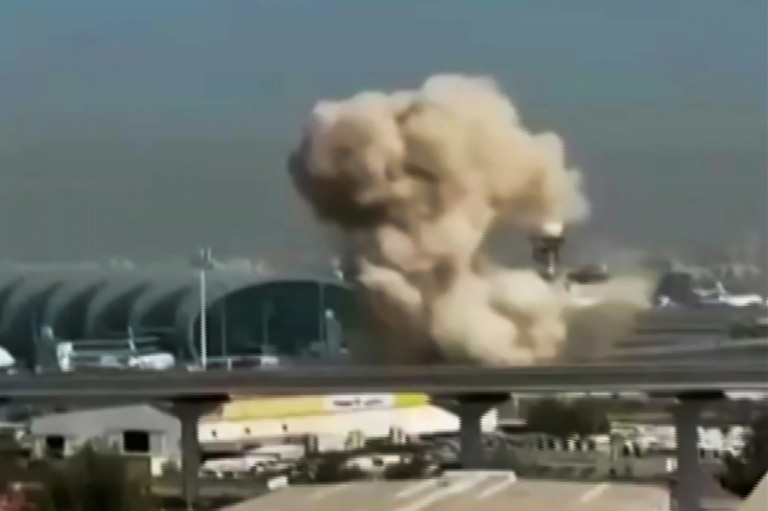
    Dubai International Airport, the world’s busiest international travel hub, temporarily suspended operations after intercepting unidentified objects nearby. Verified footage captured drone sounds followed by explosions and smoke plumes near airport concourses. Emirates airline initially halted all Dubai operations before resuming services.

    United Arab Emirates President Mohammed bin Zayed Al Nahyan delivered a rare televised address declaring the nation in ‘a period of war’ but vowed emergence strengthened from the conflict. The UAE defense ministry reported detecting 221 ballistic missiles and over 1,300 drones since hostilities began on February 28.

    Regional damage assessment revealed Iranian strikes hit Abu Dhabi airport, Palm Jumeirah development, and Burj Al Arab hotel during the past week, with drone debris igniting fires at the US consulate in Dubai. Bahrain reported intercepting 92 missiles and 151 drones since the conflict’s inception, with one civilian injured by falling shrapnel in Manama.

    Saudi defenses destroyed three ballistic missiles targeting Prince Sultan Air Base—host to American troops—and neutralized 17 drones over the southeastern Shaybah oil field, underscoring the broadening scope of Tehran’s offensive operations.