标签: North America

北美洲

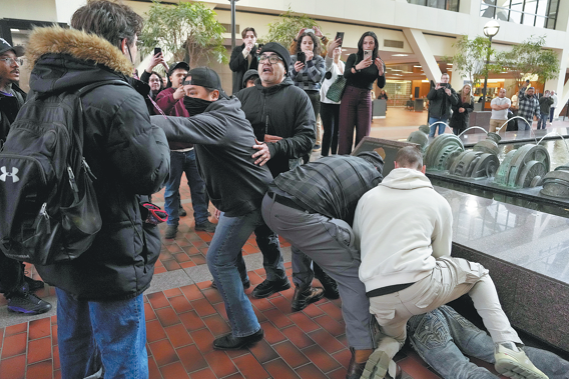
  • Protest in front of the White House over US military action in Venezuela

    Protest in front of the White House over US military action in Venezuela

    Washington, D.C. witnessed significant public dissent as demonstrators assembled outside the White House to voice strong opposition to American military operations in Venezuela. This civic mobilization follows President Donald Trump’s declaration regarding the apprehension of Venezuelan leader Nicolás Maduro.

    The protest represents a growing domestic criticism against the United States’ foreign military strategy, highlighting deepening concerns about international intervention practices. The gathering occurred amidst parallel demonstrations across various global locations, including Caracas, Mexico City, and Colombia, where citizens expressed solidarity with Venezuela and condemnation of U.S. actions.

    Meanwhile, Moscow has officially denied allegations that Venezuelan Vice President Delcy Rodríguez has sought refuge within Russian borders, adding another layer of complexity to the international diplomatic landscape. The simultaneous protests across multiple nations indicate coordinated resistance to American foreign policy decisions and growing international apprehension regarding military interventions in sovereign states.

    The developing situation underscores escalating tensions between the U.S. and several South American nations, potentially signaling a broader geopolitical realignment in the Western Hemisphere as countries position themselves regarding the Venezuela crisis.

  • Nicolas Maduro put in New York jail; Venezuela’s VP demands his release

    Nicolas Maduro put in New York jail; Venezuela’s VP demands his release

    In an unprecedented military operation, Venezuelan President Nicolás Maduro has been apprehended by U.S. forces and transported to New York City to face federal charges. The dramatic capture occurred following early Saturday airstrikes on Caracas that targeted key military installations, marking a significant escalation in Washington’s efforts to dismantle Maduro’s administration.

    White House-released footage depicts the 63-year-old leftist leader handcuffed and wearing sandals while being escorted through a Manhattan DEA facility. Maduro, who has governed Venezuela for over a decade amid widespread allegations of electoral manipulation, was heard offering a subdued greeting in English: ‘Good night, happy new year.’

    The operation involved approximately 150 aircraft providing support for commandos who extracted Maduro and his wife based on extensive intelligence regarding his personal routines. General Dan Caine confirmed the capture occurred without resistance and with no American casualties, though President Trump subsequently indicated ‘many’ Cuban security personnel had been killed during the intervention.

    Venezuela’s political future remains uncertain as Vice President Delcy Rodriguez assumed acting presidential powers following a Supreme Court directive. Rodriguez has vehemently demanded Maduro’s immediate release while vowing to defend national sovereignty, despite Trump’s suggestion of potential cooperation with her administration.

    The U.S. President openly acknowledged strategic economic interests behind the operation, stating American oil companies would invest billions to rehabilitate Venezuela’s crippled petroleum infrastructure. The country possesses approximately 17% of global oil reserves but currently produces under one million barrels daily due to systemic mismanagement.

    International reactions reflect deep divisions. While exiled Venezuelans celebrated from Madrid to Miami, traditional U.S. allies including France and the EU joined China, Russia, and Iran in condemning the operation. United Nations Secretary-General António Guterres expressed profound concern regarding potential violations of international law, with the Security Council scheduled to convene urgently to address the crisis.

  • Dire year for dollar has little light at end of tunnel this year

    Dire year for dollar has little light at end of tunnel this year

    The US dollar concludes one of its most challenging years in nearly a decade with mounting evidence suggesting its decline will extend throughout 2026. Financial analysts project continued pressure on the currency as global growth dynamics shift and Federal Reserve policy maintains its accommodative stance.

    Currency strategists note the dollar index plummeted over 9% in 2025, representing its most significant annual decline in eight years. This substantial depreciation stems from multiple factors: anticipated Federal Reserve rate reductions, narrowing interest rate differentials with other major economies, and growing concerns regarding US fiscal deficits and political uncertainty.

    Market experts emphasize that dollar weakness primarily reflects changing global growth expectations. Germany’s fiscal stimulus initiatives, China’s comprehensive policy support measures, and improving economic trajectories across the eurozone are collectively diminishing the US growth premium that previously supported dollar strength. This convergence in global economic performance reduces the dollar’s relative attractiveness to international investors.

    The Federal Reserve’s monetary policy direction remains crucial to dollar valuation. With Chair Jerome Powell preparing to transition out of his position and President Trump expected to appoint a successor advocating for lower interest rates, markets are pricing in continued accommodative policies. Several potential candidates, including White House economic adviser Kevin Hassett and former Fed Governor Kevin Warsh, have historically supported more dovish monetary approaches.

    Despite these bearish fundamentals, analysts caution that dollar weakness may not follow a linear path. Temporary factors including sustained investor enthusiasm for artificial intelligence technologies, potential US equity market inflows, and stimulus effects from recent tax cuts and government reopening could provide near-term support. However, most strategists view these as temporary factors unlikely to alter the broader downward trajectory.

    International asset managers are positioning portfolios for continued dollar weakness, noting that currency depreciation typically benefits US multinational corporations through enhanced overseas revenue conversion while improving relative returns in international markets. Current valuation metrics from the Bank for International Settlements indicate the dollar remains overvalued despite recent declines, suggesting further adjustment potential throughout 2026.

  • Why haven’t Trump’s tariffs had a bigger impact on prices?

    Why haven’t Trump’s tariffs had a bigger impact on prices?

    A groundbreaking economic study from Harvard University and the University of Chicago has uncovered a substantial discrepancy between the tariff rates publicly announced by the Trump administration and what importers actually paid throughout 2025. The research demonstrates that while official figures suggested trade-weighted tariffs reaching 32.8% in April, the effective rate paid by companies stood at just 14.1% by September.

    The comprehensive analysis identifies multiple factors contributing to this significant gap. Critical exemptions for products in transit during tariff announcements created implementation delays, while special considerations for semiconductor imports substantially reduced rates for technology products. Additionally, preferential treatment under the US-Mexico-Canada Agreement and widespread compliance declarations from North American trading partners further diminished the effective tariff burden.

    The research further reveals that tariff evasion strategies, including misdeclaration of product content, value, and country of origin, contributed to the reduced effective rates. Contrary to administration claims that foreign exporters would absorb costs, the study found that 94% of tariff expenses were passed through to American importers in 2025, significantly higher than the 80% rate observed during the 2018-2019 China tariff implementation.

    Despite the lower-than-expected effective rates, the tariffs have substantially reshaped global trade patterns. China’s share of US imports plummeted from 22% in 2017 to just 8% by late 2025. The policies have particularly affected manufacturers relying on imported components, with heavy machinery, automotive, and agricultural equipment sectors experiencing the most significant cost increases.

    The administration has recently shown flexibility, delaying scheduled tariff increases on furniture and reconsidering pasta tariffs amid affordability concerns. Economists caution that with only limited data available since full implementation, the long-term economic consequences remain to be fully understood.

  • UAE golf at a pivotal turning point: Blending innovation and entertainment for the future

    UAE golf at a pivotal turning point: Blending innovation and entertainment for the future

    In a significant move set to reshape construction efficiency benchmarks, BNW Developments has announced a comprehensive strategic partnership with the global infrastructure giant China Railway No. 4 Engineering Group (CREC4). This alliance represents a major strategic pivot, leveraging CREC4’s extensive engineering prowess and rapid deployment capabilities to dramatically accelerate BNW’s development pipeline.

    The collaboration is founded on a synergistic model: BNW Developments brings its prime real estate projects and market expertise to the table, while CREC4 contributes its monumental experience in large-scale, high-speed construction projects, honed on massive infrastructure endeavors worldwide. The partnership extends beyond mere contracting, envisioning a deep integration of project management methodologies, supply chain logistics, and cutting-edge construction technologies.

    Industry analysts highlight that this move is a direct response to persistent project delays and supply chain bottlenecks that have plagued the construction sector. By aligning with a state-owned enterprise renowned for its ability to execute complex projects on an accelerated schedule, BNW positions itself to gain a formidable competitive advantage, potentially reducing time-to-market for its developments by a significant margin.

    The implications for the real estate market are substantial. This acceleration strategy could enable BNW to capitalize more effectively on market demand cycles and improve overall capital efficiency. The partnership also signals a growing trend of Western real estate firms seeking strategic alliances with Eastern engineering powerhouses to overcome contemporary construction challenges and implement industrialized building techniques on a broader scale.

  • Over 100 US cities protest against US strikes on Venezuela

    Over 100 US cities protest against US strikes on Venezuela

    A significant wave of dissent swept across the United States as coordinated demonstrations unfolded in over 100 cities, including New York, Washington D.C., and Los Angeles. The protests, organized under the banner “No War on Venezuela,” were a direct response to the recent U.S. military operation that resulted in the capture of Venezuelan President Nicolas Maduro.

    In the heart of Manhattan’s Times Square, hundreds of activists gathered on Saturday, brandishing placards with messages such as “Hands Off Venezuela,” “US Out of Caribbean,” and “No War for Venezuelan Oil.” The crowd’s chants of “Defend Venezuela, Free Maduro” reverberated through the iconic urban landscape, creating a powerful visual and auditory statement against American foreign policy.

    Protest participants expressed strong condemnation of what they characterized as imperialist aggression. Karen, a middle-aged New Yorker among the demonstrators, articulated a common sentiment: “This war is not about drugs—it is about Venezuela’s oil. How do you have the right to step in Venezuela, to attack Venezuela? It feels like we act as criminals.”

    International perspectives joined the chorus of criticism. Hassan, a college student from Pakistan, observed that while U.S.-led regime change efforts were not novel, the current operation represented a departure from previous justification narratives. “At least it wore a mask, like in the name of restoring democracy in the Middle East,” Hassan noted. “However, today it takes the mask off. This is quite nakedly about oil and natural resources.”

    The protest movement gained organizational support from the Answer Coalition (Act Now to Stop War and End Racism), which issued a statement condemning the bombing of Caracas and Maduro’s capture. The anti-war group emphasized the human and economic costs of military intervention, stating: “A US war would cause death and destruction to the people of Venezuela. The war machine consumes an unimaginable amount of our tax dollars while working families struggle to make ends meet.”

    Speakers at the rallies directly challenged President Trump’s announcement that the United States would “run” Venezuela until a “safe, proper and judicious transition” could be implemented. One Times Square speaker denounced this approach as arrogance, referencing Trump’s statement about claiming Venezuelan resources: “The Venezuelan people will not accept the United States running their country or stealing their oil, gas, gold, or any resources. There will be strong resistance. No, that age is over.”

  • A ‘Stranger Things’ spin-off? Makers confirm new characters, new world

    A ‘Stranger Things’ spin-off? Makers confirm new characters, new world

    The cultural phenomenon that defined a generation of streaming television has reached its conclusion. Netflix’s Stranger Things, which premiered as a nostalgic supernatural mystery set in Hawkins, Indiana, has officially concluded with its two-hour series finale—the longest episode in the show’s history. The finale, released on December 31st following a three-part season rollout, brought closure to nearly a decade of storytelling that transformed from cult favorite to global sensation.

    Yet the gates to the Upside Down haven’t closed permanently. In an exclusive interview with Variety, creators Matt and Ross Duffer confirmed active development on a spin-off project that will expand the Stranger Things universe in unexpected directions. Contrary to fan speculation, the new series will not serve as a direct exploration of existing mythology like the Mind Flayer’s origins, but will instead establish what Matt Duffer described as ‘a completely different mythology.’

    The brothers clarified that while the spin-off will address lingering narrative threads from the original series, it will primarily introduce audiences to entirely new characters, settings, and supernatural frameworks. ‘It’s very fresh and very new,’ Matt emphasized, noting that the project would provide explanations for certain unresolved elements while building something fundamentally distinct.

    Production is moving forward rapidly, with the Duffers confirming they would resume work on the spin-off immediately following a brief hiatus. Ross Duffer expressed enthusiasm about the creative freedom afforded by this expansion: ‘We’re actually really excited, and it’s very exciting to work with a clean slate: completely new characters, new town, new world, new mythology.’

    The original Stranger Things, which debuted in 2016, revolutionized streaming television through its blend of 1980s nostalgia, supernatural horror, and character-driven storytelling. Its conclusion marks the end of an era for Netflix, where it became one of the platform’s most commercially and critically successful original productions.

  • ‘Jana Nayagan’ trailer racks up 29m+ views within day of release, tops UAE charts

    ‘Jana Nayagan’ trailer racks up 29m+ views within day of release, tops UAE charts

    The trailer for Thalapathy Vijay’s highly anticipated final film, ‘Jana Nayagan,’ has shattered digital records by amassing over 29 million views within just 19 hours of its YouTube release. This unprecedented viewership surge propelled the trailer to the number one trending position on UAE charts, demonstrating the massive global appeal of the Indian superstar’s cinematic farewell before his transition into politics.

    Directed by acclaimed filmmaker H. Vinoth and produced by KVN Productions with a monumental budget of approximately Dh 160 million (Rs 4 billion), the action-packed showcase features Vijay in a powerful police officer role. The ensemble cast includes Pooja Hegde, Bobby Deol as the primary antagonist, Mamitha Baiju, Prakash Raj, Priyamani, Narain, and Gautam Vasudev Menon, creating one of the most star-studded productions in recent Indian cinema.

    The nearly three-minute trailer presents Vijay as a fearless law enforcement officer combating corruption while simultaneously preparing his daughter for a future in the nation’s armed forces. This marks Vijay’s return to the khaki uniform after nine years, drawing immediate comparisons to his previous critically acclaimed performance in ‘Theri’ (2016). The narrative weaves together intense action sequences, emotional family dynamics, and underlying political commentary that reflects Vijay’s real-life transition into political leadership.

    Technical excellence shines through with Anirudh Ravichander composing the film’s score for his fifth collaboration with Vijay, following their successful partnerships in ‘Kaththi,’ ‘Master,’ ‘Beast,’ and ‘Leo.’ The trailer also incorporates futuristic elements, including drone technology and robotic assistance, suggesting a innovative blend of traditional action with sci-fi undertones.

    Notably, sharp-eyed viewers detected the Google Gemini AI logo during a scene where Vijay loads a shotgun, sparking discussions about potential artificial intelligence integration in the film’s production or narrative elements. This discovery quickly circulated on social media platforms, adding another layer of intrigue to the already viral trailer.

    The film is scheduled for UAE cinema release on January 9, marking what promises to be a monumental conclusion to Vijay’s distinguished acting career as he prepares to contest assembly elections in Tamil Nadu with his political party, Tamilaga Vettri Kazhagam.

  • US raid in Venezuela sparks global outcry

    US raid in Venezuela sparks global outcry

    The international community has erupted in widespread condemnation following a controversial US military operation in Venezuela that resulted in the capture and extradition of President Nicolas Maduro and his wife to New York. The Saturday operation has triggered diplomatic shockwaves across global capitals, with multiple nations characterizing the action as an unprecedented violation of sovereign state principles.

    Multiple governments have issued formal protests against what they describe as a flagrant breach of international law. The operation has particularly strained relations between Washington and several allied nations, while drawing fierce criticism from traditional US adversaries. Regional analysts note that this development represents one of the most significant escalations in Western Hemisphere relations in recent decades.

    Across Latin America and the Caribbean, political leaders have expressed grave concerns about the implications for regional stability. The operation has sparked immediate protests in several capitals, including demonstrations outside US embassies in Mexico City and Bogotá. In Caracas, Venezuelan citizens gathered in significant numbers to denounce what they perceive as foreign intervention in their nation’s sovereignty.

    Meanwhile, the Russian government has officially denied reports that Venezuelan Vice President Delcy Rodríguez has sought refuge in Moscow, dismissing such claims as misinformation. The Kremlin has joined other nations in condemning the US operation while calling for an emergency session of the United Nations Security Council.

    The Biden administration faces mounting domestic criticism from both political parties, with legislators questioning the legal justification and strategic wisdom of the operation. Legal experts are debating whether the extraction violates extradition treaties and international norms regarding sovereign immunity for sitting heads of state.

  • US strike on Venezuela sets ‘troubling precedent’, say UAE experts

    US strike on Venezuela sets ‘troubling precedent’, say UAE experts

    Political analysts from the United Arab Emirates have characterized the United States’ military operation resulting in the capture of Venezuelan President Nicolás Maduro as establishing a profoundly ‘troubling precedent’ that degrades the established framework of international law. The action, confirmed by US President Donald Trump via a post on Truth Social, involved large-scale strikes on Venezuelan territory and culminated in the detention of Maduro and his wife, who were subsequently transported to a New York detention facility to face drug and weapons charges.

    This dramatic escalation follows months of heightened tensions between the two nations, during which President Trump repeatedly advocated for regime change in Venezuela and issued an ultimatum in November for Maduro to relinquish power. Experts assert that while the US has a history of unilateral military interventions, directly targeting and extracting a sitting head of state from a sovereign nation marks an unprecedented evolution in foreign policy.

    Jesse Marks, CEO of Rihla Research & Advisory LLC, condemned the maneuver as a descent into ‘mafia-style politics,’ ushering in a ‘new era of Godfather-style foreign policy.’ He emphasized that the operation was conducted without congressional approval, a UN Security Council mandate, or any recognized legal framework, thereby constituting a ‘persistent degradation of international law.’

    Emirati columnist Eisa Eisa Abdalla AlZarooni noted the strategic use of language by the Trump administration, which framed the operation not as a conventional intervention but as a ‘national security’ and judicial action by linking the Venezuelan leadership to organized crime. This narrative, AlZarooni argues, is a tactical tool to justify the use of military force outside a UN mandate, effectively redefining sovereignty not as a guaranteed right but as a state’s ability to protect itself—a shift he labeled ‘dangerous’ for the global order.

    The aftermath presents significant challenges. Dr. Paulo Botta of TRENDS Research & Advisory drew parallels to the 1990 capture of Panamanian leader Manuel Noriega, suggesting the impact will resonate most profoundly on the rules of the international system itself, where ‘pure realism reigns supreme.’ Internally, Venezuela faces a critical power vacuum concerning control over its armed forces, intelligence services, and financial flows. Kristian Alexander of Rabdan Academy warned that ensuing chaos could empower drug traffickers and criminal elements to expand their influence, exploiting a lack of governance. Alexander concluded that regardless of its branding as law enforcement, the forceful capture of a sitting leader to oversee governance constitutes de facto regime change.