
Four Chinese villages have been globally recognized for their exceptional contributions to cultural preservation, sustainable development, and rural tourism. The United Nations World Tourism Organization (UN Tourism) awarded Huanggang in Guizhou, Jikayi in Sichuan, Dongluo in Jiangsu, and Digang in Zhejiang the prestigious title of Best Tourism Villages during a ceremony held in Huzhou, Zhejiang province. This initiative, launched in 2021, highlights rural destinations worldwide that excel in maintaining landscapes, cultural diversity, and local traditions. With these latest additions, China now boasts 19 villages on the global list, showcasing the country’s readiness and diversity as a tourism destination. Huanggang village, renowned for its Dong cultural heritage, features ancient drum towers and traditional wooden architecture. It is also celebrated for the Dong Grand Song, a UNESCO Intangible Cultural Heritage. Jikayi, nestled among snow-capped peaks and forests, is home to Gyalrong Tibetan-style homes and a unique highland agricultural civilization. Digang stands out for its ancient mulberry fish pond system, recognized as a Globally Important Agricultural Heritage System. UN Tourism Secretary-General Zurab Pololikashvili emphasized the initiative’s role in poverty alleviation, stating that 80% of the world’s poor reside in rural areas. By promoting these villages as tourist destinations, the program creates job opportunities and boosts local incomes. The recognition also motivates local governments to enhance infrastructure, as seen in Huanggang, where traditional granaries have been transformed into modern guesthouses, generating significant revenue. UN Tourism continues to support these communities through follow-up education and a global network for peer learning and exchange.
标签: Asia
亚洲
-

‘The man who made India laugh’ – Tributes pour in for veteran actor Asrani
The Indian film industry mourns the loss of veteran actor Govardhan Asrani, who passed away at the age of 84 on Monday in Mumbai. Asrani, celebrated for his iconic comic roles, succumbed to a brief illness, as confirmed by his manager. His death marks the end of a remarkable career spanning over five decades, during which he starred in more than 300 films. Among his most unforgettable performances was his portrayal of an eccentric jailer in the 1975 classic *Sholay*, a role that cemented his place in Bollywood history. Born in 1941 in Rajasthan, Asrani began his journey as a voice artist at All India Radio before honing his craft at the Film and Television Institute of India (FTII). His versatility extended beyond comedy, with notable performances in films like *Koshish* (1972) and *Chaitali* (1975), showcasing his ability to tackle darker, more complex characters. Tributes poured in from across the industry, with Indian Prime Minister Narendra Modi praising Asrani as a ‘gifted entertainer’ and ‘versatile artist.’ Colleagues, including director Ramesh Sippy and actor Akshay Kumar, reminisced about his unparalleled comic timing and generosity. Asrani’s family described his passing as an ‘irreparable loss’ for Hindi cinema and their hearts. His final rites were held in Mumbai, attended by close family and friends. Asrani leaves behind a legacy of laughter, artistry, and an indelible mark on Indian cinema.
-

China, EU expected to play key role at COP30
As the world gears up for the 30th session of the Conference of the Parties to the United Nations Framework Convention on Climate Change (COP30), China and the European Union are anticipated to take center stage in driving global climate efforts. Inger Andersen, Executive Director of the United Nations Environment Programme (UNEP), expressed optimism about the collaborative potential of these two major climate actors, particularly in light of the United States’ withdrawal from the Paris Agreement for the second time. COP30, set to take place in Belem, Brazil, next month, will review the Nationally Determined Contributions (NDCs) under the Paris Agreement, a critical step in global climate governance. Andersen highlighted China’s ambitious renewable energy goals, including a target to increase wind and solar power capacity to 3,600 gigawatts by 2035, as a transformative force in the global energy transition. She also emphasized the potential for China-EU cooperation to spur low-carbon investments in developing economies, creating multilateral benefits. Andersen noted that such collaborations could stimulate industrial growth, generate jobs, and provide foundational infrastructure like renewable energy systems, which are essential for education, healthcare, and economic development in the Global South. The absence of the US, historically a key player in climate negotiations, underscores the importance of China and the EU’s leadership in ensuring the success of COP30. Andersen praised the ongoing dialogue between China and the EU, particularly within the G20 framework, and expressed confidence in their ability to drive ambitious climate action. She described the potential outcomes of their joint efforts as a ‘true win-win,’ with innovations and investments catalyzing sustainable development worldwide.
-

Farmers return to their roots to reap abundant profits
Zhaotong, a city in Yunnan province, has emerged as a beacon of rural revitalization, leveraging its unique agricultural products to drive economic growth and improve living standards. Once part of China’s 832 poverty-stricken counties, Yiliang, a county within Zhaotong, has transformed its fortunes through the cultivation of specialty crops such as gastrodia elata, apples, and Sichuan peppers. The city now leads Yunnan in agricultural output, with last year’s total value exceeding 150 billion yuan ($21.06 billion) and projected to reach 180 billion yuan this year.
-

Toxic haze in Delhi despite ‘green’ Diwali
Delhi, India’s capital, faced a severe air quality crisis following the Diwali festival, as firecrackers exacerbated the city’s already toxic atmosphere. Despite a Supreme Court directive to use less-polluting ‘green’ fireworks and restrict their use to specific time slots, residents defied the orders, bursting traditional firecrackers late into the night. On Tuesday, the Air Quality Index (AQI) in Delhi reached 360, categorizing the air as ‘very poor.’ The AQI measures PM 2.5 levels—fine particulate matter that can cause respiratory and other health issues. The World Health Organization recommends PM 2.5 levels should not exceed 15 micrograms per cubic meter over 24 hours, but Delhi’s levels were 24 times higher in some areas. The city’s pollution problem intensifies during winter due to crop stubble burning in neighboring states and low wind speeds that trap pollutants. Although firecrackers were banned in Delhi since 2020, enforcement has been lax, and traditional crackers were openly sold in shops. Critics argue that even ‘green’ crackers, which emit 20-30% fewer pollutants, still release harmful substances. Residents reported thick smog and poor visibility, with many expressing resignation over the recurring issue. Experts fear that relaxing rules around firecrackers could undermine efforts to raise awareness about air pollution dangers. Authorities have implemented measures under the Graded Response Action Plan (GRAP) to curb emissions, but the situation remains dire.
-

Almond-sized crab and tiny lantern shark discovered in Australia
In a groundbreaking expedition, Australian scientists have uncovered a treasure trove of new marine species in the uncharted depths of the Gascoyne Marine Park, located approximately 20 kilometers off the coast of Western Australia. The discoveries, made during a 2022 research voyage led by CSIRO, Australia’s national science agency, include a semi-transparent porcelain crab and a bioluminescent lantern shark, shedding light on the rich biodiversity of the region.
-

What to expect for Japan’s economy under Sanae Takaichi, its 1st female prime minister
Tokyo’s stock market has surged following the election of Sanae Takaichi as Japan’s first female prime minister, with investors optimistic about her commitment to market-friendly policies. The Nikkei 225 index rose 0.7% to 49,517.57, nearing the symbolic 50,000 mark. Takaichi, a conservative lawmaker and heavy metal enthusiast, secured 237 votes in a parliamentary ballot, surpassing the 233 required for victory. Her policy framework, dubbed ‘Sanaenomics,’ is expected to emphasize increased defense spending and sustained low interest rates, despite concerns over inflation and a weak yen. Takaichi has vowed to address rising consumer prices, which have exceeded the Bank of Japan’s 2% target, reaching 2.5% to 3%. However, her opposition to raising interest rates could complicate efforts to curb inflation and strengthen the yen. Wage stagnation remains a pressing issue, with current levels only recently surpassing 1997 averages. Takaichi also faces the challenge of Japan’s shrinking and aging population, which has led to labor shortages and hindered economic growth. She has proposed tax incentives for companies offering childcare and hinted at family-friendly tax breaks. Takaichi’s policies are expected to mirror those of her late mentor, former Prime Minister Shinzo Abe, including boosting government spending and strengthening Japan’s defense capabilities. Her political rise has already spurred investment in military-related firms. While Takaichi seeks to maintain cordial relations with the U.S., her tenure will likely be fraught with challenges, including resistance to reforms and the need for cross-party support in a fragmented parliament.
-
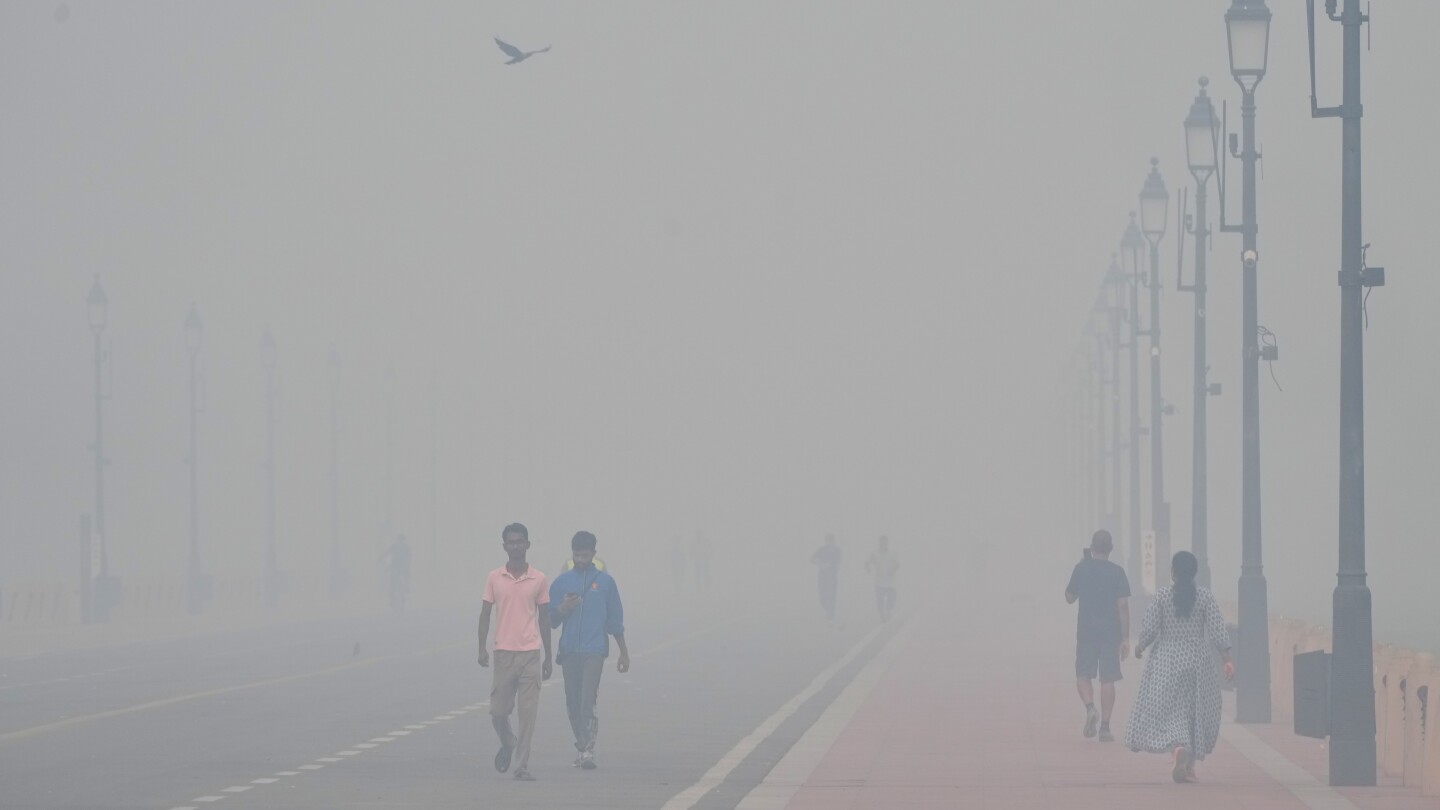
Thick smog blankets New Delhi after Diwali fireworks, pushing air quality to hazardous levels
New Delhi, India’s bustling capital, was shrouded in a thick layer of smog on Tuesday, following the vibrant celebrations of Diwali, the Hindu festival of lights. The revelry, marked by the widespread use of fireworks, exacerbated the city’s already precarious air quality, pushing pollution levels to hazardous heights. By Tuesday morning, the Air Quality Index (AQI) in several neighborhoods had soared above 350, a threshold classified as ‘severe’ by the World Health Organization (WHO), posing significant health risks to the city’s inhabitants. The dense haze reduced visibility, obscuring streets, high-rise buildings, and historical landmarks, leaving residents and tourists alike in dismay. ‘I have never seen anything like this before. We can’t see anything here because of pollution,’ remarked Vedant Pachkande, a visitor to the city. Despite the Indian Supreme Court’s recent decision to permit the use of ‘green firecrackers’—designed to reduce emissions by approximately 30%—during specific hours, the regulation was largely ignored, mirroring the pattern of previous years. New Delhi, home to over 30 million people, consistently ranks among the world’s most polluted cities, particularly during the winter months when Diwali fireworks, crop residue burning, and stagnant weather conditions converge. Authorities have implemented temporary measures, such as restricting construction activities and diesel generator usage, but environmentalists argue that long-term solutions, including cleaner energy sources and stricter vehicle emission controls, are imperative to address the annual pollution crisis. A recent study published in Scientific Reports highlighted the broader implications of rising air pollution, noting a steady decline in sunshine hours across India, which could adversely affect solar power generation, agricultural productivity, and public health.
-

Asian markets extend gains, with Chinese shares up more than 1%, after Wall Street rally
Asian markets experienced a notable uptick on Tuesday, with Japan’s Nikkei 225 index nearing the symbolic 50,000 mark for the first time. This surge coincided with the historic appointment of Sanae Takaichi as Japan’s first female prime minister, following a parliamentary vote. Takaichi, known for her conservative stance, is anticipated to advocate for market-friendly policies, including sustained low interest rates and increased government expenditure. The U.S. dollar strengthened against the Japanese yen, rising to 151.31 yen from 150.75 yen, as Takaichi’s potential influence on the Bank of Japan’s interest rate decisions could maintain the yen’s relative weakness, complicating inflation control efforts. Meanwhile, Hong Kong’s Hang Seng and Shanghai Composite indices rose by 1.2% and 1.3%, respectively, reflecting broader regional optimism. In South Korea, the Kospi edged up 0.2%, while Australia’s S&P/ASX 200 climbed 0.7%. Taiwan’s Taiex also saw a modest 0.2% increase. The positive sentiment was further bolstered by expectations of a meeting between U.S. President Donald Trump and Chinese President Xi Jinping at an upcoming regional summit, which could ease trade tensions between the two economic giants. In the U.S., stocks rallied on Monday, with the S&P 500 nearing its all-time high, driven by strong performances from companies like Apple and Cleveland-Cliffs. Apple’s stock surged 3.9% amid optimism over its latest iPhone design, while Cleveland-Cliffs jumped 21.5% following CEO Lourenco Goncalves’ announcement of potential rare earth discoveries and a major global steel deal. Despite a widespread outage of Amazon’s cloud computing service, its stock rose 1.6%. Corporate earnings reports this week, including those from Coca-Cola, Tesla, and Procter & Gamble, are under scrutiny as investors assess whether profitability can sustain the S&P 500’s 35% rally since April. The Federal Reserve faces challenges in balancing inflation concerns with a slowing job market, with potential rate cuts on the horizon. U.S. benchmark crude oil prices rose slightly, with Brent crude also gaining 4 cents, while the euro dipped slightly against the dollar.
-

Hong Kong runway set for reopening after crash but won’t be used regularly for now
Hong Kong authorities are taking steps to reopen the airport runway where a cargo aircraft crashed on Monday, though it will remain on standby until all wreckage is cleared. The Boeing 747, operated by Turkey-based ACT Airlines and leased by Emirates, skidded off the runway during landing, colliding with a patrol car and plunging both into the sea. Tragically, two airport workers in the car lost their lives, while the four crew members on the plane escaped unharmed. Steven Yiu, the executive director for airport operations, confirmed that repairs to the runway and fencing have been completed, and initial evidence has been collected. However, the cockpit voice recorder and flight data recorder remain unrecovered. The runway will be available for emergency landings but excluded from regular flight schedules until the debris is fully cleared. Authorities are coordinating with barge companies for the removal, though Tropical Storm Fengshen has delayed operations. Investigators are examining weather, mechanical, and human factors to determine the cause of the crash. This incident marks the second fatal crash for ACT Airlines, following a 2017 tragedy in Kyrgyzstan that claimed 39 lives.