标签: Asia

亚洲

  • From automated farm tractors to exam paper grading, AI boosts efficiency for some in India

    From automated farm tractors to exam paper grading, AI boosts efficiency for some in India

    Across India’s diverse economic landscape, artificial intelligence is rapidly transforming traditional sectors through innovative applications that enhance productivity and operational efficiency. In the agricultural heartlands of Karnal, northern India, progressive farmer Bir Virk demonstrates this technological shift by operating his tractor in fully autonomous mode using an iPad-controlled AI system that harvests potatoes with millimeter precision.

    Simultaneously, in New Delhi’s competitive education sector, educator Swetank Pandey leverages algorithmic intelligence to automate the evaluation of handwritten civil service examination papers. This dual demonstration across fundamentally different industries illustrates AI’s expanding footprint throughout the Indian economy.

    The Indian government is actively supporting this technological transformation through substantial national initiatives, including research funding and workforce training programs. This commitment was prominently displayed during New Delhi’s recent five-day AI summit, which attracted global heads of state and leading technology executives.

    India’s massive digital ecosystem, comprising nearly one billion internet users, has positioned the country as a critical growth market for international tech corporations. Microsoft has committed $17.5 billion over four years to expand cloud and AI infrastructure, while Google plans a $15 billion investment that includes establishing its first AI hub within the country.

    Despite this rapid adoption, India faces significant challenges in AI development, particularly in creating large-scale indigenous AI models comparable to U.S.-based OpenAI or China’s DeepSeek. Constraints include limited access to advanced semiconductor chips, inadequate data center infrastructure, and the complexity of accommodating hundreds of local languages.

    The workforce transformation presents both opportunities and challenges. While technology companies increase spending on AI training and reskilling programs, Tata Consultancy Services—India’s largest private employer—eliminated over 12,000 positions last year due to AI-driven operational shifts.

    In agriculture, Virk’s AI-enabled tractor system, imported from Sweden at approximately $3,864, represents a technological leap forward. The system combines satellite guidance, AI-driven software conversion, and cloud-based error logging that enables continuous improvement through machine learning. Virk reports his automated equipment has reduced farming time by 50% while maintaining exceptional accuracy.

    In education, Pandey’s coaching academy utilizes large language models including ChatGPT, Gemini, and Claude to process tens of thousands of answer sheets within minutes. The hybrid model combines AI evaluation with teacher review, resulting in both accelerated processing and improved educational quality. Surprisingly, students often find AI-generated study materials more relatable than those created exclusively by human instructors.

    This technological integration across sectors demonstrates how AI is becoming an invisible yet indispensable partner in India’s economic development, creating new paradigms of efficiency while preserving traditional occupations through technological enhancement.

  • Looking for unique things to do in Abu Dhabi? Try breakfast with sea lions

    Looking for unique things to do in Abu Dhabi? Try breakfast with sea lions

    In a country renowned for extraordinary experiences, Emirates Park Zoo & Resort has elevated the concept of unique dining with its groundbreaking breakfast encounter featuring sea lions. This viral attraction offers visitors the rare opportunity to dine alongside four charismatic South African sea lions while enjoying a Mediterranean-inspired meal in a shallow pool setting.

    The experience begins with guests checking in and changing into swimwear before being seated at tables partially submerged in water. While multiple breakfast options are available—including Arabic mezze, Full English, and Hawaiian fruit platters—the Greek selection has proven particularly noteworthy. The Strapatsada (fried eggs with Greek olive oil and feta cheese) and Tiropita (flaky phyllo with white sauce and feta) have received unexpected praise for their authentic flavors.

    The true highlight, however, involves interacting with the zoo’s four sea lion personalities: Arcto, Bia, Claudio, and Victoria. Under careful supervision by trained professionals, guests participate in feeding sessions and observe impressive aquatic demonstrations. The experience emphasizes animal welfare standards with clear boundaries—no direct contact is permitted, and human food remains separate from the sea lions’ feeding routines.

    Priced at AED 2,205 for groups of up to four people, the package includes full-day access to the entire zoo facility. For those seeking extended immersion, the adjacent resort offers rooms overlooking free-roaming giraffes and gazelles, alongside other animal-themed dining experiences including breakfast with giraffes and Ramadan iftar events featuring big cats and elephants.

    This innovative attraction represents the latest evolution in the UAE’s competitive experience economy, offering something genuinely distinctive even within a market saturated with extraordinary offerings.

  • Halved tariffs should benefit Scotch whisky exports to China

    Halved tariffs should benefit Scotch whisky exports to China

    For over ten years, China has served as a pivotal growth catalyst for Western luxury brands, driving demand across fashion, timepieces, and premium beverages. Rising disposable incomes and increased global connectivity fueled an exceptional appetite for high-end products during this period.

    Scotch whisky emerged as a significant beneficiary of this trend. Export values to China skyrocketed from under £90 million in 2019 to exceeding £235 million by 2023. However, the sector has faced three consecutive years of declining sales, compounded by inflationary pressures, escalating costs, and trade tensions that have substantially compressed profit margins. A recent development offers potential relief: China has implemented a 50% tariff reduction on Scotch whisky, lowering rates from 10% to 5%.

    This sales contraction reflects a market entering maturity, where Chinese consumers demonstrate heightened selectivity, sophistication, and demanding standards. The market is undergoing a fundamental transformation—shifting from volume-driven to value-oriented consumption, from older to younger demographic dominance, and from conspicuous displays to considered purchasing decisions. These evolving patterns explain both the recent market adjustment and the sector’s underlying resilience.

    Post-pandemic economic uncertainties prompted a recalibration of luxury spending patterns. Chinese consumers began purchasing fewer items while making more deliberate investment choices in their acquisitions. This behavioral shift is particularly evident in the whisky category, where overall volumes have declined despite sustained interest in premium offerings including aged single malts, limited editions, and iconic distilleries.

    China’s whisky consumption demographic differs markedly from Western markets. Rather than appealing primarily to older drinkers, Scotch whisky has found its core audience among Generation Z consumers—urban, affluent, well-educated, and internationally experienced individuals. This new generation has reinterpreted whisky as cultural capital, embracing tasting rituals, collectible acquisitions, and cask investments as sophisticated pursuits.

    Brands such as Glenfiddich and The Macallan have capitalized on this trend, tripling their market share since 2019. The United Kingdom dominates China’s whisky import market, accounting for 85.6% of import value in 2024, with China ranking as the ninth largest market for UK whisky exports.

    The luxury valuation framework in China remains deeply connected to authenticity and provenance. Western luxury brands derive their appeal from historical legacy, craftsmanship, and distinctive cultural narratives. For premium spirits, ‘country of origin’ functions as a crucial authenticity marker—particularly for Scotch whisky, which embodies Scotland’s landscape, climate, and production traditions. Stringent regulatory frameworks governing production, maturation, and bottling processes provide Chinese consumers with symbolic reassurance regarding quality and legitimacy.

    Despite international investments in Chinese distilleries, domestic whisky production has not diminished demand for imported Scotch. Instead, it has accentuated distinctions between ‘original’ and ‘localized’ products. In business and social contexts, prestigious Scotch continues to function as social currency, signaling trust, respect, and global sophistication.

    China’s broader luxury market has softened since 2023, with certain categories experiencing up to 20% sales declines. Economic uncertainties influenced by geopolitical factors, real estate market adjustments, and subdued consumer confidence have reshaped spending priorities. Concurrently, value systems are evolving among younger consumers who favor subtle taste expressions over overt wealth displays, prioritizing experiences and cultural capital.

    The tariff reduction agreement emerged during UK Prime Minister Keir Starmer’s state visit to Beijing, marking a significant diplomatic engagement after nearly eight years of strained relations. Beyond economic implications, this diplomatic re-engagement carries substantial symbolic importance for British heritage brands, whose appeal rests partially on emotional and cognitive appreciation of British traditions, aesthetics, and lifestyle—a manifestation of UK soft power.

    This diplomatic reconnection symbolizes renewed mutual interest and long-term commitment, potentially reinforcing perceptions of openness, legitimacy, and stability among Chinese consumers. For British luxury brands, this symbolic reassurance may prove nearly as valuable as tariff reductions in maintaining consumer trust and loyalty.

    The agreement underscores the importance of constructive UK-China relations for the Scotch industry, which supports distilling, agriculture, packaging, logistics, tourism, and rural employment throughout the United Kingdom. Maintaining access to China’s premium market segment remains vital for sustaining investment and specialized skills.

    As China’s relationship with Western luxury brands transitions from explosive growth to stabilized maturity, Scotch whisky’s emphasis on rarity, provenance, and authenticity positions it favorably. Provided producers adapt to China’s increasingly discerning consumers and benefit from constructive trade relations, the long-term outlook remains promising. In an environment characterized by oversupply and contracting margins, China’s cautious connoisseurs may ultimately emerge as Scotch whisky’s most valuable allies.

  • Iran to shut parts of Strait of Hormuz as it holds nuclear talks with US

    Iran to shut parts of Strait of Hormuz as it holds nuclear talks with US

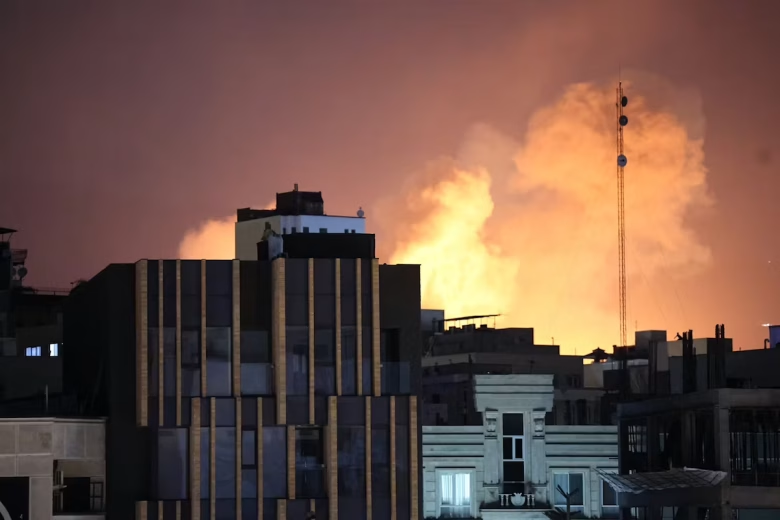
    Iran has announced plans to temporarily close sections of the strategically vital Strait of Hormuz for military exercises, coinciding with sensitive nuclear negotiations with the United States. The development emerges amid escalating tensions, with U.S. President Donald Trump suggesting regime change in Tehran might be desirable, while Iran’s Supreme Leader Ayatollah Ali Khamenei defiantly declared any American attempts to overthrow his government would inevitably fail.

    The Geneva talks, mediated by Oman and involving high-level officials including U.S. envoy Steve Witkoff and Jared Kushner, represent a critical diplomatic effort to address Iran’s controversial nuclear program. Iranian state media confirmed the talks concluded a second round, with Foreign Ministry spokesperson Esmaeil Baghaei acknowledging the complexity of discussions covering both sanctions relief and nuclear matters.

    This maritime closure threat carries significant global implications, as the Strait of Hormuz serves as a crucial transit route for approximately 20% of the world’s oil shipments. Tehran has historically threatened to blockade the waterway if attacked, a move that would dramatically impact global energy markets and crude oil prices.

    The negotiations occur against a backdrop of recent military actions, including U.S.-Israel coordinated strikes against Iranian nuclear facilities in June last year using B-2 bombers. These operations followed the collapse of previous diplomatic efforts and have significantly weakened Iran’s nuclear capabilities according to Western assessments.

    Domestically, Iran’s leadership faces substantial challenges, including widespread protests driven by economic hardship exacerbated by international sanctions that have severely constrained the country’s oil revenues. Despite these pressures, Iranian officials maintain that their missile program remains non-negotiable and separate from nuclear discussions.

    The success of current diplomatic efforts appears contingent on Washington’s willingness to lift crippling economic sanctions without imposing unrealistic demands, according to Iranian officials. Both nations maintain fundamentally opposing positions regarding the scope of negotiations, with Washington seeking to include Iran’s missile arsenal while Tehran insists discussions should focus exclusively on nuclear matters in exchange for sanctions relief.

  • Calls grow among Democrats for anti-Muslim lawmaker Randy Fine to resign

    Calls grow among Democrats for anti-Muslim lawmaker Randy Fine to resign

    Florida Republican Representative Randy Fine is confronting mounting demands for his resignation following a series of inflammatory statements targeting Muslim communities and Palestinian advocates. The controversy escalated when Fine posted on social media platform X that “if they force us to choose, the choice between dogs and Muslims is not a difficult one.” This remark, made in response to a Palestinian activist’s joke about Islamic views on canine cleanliness, has triggered widespread condemnation from Democratic lawmakers, civil rights organizations, and Jewish groups.

    Fine’s political career has been marked by recurrent controversies regarding his rhetoric toward Muslims and Palestinians. In September 2024, he faced accusations of Islamophobia after celebrating the death of Aysenur Eygi, a Turkish-American activist fatally shot by Israeli forces in the West Bank. Eygi was participating in a peaceful protest against illegal Israeli settlements when she was killed, with eyewitnesses confirming she was unarmed.

    The lawmaker’s extremist positions extend to foreign policy advocacy. During a May 2025 Fox News appearance, Fine suggested Gaza should be “nuked” analogously to Hiroshima and Nagasaki, following the killing of two Israeli embassy staff members in Washington, DC.

    Democratic leadership has repeatedly condemned Fine’s conduct. California Congressman Ro Khanna characterized the recent statements as “disgusting bigotry,” while New York Representative Alexandria Ocasio-Cortez described them as “among the most disgusting statements ever issued by an American official.” California Governor Gavin Newsom, a potential 2028 presidential contender, explicitly demanded Fine’s immediate resignation.

    Fine belongs to the recently established “Sharia Free America Caucus,” formed by Republican legislators despite the constitutional separation of church and state and the absence of Islamic law implementation in the United States. His tenure began after filling a vacancy created by President Trump’s UN Ambassador Mike Waltz, with Trump having enthusiastically endorsed Fine’s candidacy.

    The representative faces re-election in November’s midterms, pending August’s Republican primary in his Florida district. The ongoing controversy highlights deepening tensions within American political discourse regarding religious tolerance and Middle East policy.

  • Two mothers, one last-16 battle: Svitolina vs Bencic in Dubai

    Two mothers, one last-16 battle: Svitolina vs Bencic in Dubai

    In an extraordinary display of athletic resilience, two top-ranked mothers are poised for a groundbreaking Round of 16 confrontation at the Dubai Duty Free Tennis Championships. Elina Svitolina advanced through unusual circumstances when opponent Paula Badosa retired with a thigh injury while trailing 6-4, marking yet another withdrawal in an injury-plagued tournament.

    Despite the unsatisfying nature of her advancement, Svitolina’s attention immediately turned to her impending match against Swiss star Belinda Bencic. Both players have captured global attention with their remarkable returns to elite competition following maternity breaks, simultaneously breaking into the world’s top ten rankings.

    ‘We actually practiced together recently and understand each other’s game intimately,’ Svitolina revealed during post-match comments. ‘Our parallel journeys as returning mothers create a special narrative that ultimately benefits our sport.’

    The Ukrainian athlete, a two-time Dubai champion currently riding momentum from her Australian Open semifinal appearance, acknowledged the significant challenges of balancing professional tennis with motherhood. ‘The adjustment period extends beyond physical recovery,’ explained Svitolina, who shares daughter Skai with French tennis star Gael Monfils. ‘Reacclimating to training regimens and achieving match readiness requires substantial adaptation to new physical demands.’

    This matchup represents more than a typical tournament battle—it symbolizes the evolving landscape of women’s sports where athletes successfully combine elite competition with motherhood. Both competitors have demonstrated exceptional form, with Bencic recently overcoming her own fitness concerns to remain in contention.

    Svitolina anticipates a demanding contest: ‘She’s performing exceptionally well currently, so I must deliver my absolute best performance. This encounter presents a significant challenge for both of us.’

  • Censorship of Colbert interview sparks free speech debate ahead of Texas primary

    Censorship of Colbert interview sparks free speech debate ahead of Texas primary

    A major controversy has erupted over free speech and media censorship after CBS intervened to block Stephen Colbert from airing his interview with Texas Democratic Senate candidate James Talarico on ‘The Late Show.’ The network’s legal team explicitly prohibited both the broadcast of the interview and any discussion of its suppression, citing concerns related to Federal Communications Commission (FCC) regulations.

    Colbert defiantly addressed the censorship during his opening monologue, stating: ‘Then I was told in uncertain terms that not only could I not have him on, I could not mention me not having him on. And because my network clearly doesn’t want us to talk about this, let’s talk about this.’ The host criticized both the FCC and the Trump administration, suggesting dissent was being suppressed under the pretext of preventing ‘partisan purposes’ in talk shows.

    Although banned from television broadcast, the interview was subsequently published on the show’s YouTube channel, where it quickly went viral. Talarico used the platform to accuse President Trump and Republican leadership of hypocrisy: ‘This is the party that ran against cancel culture. And this is the most dangerous kind of cancel culture, the kind that comes from the top.’

    The Democratic candidate further asserted that ‘corporate media executives are selling out the First Amendment to curry favor with corrupt politicians,’ warning that ‘a threat to any of our First Amendment rights is a threat to all of our First Amendment rights.’

    This incident marks the second time Talarico has faced FCC-related scrutiny, following a previous investigation into his appearance on ‘The View.’

    The censorship attempt has triggered widespread backlash across social media platforms, with many users accusing the FCC and Trump administration of undermining constitutional free speech protections. Journalist Mehdi Hassan commented on X: ‘The party (GOP) and politician (Trump) who spent the past decade screaming about free speech and snowflakes have declared war on late night comedians.’

    Some analysts suggest the censorship may ultimately benefit Talarico’s campaign, with the interview garnering over 10 million views online—far exceeding the show’s typical television audience of approximately two million viewers. Many commentators argue that the suppression attempt has generated more attention for the candidate than a standard broadcast would have achieved.

    The controversy emerges against the backdrop of Texas’ March 3 primary, where Talarico faces Congresswoman Jasmine Crockett. The candidates differ significantly on foreign policy, particularly regarding Israel-Palestine relations, with Talarico maintaining a firm stance against sending additional military aid to Israel during the conflict in Gaza.

  • Witkoff may have gone out on a limb with a new Iran agreement

    Witkoff may have gone out on a limb with a new Iran agreement

    Geneva witnessed a pivotal moment in US-Iran relations on February 17, 2026, as diplomatic envoys engaged in three to four hours of indirect negotiations facilitated by Omani intermediaries. The talks, which avoided direct contact between American and Iranian delegations, reportedly produced a tentative framework agreement focusing primarily on uranium enrichment—a significant departure from the comprehensive demands previously outlined by the Trump administration.

    According to Iranian sources, US negotiators Steve Witkoff and Jared Kushner acquiesced to a narrowed negotiation framework that potentially bypasses Secretary of State Marco Rubio’s established ‘pillars’ for any Iran agreement. These pillars explicitly require addressing Iran’s ballistic missile program, regional proxy forces, and human rights record alongside nuclear considerations.

    The emerging arrangement, as interpreted by Iranian officials, links sanctions relief to concessions on uranium enrichment—a direct reflection of Supreme Leader Ali Khamenei’s stated position. However, the White House has maintained official silence regarding the Geneva discussions, leaving the accuracy of Iranian claims unverified.

    This diplomatic maneuvering occurs against a backdrop of substantial US military mobilization. The Gerald R. Ford carrier group is en route to the Arabian Sea, while approximately 50,000 US troops are now stationed across the Middle East—a notable increase from the typical 34,000-40,000 baseline. Advanced military assets including F-35 stealth fighters, F-15E Strike Eagles, and A-10 Thunderbolts have been deployed to regional bases, complemented by sophisticated missile defense systems such as THAAD batteries in Jordan and Patriot installations throughout the Gulf.

    The convergence of diplomatic developments and military posturing creates a complex decision matrix for President Trump, who must weigh the potential for a limited nuclear agreement against Rubio’s comprehensive demands and considerable internal opposition. The timing of military assets reaching full operational capacity in early March establishes a de facto deadline for diplomatic resolution before potential escalation.

  • Botim Money launches digital silver investing from Dh10

    Botim Money launches digital silver investing from Dh10

    In a significant expansion of its digital wealth ecosystem, UAE-based fintech platform Botim Money has launched fractional silver investing, enabling users to trade the precious metal with investments as low as Dh10. The new feature, accessible through the Botim app, allows eligible users to purchase, sell, and manage digital silver holdings without the traditional barriers associated with physical precious metals.

    This strategic move follows the remarkable success of Botim Money’s gold investment service, introduced in partnership with OGold in 2025, which has processed over 128,000 trades totaling more than Dh100 million in transaction value. The platform’s latest offering eliminates conventional obstacles such as high minimum purchase requirements, storage costs, and handling concerns that have historically limited retail participation in precious metals markets.

    Sacha Haider, Chief Operating Officer of Astra Tech and Botim, emphasized that fractional investing has removed traditional investment thresholds, creating accessible pathways for portfolio diversification. The initiative strengthens Botim’s partnership with OGold, an Emirati precious metals platform dedicated to digitizing gold and silver ownership.

    Bandar Alothman, Chairman and Founder of OGold, highlighted that the collaboration enables digital silver holdings to generate returns through structured investment solutions rather than remaining idle assets. The launch comes at a pivotal time for silver markets, with industry forecasts projecting a sixth consecutive annual supply deficit in 2026 of approximately 67 million ounces, alongside growing retail investment demand despite softer industrial consumption in certain segments.

    This development reflects the broader transformation toward digital-first financial services in the UAE, where fintech platforms are increasingly integrating accessible investment tools within everyday payment and remittance applications, particularly appealing to younger and first-time investors seeking inflation hedges and portfolio diversification options.

  • Look: UAE’s faithful offer first Taraweeh prayers on eve of Ramadan

    Look: UAE’s faithful offer first Taraweeh prayers on eve of Ramadan

    Across the United Arab Emirates, Muslim communities gathered in mosques and prayer halls on Tuesday evening to observe the inaugural Taraweeh prayers, marking the spiritual commencement of the holy month of Ramadan. The special night prayers, conducted following the confirmation of the Ramadan crescent moon, demonstrated the nation’s deep religious observance and cultural traditions.

    Worshippers participated in extended congregational prayers that characterize Taraweeh, a distinctive feature of Ramadan nights where lengthy portions of the Quran are recited throughout the month. Mosques across the seven emirates saw faithful attendees following COVID-19 precautionary measures while maintaining the spiritual atmosphere of the occasion.

    The first Taraweeh prayers hold particular significance as they set the tone for the month of fasting, reflection, and increased devotion. Religious authorities across the UAE had coordinated preparations to ensure smooth arrangements for the night prayers, including crowd management, sanitation protocols, and organized recitation schedules.

    This religious observance occurs as the UAE continues to balance traditional Islamic practices with modern urban requirements, implementing appropriate measures to facilitate worship while maintaining public health standards. The successful commencement of Taraweeh prayers reflects the country’s commitment to preserving religious customs while adapting to contemporary circumstances.