标签: Asia

亚洲

  • Chinese premier calls for implementation of new urbanization strategy to boost social, economic development

    Chinese premier calls for implementation of new urbanization strategy to boost social, economic development

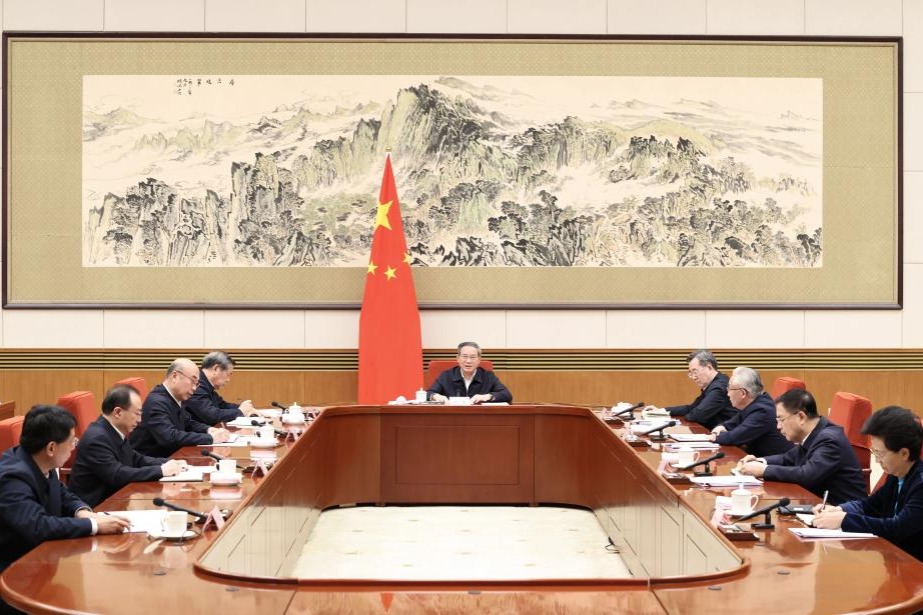
    In a pivotal State Council study session convened on December 3, 2025, Premier Li Qiang championed the accelerated implementation of China’s people-centered new urbanization strategy. He emphasized its critical role in unlocking domestic demand potential through urban-rural integration and driving comprehensive socioeconomic advancement.

    Presiding over the high-level meeting attended by Vice Premiers Ding Xuexiang, He Lifeng, and State Councilor Wang Xiaohong, Premier Li characterized urbanization as a fundamental engine for expanding domestic consumption, catalyzing industrial modernization, and strengthening China’s internal economic circulation. He noted that while significant progress has been achieved nationwide, the 15th Five-Year Plan period (2026-2030) presents substantial opportunities for further development.

    Premier Li observed that China’s urbanization is transitioning from rapid expansion to stable maturation, accompanied by profound transformations in demographic patterns, urban systems, and rural-urban dynamics. This evolution necessitates enhanced precision and effectiveness in policy implementation.

    The Premier outlined a multifaceted approach requiring localized adaptation of urbanization plans, optimized coordination between population distribution, industrial development, and urban planning. He specifically highlighted the urgency of addressing critical social challenges including employment security, social welfare provisions, housing accessibility, and educational opportunities for rural migrant populations.

    Further directives included advancing urban renewal initiatives, promoting construction of ‘quality homes,’ and fostering high-quality development within the real estate sector. Premier Li also stressed the importance of strengthening infrastructure connectivity and industrial alignment between urban and rural regions to achieve genuinely integrated development.


  • Influx of intl tourists helps illuminate the real Xinjiang

    Influx of intl tourists helps illuminate the real Xinjiang

    URUMQI, China — Northwest China’s Xinjiang Uygur Autonomous Region is experiencing an unprecedented surge in international tourism, with over 2.1 million overseas visitors recorded in the first ten months of 2025 alone. This represents a 6 percent year-on-year increase, positioning the region as an emerging global destination for winter sports and cultural exploration.

    The current winter season has attracted adventure seekers like Nicolas de Fermor, a French skiing enthusiast who chose Xinjiang over traditional European resorts. “We came specifically for the snow season,” Fermor remarked during his visit to the Silk Road Ski Resort near Urumqi. “The seamless experience—from passport-based bookings to mobile payments and English-speaking staff—exceeded our expectations. We’re already planning our return.”

    Xinjiang’s transformation into a international tourism hub stems from comprehensive policies facilitating visa processing, digital payment systems, and accommodation infrastructure. The region’s diverse attractions range from pristine snow-capped mountains and golden deserts to ancient cultural sites and vibrant marketplaces.

    Tour industry professionals report unprecedented demand. “During peak season between June and September, securing English-speaking tour guides becomes exceptionally challenging,” noted Chen Bianxia, a veteran guide with nearly twenty years of experience.

    Liang Changhong, General Manager of China CYTS Tours Holding Co., Ltd.’s Xinjiang branch, identified distinct travel preferences among visitor demographics: “While Southeast Asian tourists predominantly seek natural landscapes and increasingly favor independent travel arrangements, European and American visitors demonstrate stronger interest in the historical cultural heritage along the ancient Silk Road corridor.”

    The convergence of natural beauty, cultural richness, and modern convenience continues to redefine Xinjiang’s position in global tourism, demonstrating how strategic development and cultural accessibility can reshape travel patterns worldwide.

  • Death toll hits 159 in Tai Po blaze, 31 still missing

    Death toll hits 159 in Tai Po blaze, 31 still missing

    Hong Kong authorities confirmed Wednesday that the devastating Tai Po apartment complex fire has claimed 159 lives, marking one of the deadliest urban disasters in the city’s history. The catastrophic blaze at Wang Fuk Court has left 31 individuals still unaccounted for as search operations concluded across all seven affected towers.

    Police Commissioner Joe Chow Yat-ming disclosed that forensic teams have identified 140 victims through meticulous examination, with victims spanning all age groups from 1 to 97 years old. The tragic tally includes 49 men and 91 women, among them one firefighter who perished during rescue operations, ten foreign domestic workers, and five on-site workers.

    Medical authorities reported that 42 injured survivors have been discharged from hospitals, while 37 remain under medical care—four in critical condition, nine classified as serious, and 24 in stable condition. Search operations will continue beneath collapsed scaffolding structures where additional victims might be located.

    Initial investigations point to substandard protective mesh netting installed during building renovations as a primary factor in the fire’s rapid escalation through the residential complex. In response, the Hong Kong Special Administrative Region government has mandated immediate removal of all similar netting from buildings undergoing major renovations citywide.

    The Buildings Department is preparing to implement stringent new safety protocols by next week, requiring all construction site mesh materials to undergo mandatory on-site laboratory testing before installation approval.

    Law enforcement agencies have intensified their investigation, arresting six additional individuals aged 44 to 55 for allegedly providing false information to fire authorities about functional alarm systems in the affected buildings. This brings the total number of arrests related to maintenance works to 21, with four separate arrests made for alleged seditious activities connected to the disaster.

    The Office for Safeguarding National Security of the Central People’s Government issued a strong statement condemning external hostile forces for attempting to exploit the tragedy, warning that such actions would face severe consequences.

    Relief efforts continue with 1,921 households receiving HK$10,000 emergency grants and 104 families obtaining HK$50,000 living allowances. Over 2,600 displaced residents are currently accommodated in temporary to long-term housing arrangements, supported by a government-established fund that has accumulated HK$2.3 billion in donations.

    The Chinese mainland has contributed additional emergency supplies including protective goggles and waterproof gloves, coordinated through the Ministry of Emergency Management and the Hong Kong and Macao Work Office of the Communist Party Central Committee.

  • Relief, prevention, investigation underway after search completed in fire-hit buildings in Hong Kong

    Relief, prevention, investigation underway after search completed in fire-hit buildings in Hong Kong

    Hong Kong authorities have initiated comprehensive emergency measures following the catastrophic fire at Wang Fuk Court housing complex that has resulted in 159 confirmed fatalities. The Hong Kong Special Administrative Region (HKSAR) government has mandated the immediate removal of all scaffolding from building maintenance projects across the territory within a 72-hour window for urgent fire safety inspections.

    Development Secretary Bernadette Linn announced that construction materials will only be reinstalled after meeting new safety standards to be formally issued next week. The police confirmed Wednesday afternoon that 31 individuals remain unaccounted for following the blaze, with victims ranging from 1 to 97 years old. Of the 159 recovered bodies, 140 have been formally identified.

    Search operations within the seven affected buildings have concluded, with authorities now expanding their recovery efforts to the surrounding areas where scaffolding collapsed during the fire. This next phase requires meticulous removal of debris and ashes under controlled safety conditions, which officials indicate will require additional time.

    In a significant development, law enforcement has arrested six individuals connected to a contractor responsible for installing fire safety equipment. The suspects are accused of falsely certifying that fire alarms were operational during maintenance work at Wang Fuk Court. Additional investigations are underway regarding potential document forgery related to renovation materials used at the site.

    Financial support for affected residents continues to grow, with the disaster relief fund reaching HK$2.4 billion (approximately $308 million) by Wednesday noon. The HKSAR government is implementing tax relief measures and fee waivers for victims and their families.

    The Central Government’s Hong Kong and Macao Work Office is coordinating delivery of critical disaster-relief supplies, including protective goggles and waterproof gloves requested by local authorities. Previous shipments from the mainland included emergency lighting equipment that assisted police in their search and recovery operations.

  • Genes key to increasing heat tolerance of grains

    Genes key to increasing heat tolerance of grains

    In a groundbreaking development addressing global food security challenges, Chinese researchers have decoded the molecular mechanisms behind heat tolerance in rice crops. The study, published in the prestigious journal Cell on December 4, 2025, reveals two critical genetic regulators that enable plants to withstand extreme temperature conditions.

    The research team from Chinese Academy of Sciences Center for Excellence in Molecular Plant Sciences, Shanghai Jiao Tong University, and Guangzhou Laboratory conducted extensive field simulations replicating future climate scenarios. Their investigation identified DGK7 (a kinase) and MdPDE1 (a lipase) as essential components in rice’s thermal response system. These function as a sophisticated biological alarm mechanism, converting external heat signals into cellular instructions that trigger protective responses.

    Experimental results demonstrated remarkable yield improvements: single-gene modifications increased production by 50-60%, while dual-gene modifications nearly doubled output compared to control groups. The research maintained crop quality under simulated heat waves reaching 46°C (115°F) during peak daylight hours, without compromising yield under normal growing conditions.

    Dr. Lin Hongxuan, corresponding author of the study, emphasized the precision engineering capabilities now possible: ‘Scientists can not only enhance heat tolerance but design gradient heat-resistant varieties tailored to specific climate conditions.’

    The findings offer transformative potential for securing global food supplies as climate change intensifies. The identified genetic markers provide a blueprint for developing resilient strains of major cereal crops including wheat and corn, potentially mitigating projected yield declines from rising global temperatures.

    This research represents a significant advancement in climate-adaptive agriculture, combining fundamental biological discovery with immediate practical applications for sustainable food production.

  • Homegrown durian tantalizes taste buds

    Homegrown durian tantalizes taste buds

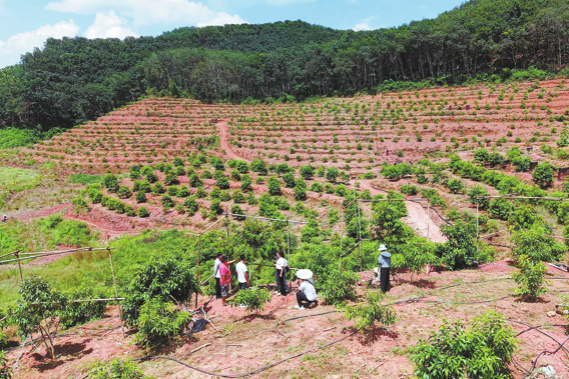
    In a remarkable agricultural development, China’s Yunnan province has successfully cultivated domestic durian, potentially disrupting the nation’s complete reliance on imported varieties of the tropical fruit. The breakthrough comes after years of experimental planting in the tropical microclimates of Xishuangbanna Dai Autonomous Prefecture, where farmers and agricultural companies have overcome significant climatic challenges typically restricting durian cultivation to Southeast Asia.

    The journey began unexpectedly in 2010 when farmer Jia Guohua planted a discarded durian seed in Mengla county. This year, his persistence yielded 16 mature fruits—a symbolic representation of Yunnan’s broader agricultural ambitions. The province’s southern regions, particularly Xishuangbanna, share ecological similarities with northern Thailand and Vietnam, creating ideal conditions for durian cultivation with consistently warm and humid tropical environments.

    Commercial enterprises have joined the effort, with Xishuangbanna Zhuo’an Agricultural Technology Development Company establishing two hectares of durian plantations in Jinghong. According to General Manager Guo Jian, the strategic decision to cultivate durian was driven by its extended growth cycle, which creates higher economic returns and addresses massive market demand. Innovative intercropping techniques have been implemented, with 27-30 jackfruit trees planted between every 11-12 durian trees per mu to maximize land efficiency.

    Official reports indicate significant expansion, with Mengla county introducing premium varieties including Monthong, Black Thorn, and Musang King across 66.7 hectares. Incomplete statistics reveal over 466.67 hectares under durian cultivation throughout Yunnan, spanning multiple counties including Jinghong, Mengla, Gengma, Yingjiang, and Jinping.

    Professor Ao Pingxing, director of the Durian Industry Research Center at Yunnan Agricultural University, emphasizes that this initiative aims to achieve ‘durian freedom’ for Chinese consumers—reducing price volatility and supply uncertainties while enhancing national food security. The cultivation project represents a strategic move toward high-value, technology-driven agricultural transformation, positioning Yunnan within the global premium tropical agriculture value chain.

    Despite promising progress, challenges remain regarding germplasm resource scarcity, optimal planting area identification, variety selection, and cultivation management techniques. The industry currently stands at the critical juncture between experimental trials and commercial exploration, marking a significant milestone in China’s agricultural innovation.

  • More than 300 flights cancelled as Indian airline faces ‘staff shortage’

    More than 300 flights cancelled as Indian airline faces ‘staff shortage’

    India’s aviation sector is confronting substantial operational challenges as IndiGo, the nation’s dominant carrier with over 60% domestic market share, has canceled more than 300 flights since Tuesday. This disruption has created travel chaos at major hubs including Delhi, Mumbai, Hyderabad, and Bengaluru, leaving thousands of passengers stranded during peak travel season.

    The budget airline attributes the widespread cancellations to a combination of technical malfunctions, adverse weather conditions, and implementation challenges with newly introduced crew rostering regulations. In response to the crisis, IndiGo has implemented what it describes as “calibrated adjustments” to its flight schedule through Friday in an effort to stabilize operations.

    According to data from ANI news agency, the scale of disruptions reached critical levels Thursday morning with 33 cancellations at Delhi, 85 at Mumbai, and 73 at Bengaluru airports. The situation has sparked significant passenger outrage, with numerous videos of frustrated travelers circulating across social media platforms. Many affected customers have taken to X (formerly Twitter) to voice their complaints, typically receiving standardized responses from the airline citing factors “beyond our control.”

    India’s aviation regulatory authorities have initiated an investigation into the disruptions, formally requesting that IndiGo provide detailed explanations for the extensive cancellations and delays. Media reports indicate the airline has been grappling with pilot and crew shortages since November 1st, when new Flight Duty Time Limit (FDTL) regulations took effect. These rules impose stricter limits on flight hours and mandate increased rest periods for crew members.

    However, the Federation of Indian Pilots has contested IndiGo’s assessment, noting that other airlines operating under the same regulatory framework have remained largely unaffected. The organization stated that the cancellations “cannot be attributed” solely to the new FDTL rules.

    This operational crisis represents a significant reputational challenge for the two-decade-old carrier, which built its brand identity around punctuality and reliability. Recent performance metrics indicate deteriorating service standards, with a LocalCircles survey revealing that 54% of IndiGo passengers reported timeliness issues over the past year. The airline’s response to this systemic disruption will likely have lasting implications for its competitive position in India’s rapidly growing aviation market.

  • China breaks foreign tech monopoly, mass-produces high-end carbon fiber

    China breaks foreign tech monopoly, mass-produces high-end carbon fiber

    China has achieved a significant technological milestone with the successful launch of a T1000 carbon fiber production line in Datong, Shanxi province, marking a decisive end to foreign dominance in high-performance material manufacturing. The demonstration facility, capable of producing 200 metric tons annually, represents China’s first domestically developed mass production system for 12K small-tow T1000 carbon fiber—a material renowned as the ‘king of new materials’ for its exceptional properties.

    The project, developed through collaboration between Huayang New Material Technology Group, the Datong municipal government, and the Chinese Academy of Sciences’ Institute of Coal Chemistry, began construction in June 2024. This achievement ensures security and resilience within China’s critical materials supply chain while breaking longstanding international technological monopolies.

    T1000 carbon fiber exhibits extraordinary characteristics: with filament diameters measuring just 6-7 micrometers (less than one-tenth the width of human hair), the material demonstrates tensile strength exceeding 6,400 MPa. Despite weighing only one-quarter as much as steel, it provides five times greater strength. A single meter-long strand weighing merely 0.5 grams can support loads up to 200 kilograms while maintaining resistance to high temperatures, corrosion, and chemical degradation in acidic or alkaline environments.

    These properties make the material indispensable for advanced applications across national defense, aerospace, rail transportation, wind energy, sports equipment, and the emerging low-altitude economy. The breakthrough culminates decades of research, with China having previously mastered aerospace-grade T300 production in 2008 and T800 carbon fiber used in equipment during the Beijing Winter Olympics.

    Government and industry leaders emphasize this achievement represents both a technological milestone and catalyst for regional economic development. The project is expected to drive growth in high-end equipment manufacturing and new energy storage industries while attracting upstream and downstream enterprises to establish operations in Datong. Provincial authorities have committed to prioritizing new materials development through policy support and fostering complete industrial chains spanning research, production, and application.

  • Railway port set to expand after setting trade record

    Railway port set to expand after setting trade record

    The Ereenhot Railway Port, a crucial border crossing in China’s Inner Mongolia Autonomous Region, is poised for significant expansion following a historic trade achievement. By November 20, 2025, the port had processed an unprecedented 3,500 China-Europe freight train journeys, marking the highest volume since the service’s inception in 2013.

    This milestone was celebrated with the departure of a Russia-bound train carrying 55 containers, highlighting the port’s growing importance in Eurasian trade networks. According to Yang Dongdong, the port’s technical manager, the facility has consistently handled over 3,000 China-Europe freight trains annually for three consecutive years, demonstrating sustained growth in cross-continental rail commerce.

    The port’s expansion strategy includes launching new routes to Russian cities later this year and accelerating construction of the second-line project between Ereenhot and Mongolia’s Zamiin-Uud Station. This infrastructure development aims to support increasing trade flows along the Belt and Road Initiative’s central corridor, where Ereenhot serves as the exclusive border crossing.

    Route connectivity has dramatically expanded from just two paths in 2013 to 74 currently active routes, linking Chinese manufacturing hubs with over 70 logistics centers across more than 10 European nations, including Germany and Poland. Recent additions include routes from Wuhu (Anhui province) and Datong (Shanxi province) to various Russian destinations, creating a denser transportation network.

    A notable development has been the improvement in return freight efficiency, with 1,760 return trains recorded—representing 50.3% of total operations and a 28.7% year-on-year increase. Trade composition remains stable, with exports dominated by automobiles, electronics, home appliances, and general merchandise, while imports primarily consist of timber and paper products.

    The port has implemented significant operational enhancements through digital transformation, including paperless customs clearance and improved coordination with Mongolian counterparts. The ‘two-station integration’ model with Zamiin-Uud Station facilitates real-time information sharing on train flows and inventory management, while optimized inspection processes have reduced customs clearance time by over 5% year-on-year.

    Local businesses report substantial benefits from the rail network’s growth. Meng Xiangyu, a freight company manager, noted that since 2018, the service has provided “a cheaper, more efficient and safe way to transport goods,” enabling expansion of both domestic and international client networks.

    Looking forward, port authorities plan to leverage capacity expansion and efficiency improvements to achieve year-on-year growth in throughput while ensuring smooth operation of international rail transport corridors, further solidifying China’s role in transcontinental trade.

  • Pomelo prospects pull urbanites to the farm

    Pomelo prospects pull urbanites to the farm

    The agricultural landscape of Shangrao in Jiangxi province is undergoing a remarkable transformation, driven by the booming Majia pomelo industry that’s reversing urban migration patterns. Young professionals are abandoning city careers to embrace farming opportunities, creating an unexpected rural revitalization movement.

    Ning Bo and Feng Qiuyan exemplify this trend, having left their positions in Hangzhou to establish a pomelo orchard in Guangfeng district. Their innovative approach combines traditional cultivation with modern entrepreneurship, developing unique products like pomelo-infused coffee and planning agritourism ventures. Their farm features a café nestled among pomelo trees, where the aroma of coffee blends with citrus scents.

    This homecoming movement addresses multiple challenges simultaneously—career satisfaction, family proximity, and rural economic development. “We wanted to solve our employment problem while being close to home,” Feng explained, noting how the pomelo’s excellent qualities presented a business opportunity despite its limited recognition outside the region.

    The technological transformation of pomelo farming is equally impressive. Smart orchards now utilize drones for spraying and automated track systems for transportation. Li Yufu, a transport worker, reported production increases from 500 to 750 metric tons following implementation of these systems. The technological advancements create substantial employment, with 40-50 villagers employed during harvest seasons and year-round workers earning over 30,000 yuan annually.

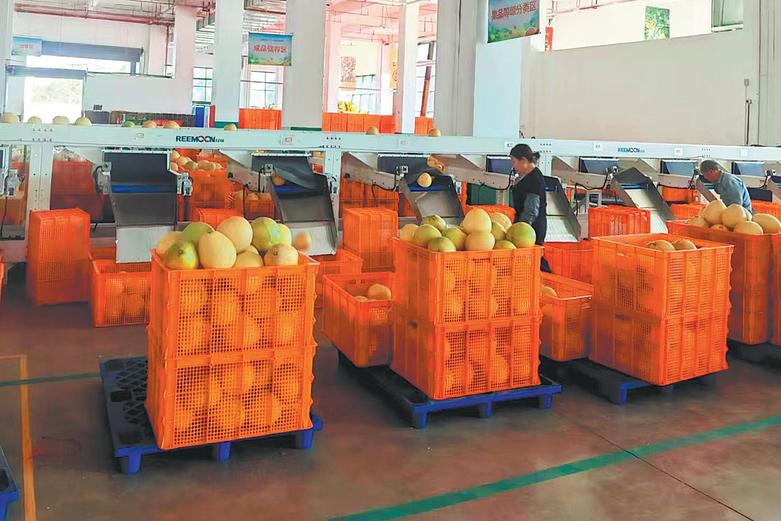
    Post-harvest processing has evolved significantly with precision grading centers that measure size, weight, and sugar content to ensure consistent quality. Intelligent sorting processed 28,500 tons last year, representing approximately 30% of total output, with graded fruit commanding a 22% price premium.

    The scale of the industry is substantial: 13,333 hectares of planting area, annual output of 250,000 tons, and comprehensive output value exceeding 3 billion yuan. According to Gong Zhenzhou, Party secretary of Guangfeng, the pomelo industry has generated 115,000 jobs and increased incomes for over 50,000 fruit growers.

    The global reach continues expanding through enterprises like Jiangxi Fengguang Biotechnology, which exports to European and Asian markets including Italy, UK, UAE, Saudi Arabia, Malaysia, and Singapore. Last year’s exports reached nearly 2,500 tons, including 100 tons to the UK alone.

    This agricultural success story represents a multifaceted approach to rural development, combining technological innovation, entrepreneurial spirit, and global market access to create sustainable prosperity in China’s countryside.