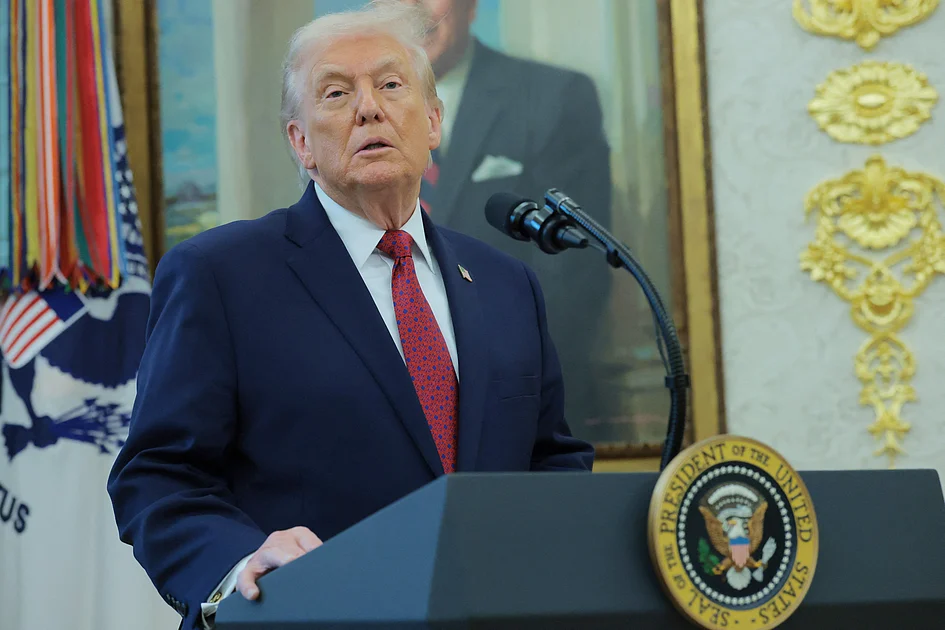
Ukrainian President Volodymyr Zelensky’s visit to Turkey on Wednesday coincided with the emergence of a contentious US-Russian peace plan aimed at ending the ongoing conflict in Ukraine. The proposal, reportedly crafted by US special envoy Steve Witkoff and Russian counterpart Kirill Dmitriev, demands significant concessions from Ukraine, including the complete withdrawal from the Donbas region and the formal cession of Crimea. Additionally, it would prevent Ukraine from joining NATO, reduce its military forces from 880,000 to 600,000, and establish a frozen line of contact in Kherson and Zaporizhzhia. While the plan offers US security guarantees, reconstruction aid, and preferential access to European markets, Ukrainian officials have dismissed it as a “Russian burger,” with one describing it as “bullshit.” Despite initial resistance, Zelensky expressed openness to discussions, emphasizing collaboration with the Trump administration. The proposal’s timing, amid corruption allegations against Zelensky’s inner circle and Russia’s battlefield gains, has raised suspicions of deliberate pressure. Western diplomats suggest the plan may be a negotiation tactic, with conditions subject to change. During his meeting with Turkish President Recep Tayyip Erdogan, Zelensky sought to revive Istanbul negotiations, potentially crafting an alternative to the Russian proposal. Turkey, while advocating for Ukraine’s sovereignty, privately acknowledges that territorial compromises may be necessary for peace.
标签: Asia
亚洲
-

Beijing’s Chaoyang aims for trillion-yuan GDP by 2026
Chaoyang District, a pivotal economic hub in Beijing, is on track to achieve a GDP exceeding 1 trillion yuan ($140.6 billion) by 2026, as announced by Zhao Haidong, Deputy Secretary and Executive Deputy District Head of Chaoyang. This ambitious target was revealed during the Linjia No 7 Salon, an investment-promotion event hosted by the Chinese Public Diplomacy Association. Zhao highlighted Chaoyang’s robust economic foundation, noting that the district is home to over 1,800 licensed financial institutions, including nearly 400 foreign-invested entities, accounting for approximately 65% of Beijing’s total. Additionally, Chaoyang serves as a central hub for international resources, hosting 90% of foreign media outlets with Beijing offices, 80% of international organizations and chambers of commerce, and 70% of multinational regional headquarters in the capital. During the 14th Five-Year Plan period (2021–25), the district saw the establishment of 2,481 new foreign enterprises, the highest number citywide. Chaoyang also hosts more than half of Beijing’s international conferences and over one-third of its international exhibitions annually. Looking ahead to the 15th Five-Year Plan period (2026–30), Zhao emphasized the district’s commitment to developing a modern industrial system and providing a high-quality business environment for global companies. Chaoyang’s GDP grew by 5.3% in the first three quarters of this year, underscoring its dynamic economic momentum.
-

Dubai Police respond to emergencies in 5.8 minutes
Dubai Police have set a new benchmark in emergency response efficiency, achieving an average response time of just 5.8 minutes in the first ten months of 2025. This marks a significant improvement from 6.2 minutes in 2024 and 6.8 minutes in 2023, showcasing the department’s commitment to rapid and effective service. The Dubai Police General Department of Transport and Rescue, equipped with advanced resources such as heavy rescue trucks and the Dubai Police Air Wing, has been instrumental in this achievement. Lt-Gen Abdullah Khalifa Al Marri, Dubai Police commander-in-chief, highlighted that over 5,200 rescue and salvage missions were conducted from January to October 2025, including responses to accidents, fires, and rescues of individuals trapped in vehicles, homes, and elevators. Al Marri emphasized the critical role of rescue teams as the first line of defense in safeguarding lives and property. He stressed the importance of continuous investment in both human and technological capabilities to enhance operational efficiency and readiness. The department’s strategic target for response time was 6.6 minutes, making the 5.8-minute average a remarkable accomplishment. Al Marri also reviewed the readiness of rescue vehicles, inflatable boats, and modern equipment, underscoring the need for preparedness in handling diverse incidents across land, sea, and mountainous terrains. This achievement reflects Dubai Police’s high level of preparedness, precise field response, and outstanding operational efficiency, further solidifying Dubai’s reputation as a city with world-class emergency services.
-

Abu Dhabi Police catch 5 drivers for reckless overtaking, lane indiscipline
In a recent enforcement drive, Abu Dhabi Police have apprehended five drivers for multiple traffic violations, including reckless overtaking, lane indiscipline, and improper use of the emergency shoulder. The violations also encompassed failing to maintain a safe distance, overtaking from the right side, and sudden stops without warning. Authorities emphasized that the emergency shoulder is strictly reserved for emergency vehicles, enabling them to swiftly reach accident sites and save lives. Drivers were reminded to overtake only from the left side and to adhere to lane discipline. The crackdown comes as part of broader efforts to enhance road safety and reduce accidents. In a related development, Dubai Police announced the seizure of 210 motorcycles and e-scooters for reckless driving on the same day. Motorists were also warned against rapid lane switching without signaling or observing road conditions. These measures underscore the UAE’s commitment to enforcing traffic laws and ensuring public safety on its roads.
-

Watch: Dubai Police seize 210 motorbikes, scooters for reckless driving
In a significant move to enhance road safety, Dubai Police have confiscated 210 motorcycles and electric scooters for reckless driving. The operation, announced on Friday, November 21, 2025, also resulted in 271 traffic violations being issued for dangerous behaviors. The police force emphasized the importance of adhering to traffic regulations to ensure public safety. A video shared by Dubai Police on social media highlighted several instances of reckless driving, including an e-scooter rider traveling on the leftmost lane and a motorcyclist dangerously overtaking vehicles. The campaign underscores the authorities’ commitment to maintaining order and safety on Dubai’s roads. Residents are urged to follow traffic rules and prioritize safety to avoid penalties and contribute to a safer community.
-

Taiwan students visit historical sites in Tianjin for exchange program
A group of Taiwanese students has embarked on a week-long cultural exchange program in Tianjin, China, aimed at exploring modern Chinese history and fostering cross-strait friendships. Organized jointly by Tianjin Foreign Studies University and Chung Hua University in Taiwan, this annual event is now in its 11th year. The program includes visits to significant historical sites such as the Dagukou Fort Ruins Museum, the Liang Qichao Former Residence, and the Tianjin Huoyuanjia School, alongside interactive sessions with local students. Hu Zhigang, deputy Party secretary of Tianjin Foreign Studies University, emphasized the program’s role in enhancing mutual understanding and camaraderie among young people from both sides of the Taiwan Strait. This year, 22 Taiwanese students participated, engaging in activities designed to deepen their appreciation of Chinese history and culture.
-

Iran’s president says capital must move from Tehran over ecological concerns
Iranian President Masoud Pezeshkian has highlighted the urgent need to relocate the country’s capital from Tehran, citing severe ecological challenges that make the city unsustainable. Speaking at a meeting in Qazvin, Pezeshkian emphasized that overcrowding and chronic water shortages in Tehran, home to 9.7 million people, have made the move unavoidable. The government has proposed the underdeveloped Makran region in southeastern Iran as a potential new capital. Pezeshkian acknowledged that budget constraints previously hindered such plans but stressed that relocation is no longer optional. He warned that continuing to expand Tehran is untenable due to its water crisis, exacerbated by a prolonged drought and inefficient water management. Environmental experts have long cautioned that Tehran’s ecological capacity has been exceeded, with poor resource management worsening the situation. Tehran’s water supply, primarily sourced from dams and underground reserves, has been severely impacted by low rainfall and increased evaporation. Pezeshkian has repeatedly raised concerns about the crisis, even discussing the issue with Supreme Leader Ali Khamenei. The government now faces mounting pressure to address the city’s ecological and infrastructural challenges.
-

China stocks putting AI froth over fragile economic reality
As global markets ride the wave of irrational AI exuberance, China’s soaring stock valuations appear increasingly disconnected from economic fundamentals. The world’s second-largest economy is slowing, with deflationary pressures persisting. Despite this, Chinese equities are rallying to decade highs, creating a critical challenge for President Xi Jinping to bridge the gap between investor optimism and the $19 trillion economy’s financial realities. Xi’s administration must act decisively to implement the 15th Five-Year Plan, unveiled in October, which emphasizes technological self-reliance, efficient manufacturing, and a green transformation. Key priorities include boosting domestic consumption, leveling industry playing fields, and advancing the ‘Made in China 2025’ initiative, which targets dominance in AI, semiconductors, electric vehicles, and other future technologies. However, the plan’s execution remains a significant hurdle. Since 2013, Xi has championed market-driven reforms, yet the gap between rhetoric and action persists. As deflation deepens and US tariffs impact global demand, Beijing faces the temptation to prioritize short-term stimulus over long-term structural reforms. Premier Li Qiang’s ability to balance these competing demands in 2026 will be crucial. Meanwhile, global investors are increasingly drawn to Chinese tech stocks, driven by successes like BYD, DeepSeek, and Alibaba. Despite concerns over deflation and property sector woes, China’s stock market rally shows resilience, with analysts noting that valuations remain below their 2015-2021 peak. However, economists warn that prolonged deflation could erode profits, weaken consumer confidence, and entrench weak domestic demand. The success of Xi’s economic strategy hinges on effectively implementing the 15th Five-Year Plan, fostering domestic consumption, and addressing structural vulnerabilities. As the global AI frenzy continues, China’s ability to navigate these challenges will determine its economic trajectory in the years ahead.
-

Lawmakers’ thousands of proposals receive responses
In a significant development for China’s legislative framework, all 9,160 proposals submitted by national lawmakers earlier this year have been fully addressed, as announced at a recent work conference in Beijing. These suggestions were put forward by deputies during the third session of the 14th National People’s Congress (NPC), China’s highest legislative body, held in March. Following a thorough review, the proposals were distributed to 211 organizations for implementation, with all actions completed on schedule and feedback provided to the respective deputies. The top areas of focus included ‘science, education, health, and sports,’ ‘development planning and comprehensive economy-related matters,’ and ‘social and public affairs,’ which collectively accounted for nearly half of all suggestions. This achievement underscores the efficiency and responsiveness of China’s legislative process in addressing critical national issues.
-

Vaccination, hygiene urged as China enters winter flu season
As China steps into the winter flu season, health authorities are calling for heightened vigilance and proactive measures to curb the spread of influenza. Peng Zhibin, a prominent researcher at the Chinese Center for Disease Control and Prevention, highlighted that the current surge in flu cases is primarily driven by the H3N2 subtype of influenza A. While infections from the H1N1 subtype and influenza B viruses are less prevalent, the overall situation remains concerning. Peng confirmed that no novel influenza strains or new respiratory pathogens have been detected so far. However, she emphasized that flu activity is rapidly escalating across most regions, with childcare facilities and schools being particularly affected. Data reveals that children aged five to 14 are experiencing significantly higher flu detection rates compared to other age groups. To mitigate the spread, Peng urged the public to get vaccinated promptly and adhere to personal protective measures such as wearing masks and ensuring proper ventilation. She also stressed the importance of health monitoring and maintaining hygienic environments in schools and other key facilities. Schools are advised to track student absences due to illness and encourage sick individuals to stay home.