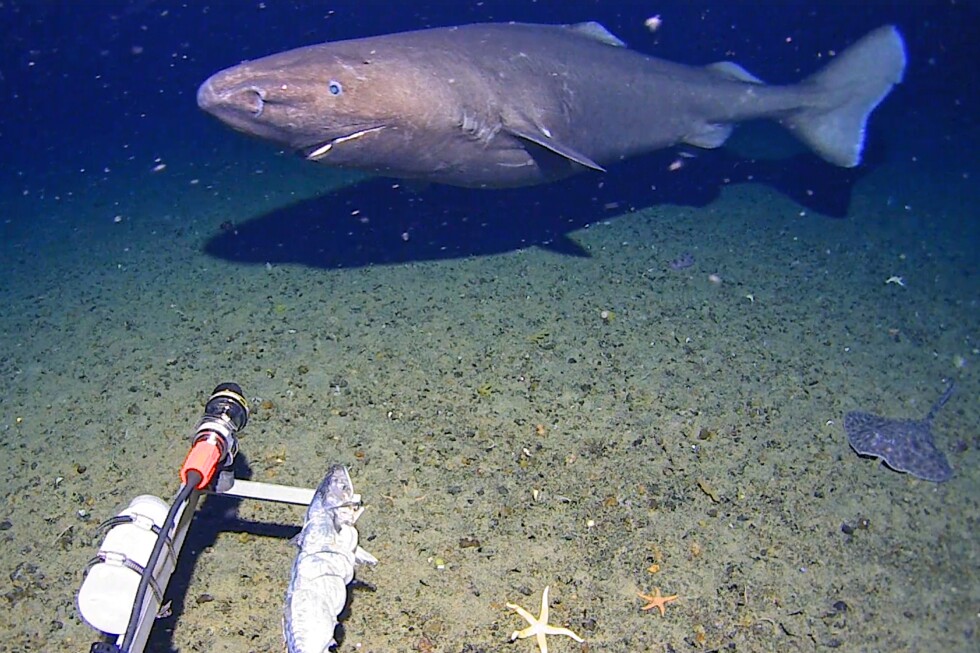
In an unprecedented marine discovery that challenges established scientific understanding, researchers have documented the first confirmed sighting of a shark within Antarctica’s icy waters. The remarkable encounter occurred in January 2025 when a deep-sea camera operated by the Minderoo-UWA Deep-Sea Research Centre captured footage of a substantial sleeper shark approximately 490 meters deep near the South Shetland Islands.
Dr. Alan Jamieson, founding director of the research center, expressed profound surprise at the discovery, noting that conventional scientific wisdom held that sharks could not survive in Antarctica’s extreme conditions. The observed specimen measured between 3-4 meters (10-13 feet) in length and was navigating waters with temperatures nearing freezing at 1.27°C (34.29°F).
The recording shows the massive shark moving deliberately across a barren seabed environment, passing a seemingly undisturbed skate (a shark relative resembling a stingray) without apparent interaction. The camera was positioned well within the Antarctic Ocean boundaries, defined as below the 60-degree south latitude line.
Independent conservation biologist Dr. Peter Kyne from Charles Darwin University confirmed this represents the first documented evidence of sharks inhabiting these southern extremes. Researchers speculate that climate change and warming oceans might be driving marine species toward colder polar regions, though they acknowledge the possibility that sleeper sharks have existed undetected in these remote waters for extended periods.
The Antarctic Ocean’s unique stratification creates distinct water layers with varying properties, and the shark was observed maintaining a depth of approximately 500 meters where water conditions were most favorable. Scientists believe these deep-water sharks likely feed on whale carcasses, giant squids, and other marine organisms that sink to the ocean floor.
This discovery highlights significant gaps in our understanding of polar marine ecosystems, particularly given that research equipment can only operate during the Southern Hemisphere’s summer months from December to February, leaving three-quarters of the year completely unobserved.