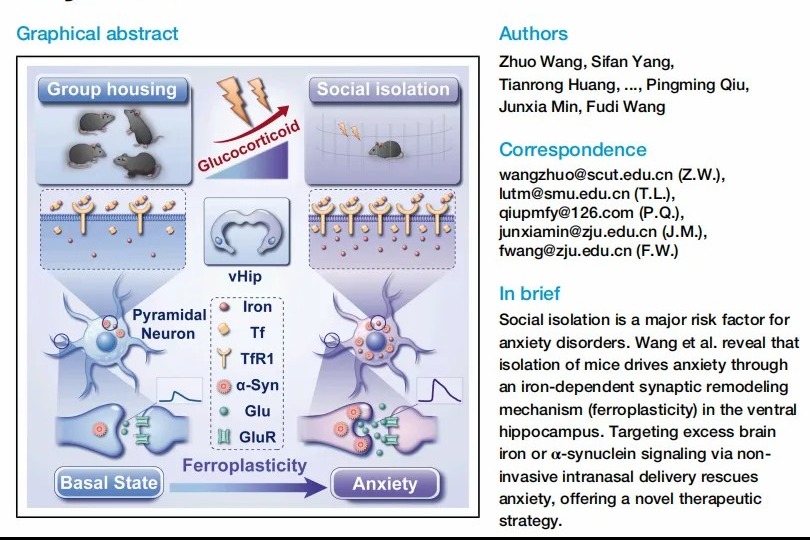
A groundbreaking study conducted by Chinese researchers has revealed a novel biological mechanism connecting prolonged social isolation to anxiety disorders. Published in the prestigious journal Cell Metabolism, the research demonstrates how extended periods of loneliness can trigger abnormal iron accumulation in specific brain regions responsible for emotional regulation.
The research team, led by Dr. Wang Zhuo from South China University of Technology’s School of Medicine in collaboration with Zhejiang University and Southern Medical University, employed mouse models to simulate long-term solitary living conditions. Their investigation uncovered that socially isolated mice developed significantly elevated iron levels in the ventral hippocampus—a critical brain area governing emotional responses.
According to the findings, this excess iron activates the α-synuclein protein, resulting in heightened neuronal activity associated with anxiety manifestations. Dr. Wang described this neurological process as resembling an electrical short circuit, where iron accumulation persistently transmits anxiety-related signals throughout the brain’s emotional regulation networks.
The researchers have termed this newly discovered mechanism ‘ferroplasticity’—a form of neuroplasticity influenced by both iron metabolism and environmental experiences. While iron is conventionally considered essential for proper brain function, the study indicates that under specific stress conditions, it may contribute to detrimental alterations in neural signaling pathways.
In therapeutic experiments, the team administered nasal-delivered compounds targeting iron levels or α-synuclein activity, observing remarkable reductions in anxiety-like behaviors and stabilized neuronal activity within approximately two weeks. These promising results suggest potential intervention strategies for anxiety disorders linked to social isolation.
The research gains particular significance amid growing global concerns about loneliness as a public health issue. The World Health Organization has identified social isolation as an escalating worldwide risk, with statistical evidence from China showing single-person households comprising 19.5% of total households in 2024, reaching 28.1% in Guangdong province according to the National Bureau of Statistics.
Dr. Wang’s team now plans to advance their research through safety testing, dosage optimization studies, and developing non-invasive imaging techniques to detect cerebral iron accumulation, with ultimate objectives指向 conducting human clinical trials.