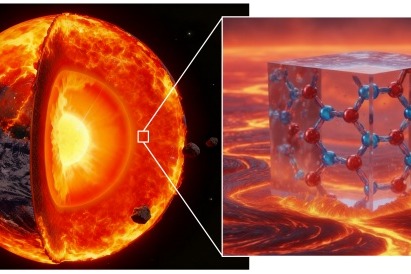
A groundbreaking scientific study has revealed the existence of massive primordial water reservoirs located thousands of kilometers beneath the Earth’s surface, fundamentally reshaping our understanding of the planet’s evolutionary journey. Published in the prestigious journal Science, this research provides unprecedented insights into how water became permanently embedded within the Earth’s geological structure during its formative years.
The international research team, led by Professor Du Zhixue from the Guangzhou Institute of Geochemistry, conducted sophisticated simulations replicating the extreme conditions found 660 kilometers underground. Their experiments demonstrated that bridgmanite—the Earth’s most abundant mantle mineral—possesses remarkable water-retention capabilities even at temperatures reaching 4,100°C, far exceeding previous estimates.
This discovery challenges conventional scientific wisdom regarding water distribution deep within our planet. The research indicates that early-retained water played a crucial role in transforming Earth from a molten inferno into the habitable world we know today. During the planet’s fiery youth 4.6 billion years ago, when frequent celestial impacts maintained surface temperatures too extreme for liquid water, substantial amounts of water became captured deep within the mantle as molten rock cooled and crystallized.
The team employed innovative methodologies including laser-generated heat simulations, high-temperature imaging, and atom probe tomography—techniques comparable to providing the microscopic world with ultra high-resolution chemical CT scans. These advanced approaches enabled researchers to visualize water distribution within tiny mineral samples and confirm that water molecules were indeed carried within bridgmanite’s crystalline structure.
According to the findings, the amount of water retained in the early solid mantle may have reached volumes equivalent to 0.08 to 1 times that of all modern oceans combined. This deeply sequestered water acts not as a static reservoir but as a geological lubricant, reducing the melting point and viscosity of molten rock to promote the slow circulation that drives tectonic plate movement and sustains the planet’s evolutionary vitality.
Over immense geological timescales, this deeply embedded water gradually migrated back to the surface through magma movement, contributing to the formation of primordial atmosphere and oceans. The research received support from multiple Chinese scientific institutions including the Chinese Academy of Sciences, the National Natural Science Foundation of China, and the Ministry of Science and Technology.