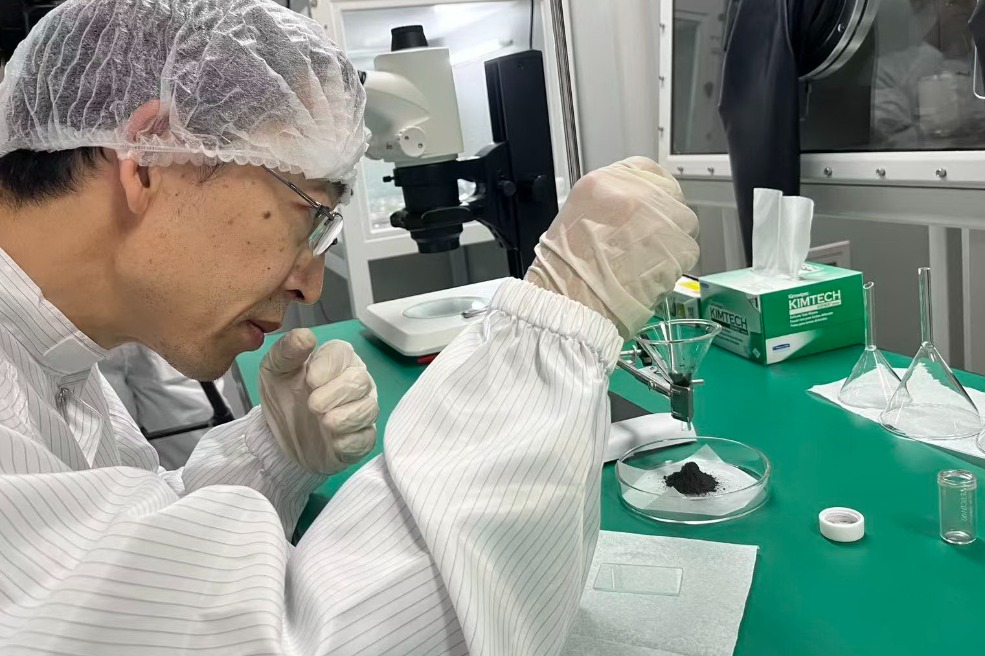
Chinese researchers have unveiled the scientific mystery behind the unexpectedly sticky lunar soil collected by the Chang’e 6 mission from the far side of the moon. Published in *Nature Astronomy*, the study reveals that the soil’s unique texture is due to a combination of extremely fine particles and irregular, jagged shapes. This discovery has significant implications for future lunar exploration and base construction. Led by Qi Shengwen from the Institute of Geology and Geophysics, the team conducted a series of tests, including an ‘angle of repose’ experiment, which demonstrated that the far-side soil behaves more like damp Earth soil than loose, sandy lunar dust. High-resolution CT scans of over 290,000 individual grains revealed that the particles are exceptionally small, averaging 48.4 microns in diameter, and unusually sharp. The researchers attribute this texture to the moon’s violent history of space weathering, including constant micrometeoroid bombardment and solar wind exposure. The findings are crucial for addressing engineering challenges in future lunar missions, such as preventing soil from clogging machinery or damaging equipment. As China accelerates its space program, aiming to land astronauts on the moon by 2030, this research provides a foundation for developing lunar infrastructure and resource utilization.