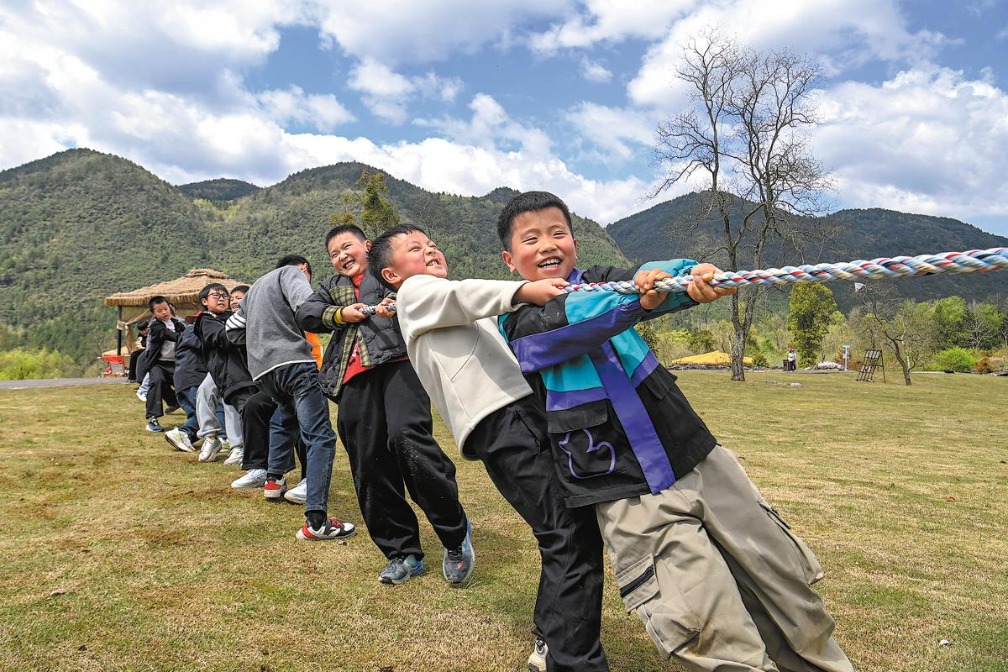
As spring paints China’s landscapes in shades of blooming wildflowers and fresh green foliage, thousands of primary and secondary school students across the country are trading chalkboards and textbooks for hiking trails, sports fields and open wilderness, taking advantage of a newly expanded national spring break initiative designed to prioritize youth wellness over classroom time.
Ten-year-old Zhang Zijian, a fourth-grade student from Nanjing, is among the millions of young people embracing the shift. Over a rare six-day holiday created by aligning the new regional spring break with the annual Qingming Festival, Zhang spent five straight days outdoors, exploring the scenic hills of eastern China, harvesting spring tea and digging for wild bamboo shoots alongside his friends. “It was exhausting, but the experience felt fresh and rewarding,” Zhang explained of his time away from textbooks.
Zhang’s holiday is not an isolated exception, but part of a growing national policy experiment. Earlier this year, a national government work report called on regions with suitable geographic and logistical conditions to introduce formal spring and autumn breaks for K-12 students. In response, multiple provinces including Jiangsu, Zhejiang, Sichuan and Hunan have rolled out mandatory three-day spring breaks, which were coordinated this year with the three-day Qingming Festival public holiday to create an extended six-day window for outdoor recreation. The initiative follows a similar model to the “snow holidays” launched in several northern Chinese regions in recent years, which encourage students to hit ski slopes and embrace winter outdoor activity.
Today, instead of sitting in crowded classrooms, students across participating regions are flocking to open fields and forested trails to take part in hiking, cycling, frisbee, tug-of-war, rock climbing and a wide range of other outdoor sports, working up a sweat under the mild spring sun.
Local governments have moved quickly to support the new policy with structured programming and expanded access to public resources. Jiangsu’s provincial sports bureau launched a catalog of student-focused spring activity itineraries, featuring options ranging from kayaking and cycling to tactical simulation games. A kite-flying carnival held in Yangcheng as part of the initiative drew more than 1,000 participating families. In the southwestern province of Guizhou, organized youth sports events during the break included traditional team competitions like football, basketball and volleyball, alongside newer recreational activities such as rock climbing, martial arts and roller skating, drawing tens of thousands of participating students. In Huainan, Anhui province, local schools integrated spring outdoor excursions and campus sports meets into the holiday schedule, prioritizing family-focused activities including group rope skipping and community tug-of-war matches.
The push to get students outdoors comes amid growing national concern over rising rates of childhood nearsightedness and obesity across China. Spring’s mild, comfortable temperatures make it an ideal season for sustained physical activity, which experts note can boost cardiovascular health, build muscle strength, improve motor coordination and support overall mental well-being for young people.
Even in regions that have not yet formally adopted a regional spring break, such as Beijing, the Qingming holiday saw a sharp surge in outdoor, hands-on learning activities, with families taking children into nearby mountains to forage for wild plants, practice tree climbing and try slacklining. In the Inner Mongolia Autonomous Region, education officials have encouraged middle school students to combine physical activity with cultural learning, inviting them to practice traditional grassland sports including wrestling and archery.
Public sports venues across participating regions have also expanded access to support the initiative. Across Jiangsu, public sports facilities extended operating hours and offer free or heavily discounted entry for student visitors during the break. At Nanjing’s iconic Olympic Sports Center, select tennis courts, badminton halls and public swimming pools opened entirely free of charge to young visitors for the duration of the holiday.
Beyond physical health benefits, the new spring break policy is also designed to address growing concerns over excessive academic pressure and poor mental health among Chinese youth. Schools across participating regions are instructed not to assign written homework during the break, and unauthorized group tutoring and off-campus academic training are strictly prohibited for the duration of the holiday. “Without homework, my child just comes out to play football,” said Nanjing parent Wang Junjun, who watched his son play from the sidelines of a community pitch. “As long as he’s happy and healthy, we parents are happy too.”
Researchers note that the new spring break initiative aligns with broader national efforts to strengthen physical education in China’s K-12 education system, which currently mandates a minimum of two hours of daily physical activity for all primary and secondary school students.
“Holidays like this do more than improve children’s well-being,” said Wang Shuhua, a senior researcher at the Jiangsu Academy of Social Sciences. “They also stimulate the integration of sports and tourism, encourage spending on sporting equipment, and energize the broader sports economy. Some regions are already preparing to introduce autumn breaks as well,” she added, pointing to the potential for the policy to expand across the country in coming years.