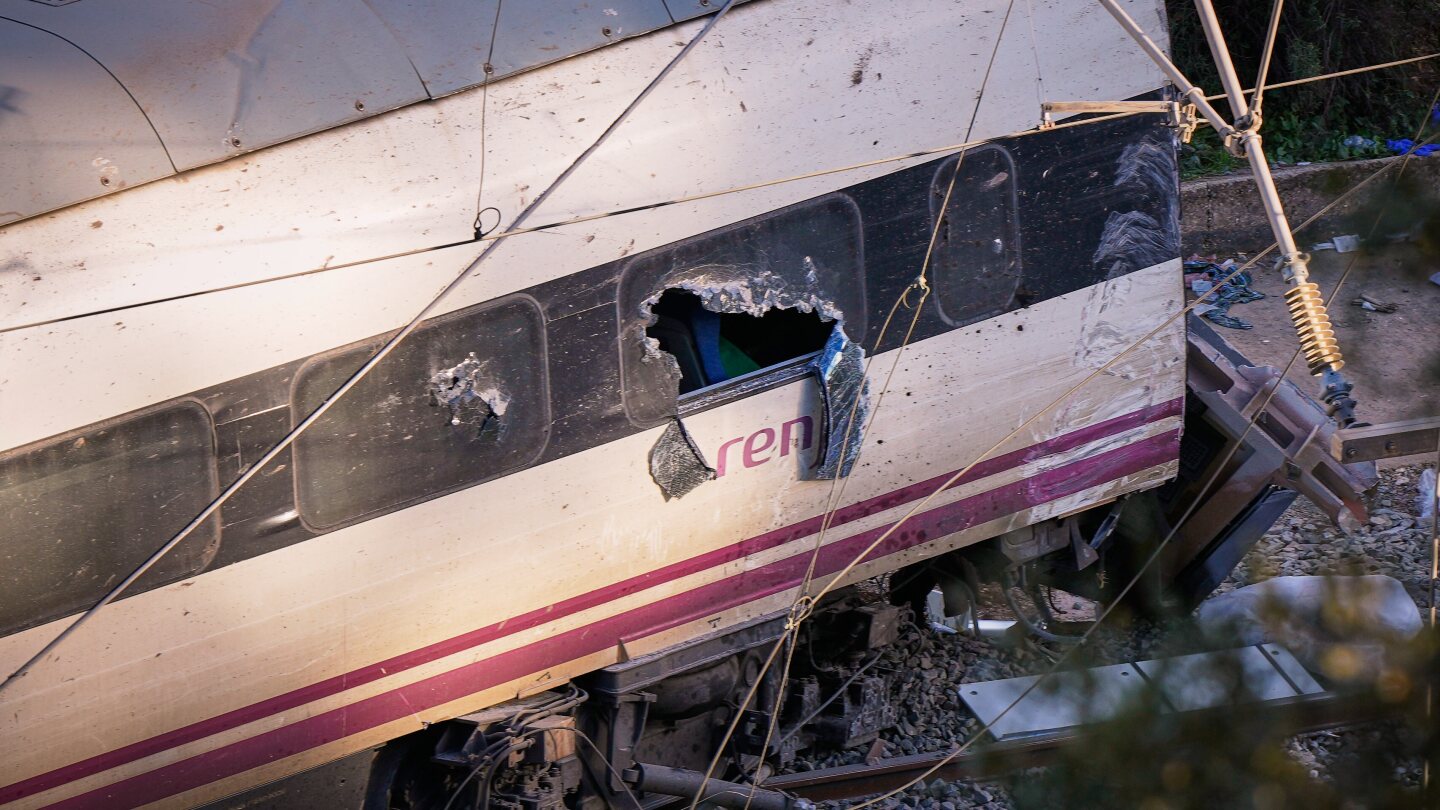
Spain has commenced three days of national mourning following a catastrophic train collision in the southern region of Andalusia that has claimed at least 40 lives. Emergency crews continue their painstaking search through the wreckage near Adamuz, where two passenger trains collided under circumstances authorities describe as “truly strange.
The tragedy unfolded Sunday evening at 7:45 p.m. when the rear section of an Iryo-operated train carrying 289 passengers from Málaga to Madrid derailed on a straight section of track. The dislodged cars then slammed into an oncoming Renfe train traveling from Madrid to Huelva with nearly 200 passengers aboard. The impact was most severe for the Madrid-Huelva train, whose first two carriages were thrown down a 4-meter (13-foot) slope upon collision.
Interior Minister Fernando Grande-Marlaska confirmed that three additional bodies have been located within the wreckage but remain unrecovered, suggesting the death toll may rise further. Regional president Juanma Moreno characterized the scene as “a twisted mass of metal,” noting that some victims were found hundreds of meters from the impact site.
Transport Minister Óscar Puente revealed investigators have discovered a broken section of track but remain uncertain whether this damage caused or resulted from the derailment. Both trains were reportedly traveling well below the 250 kph (155 mph) speed limit, with Renfe president Álvaro Fernández stating that “human error could be ruled out.” The Iryo train involved was relatively new, manufactured in 2022 and having passed its latest safety inspection on January 15.
The collision has profoundly shaken a nation that prides itself on operating Europe’s most extensive high-speed rail network. Prime Minister Pedro Sánchez visited the accident site Monday and declared official mourning, with flags lowered to half-staff on all public buildings and naval vessels. King Felipe and Queen Letizia are scheduled to visit the area Tuesday.
Meanwhile, transportation disruptions continue throughout Andalusia, Spain’s most populous region, with train services between Madrid and Andalusian cities canceled indefinitely. Spanish airline Iberia has added extra flights to Sevilla and Málaga to accommodate stranded travelers, while bus companies have reinforced their services in affected areas. The Civil Guard is collecting DNA samples from families seeking to identify missing relatives among the deceased.