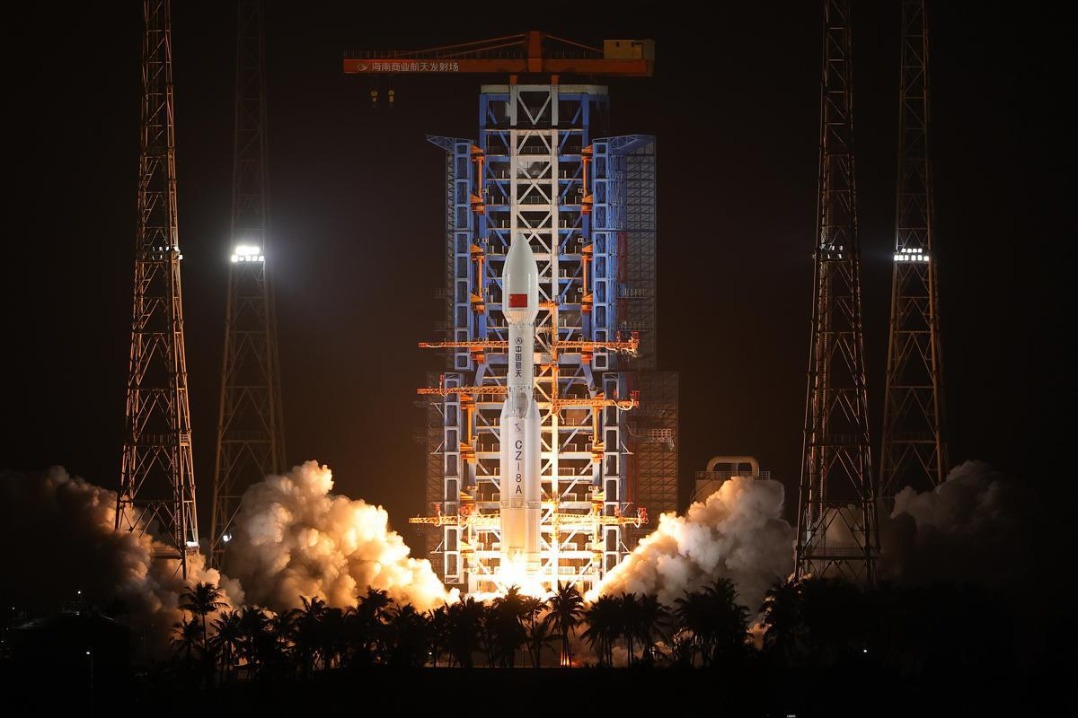
China inaugurated its 2026 space exploration agenda with two successful rocket launches on Tuesday, marking the commencement of an ambitious year that will feature lunar landings and manned spaceflights. The dual launches demonstrate China’s accelerating capabilities in space technology and satellite deployment.
The space operations initiated at 10:16 pm with a Long March 6A rocket ascending from the Taiyuan Satellite Launch Center in Shanxi province. The vehicle successfully deployed the Yaogan 50A remote-sensing satellite into predetermined orbit. Developed by the Shanghai Academy of Spaceflight Technology, this advanced satellite will gather critical data to support land resource surveys, agricultural productivity forecasting, and disaster prevention initiatives. The Yaogan satellite series represents China’s primary remote-sensing spacecraft network, with collected data extensively utilized across governmental, public service, and commercial sectors.
Engineered by the Shanghai academy, the Long March 6A is a medium-lift launch vehicle featuring a 50-meter liquid-propelled core booster augmented by four solid-fuel side boosters. With a substantial liftoff weight of 530 metric tons, this versatile rocket can transport satellites to diverse orbits including sun-synchronous, low-Earth, and intermediate circular trajectories. This mission constituted China’s inaugural space launch of 2026 and the 624th overall flight of the Long March rocket family.
At 11:25 pm, a second launch featured a Long March 8A carrier rocket lifting off from the Hainan International Commercial Aerospace Launch Center. This coastal spaceport mission successfully deployed the eighteenth cluster of low-orbit satellites for China’s state-operated satellite internet constellation. These satellites, designed and developed by the China Academy of Space Technology, expand the national mega internet satellite network to over 140 operational satellites in low Earth orbit.
The China Academy of Launch Vehicle Technology-developed Long March 8A stands 50.5 meters tall, incorporating a core booster with two side boosters. Weighing 371 tons at liftoff with approximately 480 tons of thrust, this vehicle primarily delivers satellites to sun-synchronous orbits, capable of transporting payloads up to 7 tons to a typical 700-kilometer altitude sun-synchronous orbit. This mission represented the seventh deployment of low-orbit internet satellites by a Long March 8A rocket.
Following a record-breaking 2025 with 93 space missions, observers anticipate another busy year for China’s space industry. The upcoming schedule includes multiple launches before January concludes, with the Chang’e 7 lunar mission representing a cornerstone of China’s fourth-phase lunar exploration program. According to the China National Space Administration, this robotic probe will target the moon’s south pole to conduct surface environment surveys, search for ice and volatile components in lunar soil, and perform high-precision analysis of lunar terrain, composition, and structure.
The Chang’e 7 spacecraft will comprise an orbiter, lander, rover, and an innovative flying probe capable of accessing lunar pits to investigate potential ice deposits. Additionally, 2026 will witness two manned missions—Shenzhou XXIII and Shenzhou XXIV—conducting crew rotations aboard the Tiangong space station. Notably, one Shenzhou XXIII crew member will attempt a year-long orbital residence, establishing a new duration record for Chinese astronauts. Industry sources indicate strong probability for a Pakistani astronaut to participate in a Tiangong mission this year, potentially becoming the first international crew member aboard the Chinese space station.