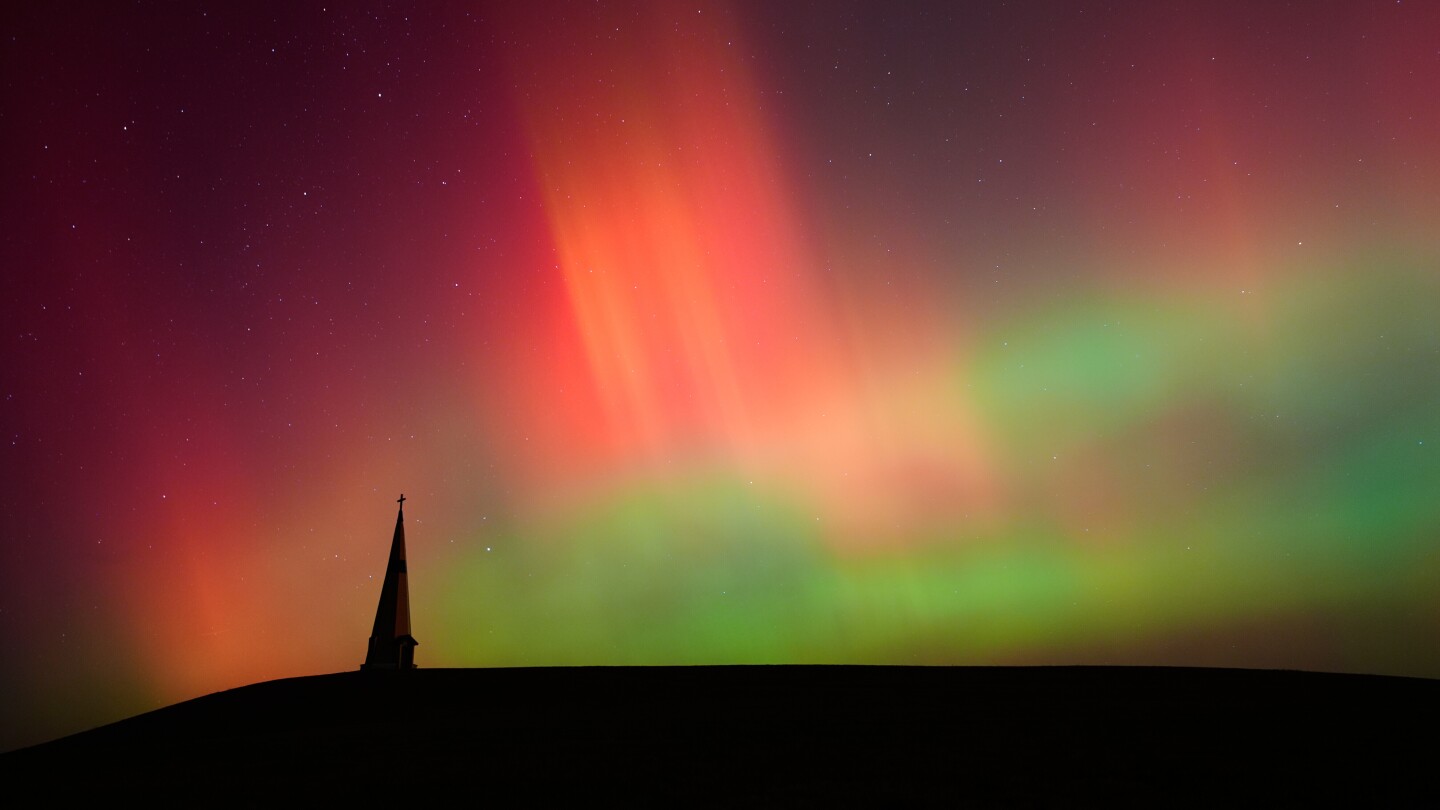
A series of powerful solar storms have painted the night skies with dazzling auroras, reaching regions far beyond their typical polar confines. On Tuesday night, vibrant northern lights were observed in unexpected locations across Europe, including Hungary and the United Kingdom, while in the U.S., the celestial display stretched as far south as Kansas, Colorado, and Texas. These geomagnetic disturbances, classified as severe by space weather forecasters, have also caused minor disruptions to GPS communications and power grids, according to Shawn Dahl of the National Oceanic and Atmospheric Administration (NOAA).
The surge in solar activity has prompted NASA to delay the launch of Blue Origin’s new rocket, which was set to carry Mars orbiters, until space weather conditions stabilize. Over the past few days, the sun has emitted multiple coronal mass ejections (CMEs), with two already reaching Earth and at least one more expected to arrive on Wednesday. Forecasters warn that this upcoming solar outburst could be the most intense of the trio, potentially amplifying the brightness and southern reach of the auroras depending on its interaction with Earth’s magnetic field and atmosphere.
This heightened solar activity is part of the sun’s 11-year cycle, currently at its peak phase, which has made auroras more frequent and widespread. The phenomenon occurs when charged particles from the sun collide with Earth’s atmosphere, creating the mesmerizing light displays known as the northern and southern lights. Last year, the strongest geomagnetic storm in two decades illuminated skies across the Northern Hemisphere, followed by another powerful solar storm that brought auroras to unexpected locations like Germany, the United Kingdom, and New York City.
While auroras are a breathtaking spectacle, solar storms can also pose significant risks. They have the potential to disrupt power grids, interfere with air traffic control, and scramble radio and GPS communications. Historical events, such as the 1859 solar storm that set telegraph lines on fire and the 1972 storm that detonated magnetic sea mines off Vietnam’s coast, underscore the unpredictable and occasionally hazardous nature of space weather. Despite advancements in forecasting, experts can only provide alerts days in advance, leaving limited time for preparation.
For those eager to witness the auroras, NOAA’s Space Weather Prediction Center website and aurora forecasting apps offer real-time updates. Skygazers are advised to seek out dark, quiet areas away from city lights, such as local or national parks, and to check weather forecasts to avoid cloud cover. Smartphone cameras can also capture subtle auroral details invisible to the naked eye, enhancing the experience of this natural wonder.