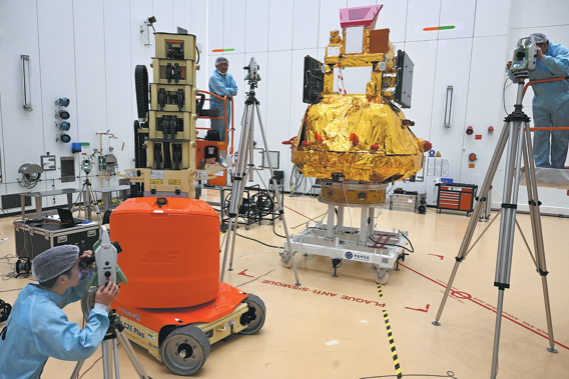
In a landmark display of international space collaboration, the Solar wind Magnetosphere Ionosphere Link Explorer (SMILE) mission is officially scheduled for launch on April 9 from Europe’s Spaceport in French Guiana. The National Space Science Center of the Chinese Academy of Sciences confirmed the completion of all prelaunch activities, marking the final countdown for this groundbreaking China-Europe joint venture.
The SMILE satellite represents the first comprehensive mission-level space science partnership between the Chinese Academy of Sciences and the European Space Agency. Currently integrated onto a Vega-C rocket, the spacecraft will pioneer innovative observation techniques to study solar-terrestrial interactions. Its primary instrument, a wide-field soft X-ray imager, will achieve unprecedented global imaging of Earth’s magnetospheric boundaries—a technological first in space weather research.
Solar wind, composed of high-speed plasma flows emanating from the sun, interacts with Earth’s magnetosphere to create space weather events that pose significant threats to orbital satellites, navigation systems, communication networks, and power infrastructure in high-latitude regions. The SMILE mission aims to provide critical insights into these interactions, potentially revolutionizing our ability to predict and mitigate space weather hazards.
The mission’s preparation followed rigorous qualification and flight acceptance reviews completed on October 28. Critical components underwent meticulous transportation logistics, with satellite propellant shipped from Shanghai in November arriving in French Guiana by early February. The flight model and testing equipment departed from the European Space Research and Technology Centre in the Netherlands on February 11, arriving via cargo vessel Colibri on February 26.
At the Guiana Space Centre, a joint China-Europe team conducted intensive verification campaigns, confirming all systems operate within specified parameters and maintain stability. The successful physical and functional integration with the payload launch adapter has met all preparatory milestones. With the launch window confirmed, final checks are underway regarding weather conditions and vehicle integration to ensure optimal conditions for liftoff.