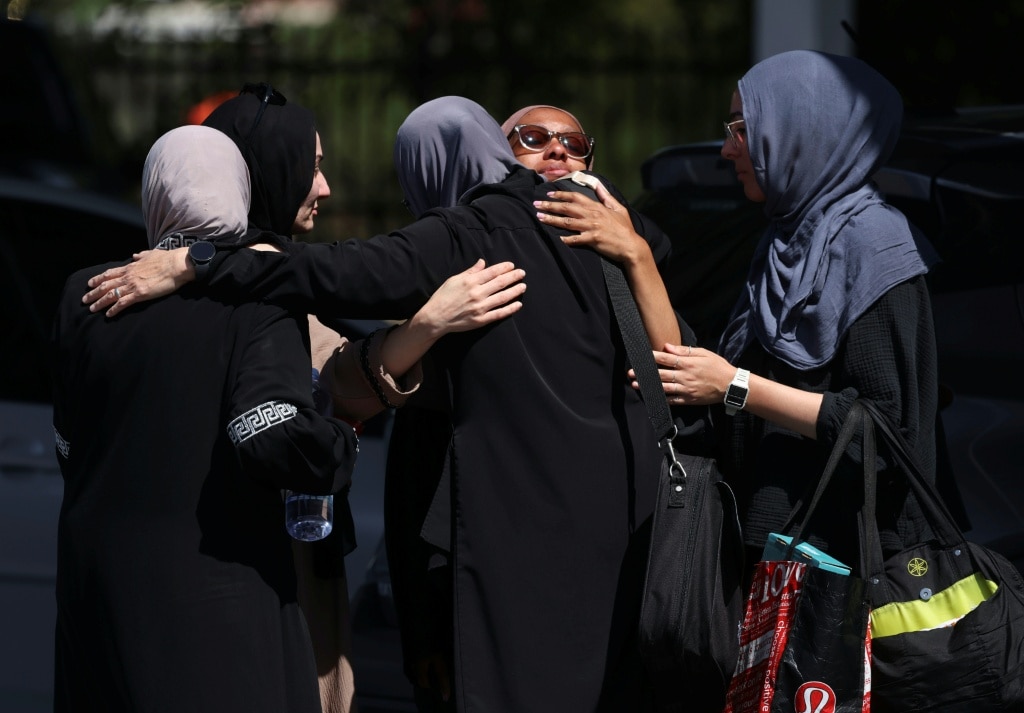
The tight-knit Muslim community of San Diego is reeling from an unthinkable act of violence Monday, when two radicalized teenage gunmen stormed the Islamic Center of San Diego, killing three people before turning their weapons on themselves. The attack, which law enforcement has officially classified as an Islamophobic hate crime, has left neighbors and community members grappling with shock, grief, and a sudden loss of the sense of safety they long felt in their suburban neighborhood.
Ramzy Awad, son of victim Nader Awad, sat blankly outside the mosque complex Tuesday, still unable to process the events that claimed his father’s life. “Everyone’s really shocked. It’s hard to believe this is real. We’re just all still figuring it out,” he told reporters from Agence France-Presse. Today, Awad and the two other slain men — security guard Amin Abdullah and community member Mansour Kaziha — are being widely celebrated as heroes whose quick, brave actions prevented a far deadlier massacre.
San Diego Police Chief Scott Wahl explained at a Tuesday press briefing that the two attackers, identified as 17-year-old Cain Clark and 18-year-old Caleb Vazquez, arrived at the center heavily armed with the intent to kill as many people as possible. At the time of the breach, as many as 140 children were in classrooms just 15 feet from the entry point where the gunmen entered. Abdullah, the on-site security guard, immediately engaged the attackers, fired on them, and radioed for backup, delaying and disrupting their plan to push deeper into the building.
After Abdullah initial confrontation, Awad and Kaziha drew the gunmen back out into the mosque’s parking lot, sacrificing their own lives to keep the attackers away from the crowded interior. All three men died at the scene. The teens’ bodies were later found in a vehicle a short distance from the mosque, and investigators have confirmed they died of self-inflicted gunshot wounds. Searches of the attackers’ homes turned up a cache of weapons, ammunition, tactical gear, and electronic devices, alongside extremist writings that laid out a radical worldview rooted in racial and religious hatred.
On Tuesday, community members and mourners gathered outside the mosque to lay flowers, their faces marked by confusion and grief. Many could only manage a few words before breaking into tears or falling silent. The Islamic Center of San Diego, one of the largest Muslim worship sites in a city of 1.4 million, has long been a hub for a diverse community of worshippers hailing from the Middle East, Asia, Africa, and Europe. Its minaret rises above palm-lined streets dotted with quiet suburban homes, and the center has long functioned as a core part of the local multicultural fabric — it even serves as a polling station during elections, and its imam regularly holds interfaith prayer events alongside a nearby Protestant church’s leadership.
Neighbors like Katelynn Fisk, who was out walking her dog near the center Tuesday, expressed their shock and support for the community. “This Muslim community, they’re really good people, you know. They never treat anybody like they’re different, even if they don’t follow their beliefs,” Fisk said. For decades, the center has felt like a refuge for local Muslims, but the attack has shattered that long-held sense of safety. “We used to feel safe here. I don’t understand why we were targeted,” said 31-year-old teaching assistant Imani Khatib, breaking down in tears outside the security booth where Abdullah gave his life.
Mosque imam Taha Hassane confirmed that without the three men’s sacrifice, the attackers would have had unimpeded access to all of the center’s classrooms. “We’re so proud of him… I see messages about him, literally from all over the world, talking about his heroism,” Hassane said of Abdullah. The imam explained that like many Muslim places of worship across the United States, the center has faced sporadic incidents of Islamophobia for decades, with tensions spiking after the 9/11 attacks and rising again more recently amid ongoing conflicts in Gaza and Iran. “We received some mails and emails and phone messages, blaming us for everything going wrong in the world. But having shooters, I mean, it never came to our mind,” he said.
Hassane attributed the deadly attack to a broader national rise in white supremacy, saying that rhetoric from elected officials and segments of the media has dehumanized Muslims, Black people, Latinos, and other marginalized groups, creating a culture that enables extremist violence. “When young people who are brainwashed, they hear this rhetoric from the media, from the elected officials. This gives them the excuse, the green light to go and commit a crime,” he added.