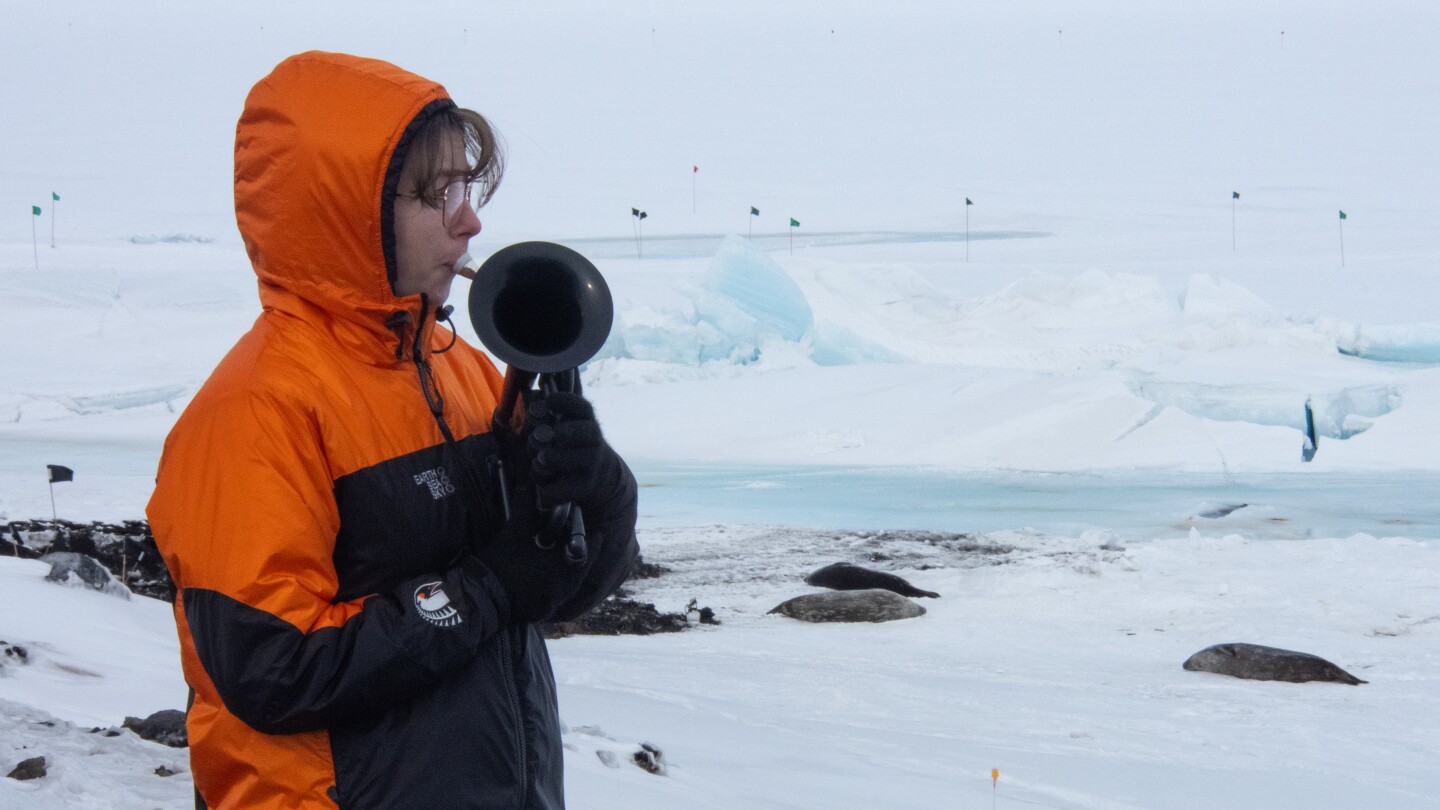
In the icy expanse of Antarctica, where the frigid air bites at exposed skin, Natalie Paine, a French horn player in New Zealand’s navy, has found an unlikely stage. Since October, Paine has been stationed at Scott Base, one of 21 military members supporting scientific research on the frozen continent. Her melodies, carried across the Ross Sea, emerge from what might be the most remote practice room on Earth. ‘It’s beautiful and very inspiring,’ Paine shared with the Associated Press. ‘I’ll sit by the window, play music in my limited free time, and let the surroundings fuel my creativity.’
Paine’s journey to Antarctica is as unconventional as her current role. Growing up in the arid climate of Adelaide, Australia, she once dreamed of visiting the frozen continent as a scientist. However, her path led her to study music at university, temporarily shelving her Antarctic aspirations. Years later, as a musician in New Zealand’s navy, she discovered that military personnel, including musicians, could be stationed in Antarctica. ‘My eyes lit up,’ Paine recalled. ‘I asked, even a musician? And my instructor said, heck yeah, why not?’
Realizing this dream was no easy feat. It took four years of persistent applications before Paine secured a posting as a communications operator. Her demanding job, involving six-day shifts monitoring radio, phone, and email communications, leaves little time for music. Yet, Paine carves out moments to practice, often retreating to a historic hut built in 1957 under the leadership of explorer Sir Edmund Hillary. There, she plays her jHorn, a lightweight, durable plastic instrument designed for children, which is better suited to the harsh Antarctic climate than her traditional French horn.
Despite the challenges, Paine’s presence has brought joy to Scott Base. She has performed live at ceremonies, replacing the usual recorded music, and even braved sub-zero temperatures to deliver a solo concert at minus 21 degrees Celsius. ‘Music is the universal language,’ Paine reflected. ‘It reminds us that we’re all connected, whether we’re on the ice or back home.’ Her story is a testament to the power of perseverance, adaptability, and the unifying force of music in even the most extreme environments.