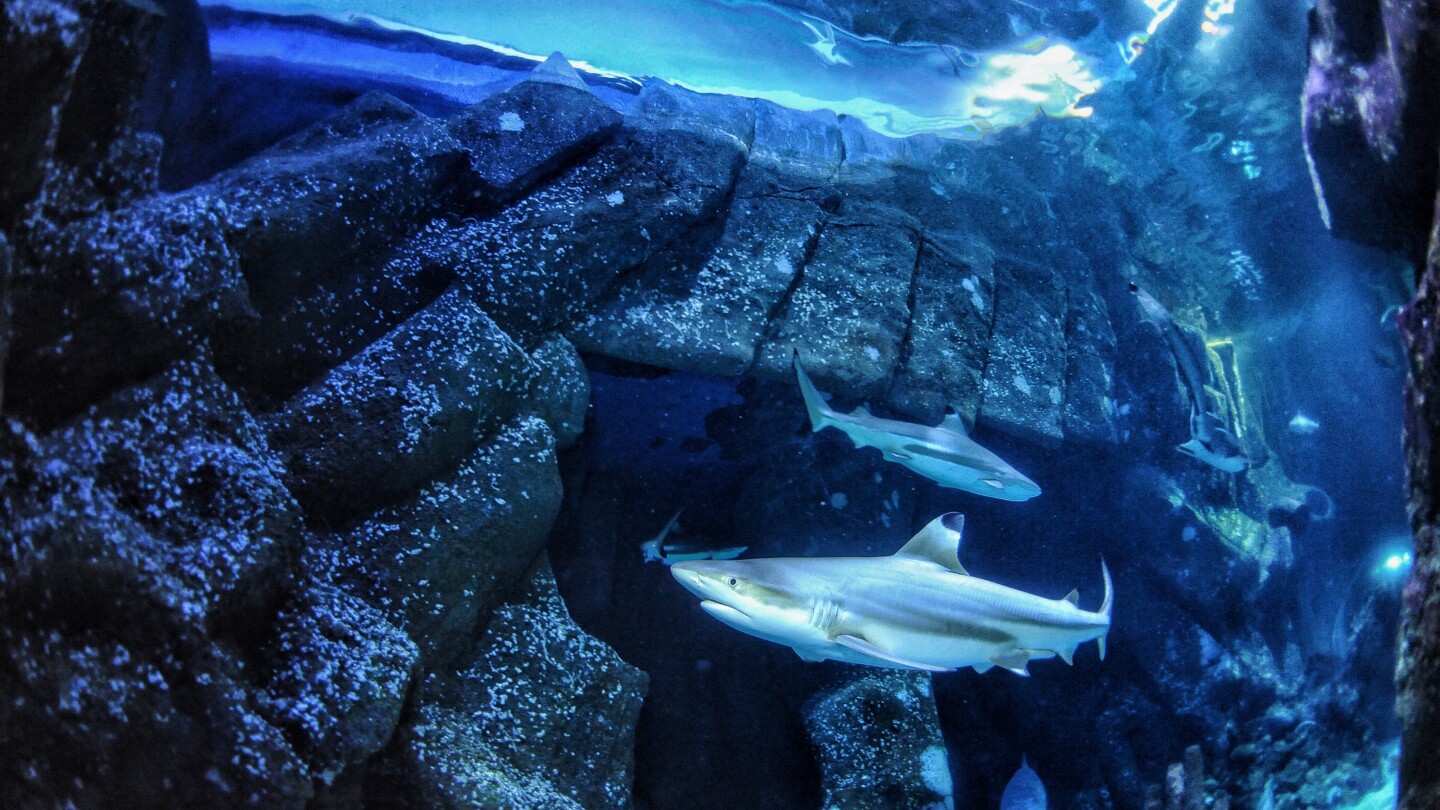
PORTLAND, Maine (AP) — The formidable dental arsenal that has secured sharks’ position as apex ocean predators for millions of years faces an unexpected threat from changing marine chemistry. A groundbreaking study conducted by German marine researchers reveals that ocean acidification—directly linked to human fossil fuel consumption—is progressively weakening shark tooth structure, potentially compromising their hunting efficiency and ecological dominance.
The research team from Heinrich Heine University Düsseldorf, led by marine biologist Maximilian Baum, discovered that increasingly acidic ocean conditions cause significant corrosion damage to shark teeth, including structural cracks, root deterioration, and surface pitting. Their findings, published in Frontiers in Marine Science, demonstrate that teeth exposed to water with acidity levels projected for year 2300 (nearly ten times current acidity) showed substantially more damage compared to those in present-day conditions.
This dental degradation represents an additional environmental pressure for sharks already confronting overfishing, habitat pollution, and climate change impacts. While sharks won’t become toothless overnight, the cumulative effect could gradually diminish their predatory effectiveness. Baum emphasized that ‘their whole ecological success in the ocean as rulers of other populations could be in danger’ if tooth integrity continues to decline.
The study examined over 600 discarded teeth from blacktip reef sharks (Carcharhinus melanopterus), a species inhabiting Pacific and Indian Ocean regions. Scientists note that shark teeth—highly specialized tools evolved for slicing flesh rather than resisting chemical corrosion—undergo constant replacement throughout a shark’s lifetime.
Independent experts including Nick Whitney of New England Aquarium’s Anderson Cabot Center acknowledge the study’s scientific validity while noting sharks’ evolutionary resilience. ‘They’ve been around for 400 million years and have adapted to changing conditions,’ Whitney observed, suggesting that protective mouth tissue might temporarily shield developing teeth from acidification effects.
However, Gavin Naylor of the Florida Program for Shark Research cautions that ocean acidification’s impacts extend beyond sharks, particularly affecting shell-forming organisms and fish scale integrity. While overfishing remains the most immediate threat to shark populations, acidification introduces complex ecological changes that could ultimately reshape marine food webs and predator-prey relationships across ocean ecosystems.